DEVELOPMENT PLAN #70 — Turning Deposits into Workshops: Bank Loans for Private Expansion
Contributed by: Takeshi Miyaoka on Thursday, October 29 2026
Last modified on Thursday, October 29 2026
This is a development plan: an idea we want to build next. Nothing described here is implemented yet, and the details are still under consideration and may change.
This morning's post (#69) covered money changers taking deposits from businesses, becoming banks, and underwriting government bonds. Tonight we look at the step we are considering next: banks lending to businesses so that private owners can expand their own facilities. We have filed it as improvement item FIN-020.
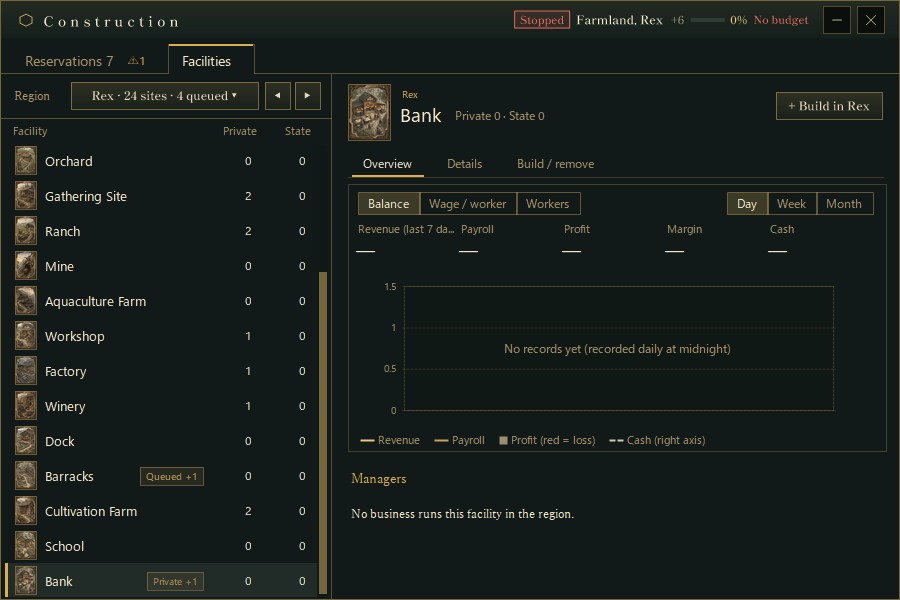
The construction screen today (an actual capture from a development Debug build, taken for verification). The only private construction is a money changer building a bank (“Private +1”). Private facilities such as workshops do not grow on private initiative yet.
Where things stand: deposits pile up, but never reach private facilitiesIn the current development build, businesses deposit spare cash with money changers and banks, and banks use it to underwrite government bonds. Banks lending to businesses, however, does not happen in the game yet.
Some of the parts already exist. A credit assessment for businesses (cash reserve, profit, cash days over the last 14 days and regional stability, each scored 0 to 1 and weighted 25%, 35%, 20% and 20%) and an equipment-loan step that checks the bank's lending capacity, collateral and interest have been written and pass their tests. Nothing in the game calls them yet. Private profits are also paid out in full to owners and are not invested in facilities. So even when demand for furniture rises, the number of workshops does not grow by private decision.
What we want to make more interestingThe state side of money — budgets, taxes, welfare and bonds — is now fairly detailed. Next we would like private money to turn into the next round of production: banks that gathered deposits help local industry grow, and private capacity expands fastest where goods are scarcest.
The other aim is to make the discount rate a real policy lever. Today it only affects deposit and bond rates. If loan rates follow it, lowering the rate would encourage private expansion and raising it would cool things down — a choice in the player's hands.
The idea: a monthly review, a loan, then private constructionThe flow we have in mind:
- Candidates: at the start of each month, private businesses with positive profit over the last 14 days whose product has a regional supply ratio below 1 (demand exceeds supply).
- Review: candidates get that day's credit assessment, and only those with a total score of 0.6 or more apply.
- Amount: the cost of one facility minus own funds (cash above 14 days of working capital), kept within the additional-loan limit and the collateral.
- Lender: a bank in the same province, otherwise the same region (private banks first, then state banks), only within the capacity left after reserve and capital ratios. Money changers do not lend.
- Rate: the discount rate at signing plus a credit spread (+1% for a score of 0.8 or more, +2% for 0.6 or more), fixed in the contract.
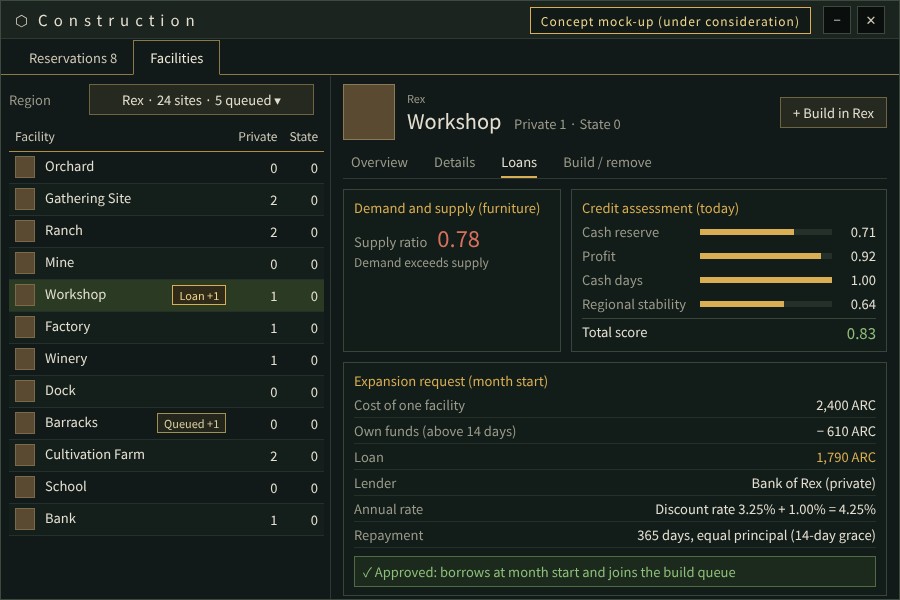
Concept mock-up (under consideration). A workshop owner applies for an expansion loan based on the furniture shortage and a credit assessment. Numbers are illustrative only.
Once a loan is approved, the project joins the end of the build queue as private construction, the same way a money changer builds a bank (we are thinking of labelling it “Private · Loan”). It uses no state budget but does use the state's workshops, so it competes with state construction. The player could reorder it but not cancel it. On completion, one more private facility is added.
To keep things in check, we plan to allow one expansion loan per business at a time and at most two new expansions per region per month. A financing policy switch would let a country disallow private equipment loans entirely.
Repayment, defaults and the screensRepayment would use the existing daily settlement for equipment loans (interest first, then principal; 30 days overdue means default; the collateral facility stays on record). If a business fails, the bank's loans go bad, its spare capacity shrinks, and that in turn limits how many bonds it can take — a link we would like players to be able to see.
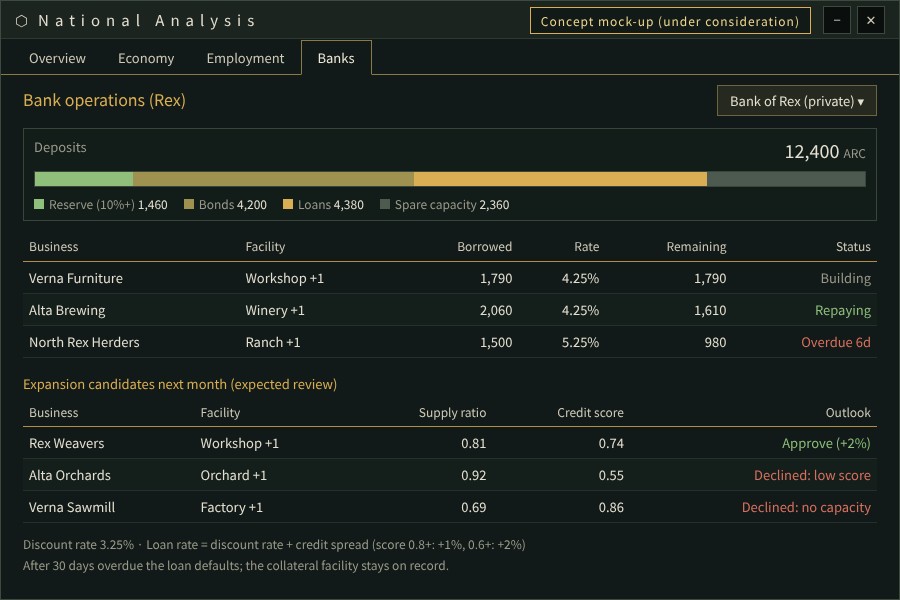
Concept mock-up (under consideration). National Analysis showing each bank's loans and the expected review of next month's expansion candidates. Names, amounts and rates are illustrative.
On screen, we are considering a Loans section for each facility (balance, rate, credit score, additional-loan limit) and, in National Analysis, loan balances, counts and arrears per bank. The checks and execution would run inside the existing month-start review of the midnight update, following our daily-performance rules so that no country-wide data is copied.
Implementation order and related systemsWith deposits (FIN-013), bank promotion (FIN-014) and bonds (FIN-011) in place, routing that money into private facilities feels like the natural next step. It can proceed independently of CUR-009, which defines where startup loans come from in countries using the common currency. The planned order: candidate selection and review → connecting loans to private construction → the screens → running a real master for several months to check how many expansions happen and how many go overdue.
Tell us what you thinkOnce private owners expand on their own, the split between state and private facilities changes. Would you rather leave shortages to the private sector, or keep a closer hand on what gets built? We would love to hear how you like to play.
Related posts:
DEVELOPMENT SNAPSHOT #69 — When a Money Changer Becomes a Bank (this morning)
DEVELOPMENT SNAPSHOT #46 — The January Budget: Planning Room for Next Year