DEVELOPMENT SNAPSHOT #92 — Trust Takes Shape: Officers Bring More Cards, or Fewer
Contributed by: Takeshi Miyaoka on Tuesday, November 10 2026
Last modified on Tuesday, November 10 2026
In the evening plan article #75 we described an idea (improvement item DOM-040): turning down an officer's proposals would lower their trust, and trust would change how many proposals they bring next time. That system is now implemented. The minister and the chief researchers (policy and technology) carry a tenure-long "trust" value from 0 to 100. It moves with how you answer their proposal cards, and high trust adds one visible card while low trust removes one. 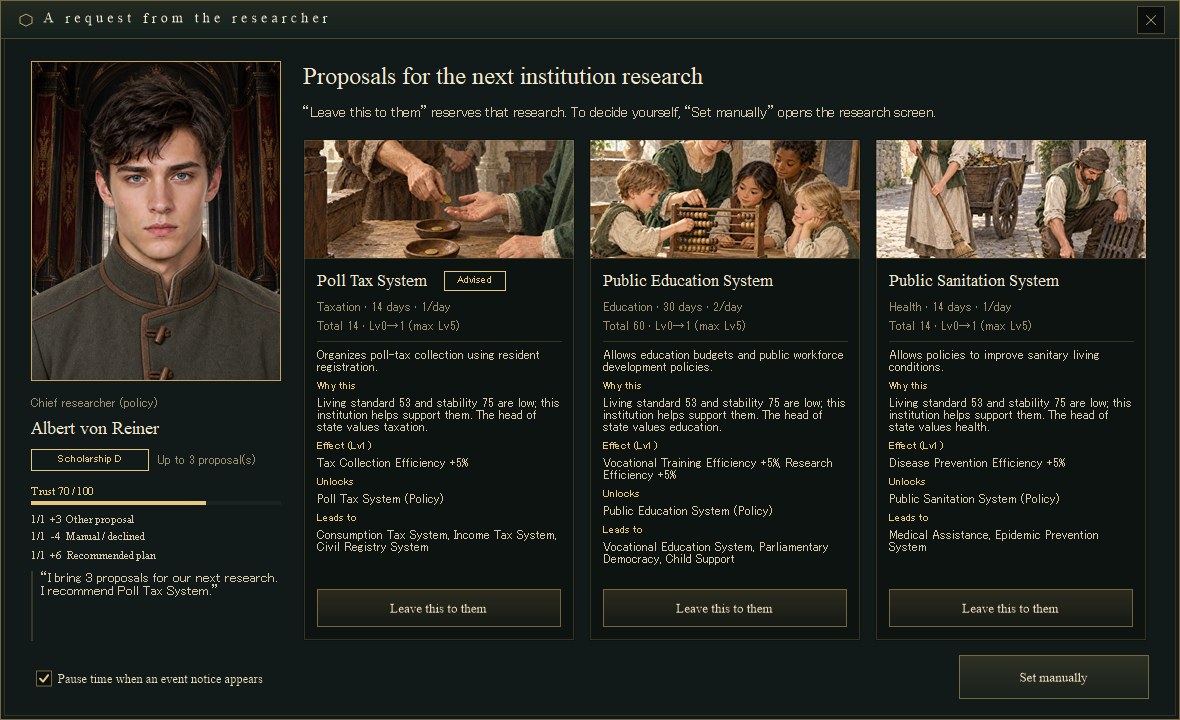
The researcher request window (actual screen, Debug build). A chief researcher with Scholarship D normally brings two proposals; at trust 70 he opens a third. Trust, its gauge and the latest changes appear under the portrait. The three change lines were inserted for this capture.
How you answer moves trustTrust belongs to one tenure and starts at 50. Only the three national roles that bring proposals have it: the minister, the chief researcher (policy) and the chief researcher (technology). Diplomats, the central bank governor and regional administrators do not, and AI countries do not use it for their normal research and budget decisions.
Answering a research request, a supplementary budget proposal or the yearly budget proposal changes trust once:
- Adopt the recommended plan: +6
- Adopt another proposal: +3
- Set manually or decline: −4
Each amount is multiplied by a personality factor (one of 16 types) between 0.65 and 1.35, so some officers shrug off a refusal while others take it to heart. Trust only moves when the research reservation or budget adoption actually succeeds; if the research cannot start, trust stays the same and the request records why. If the officer who made the proposal is no longer in office when you answer, the change is not passed on to the successor.
Card count: ability plus trustThe number of visible cards still starts from the ability grade (E: 1, D and C: 2, B or better: 3). Trust 70 or more adds one, trust 30 or less removes one, and the result stays between 1 and 3. Budget proposals, domestic proposals, regional facility proposals and researcher requests all use this calculation. A larger allowance never invents extra candidates, so similar budget plans are still merged into one.
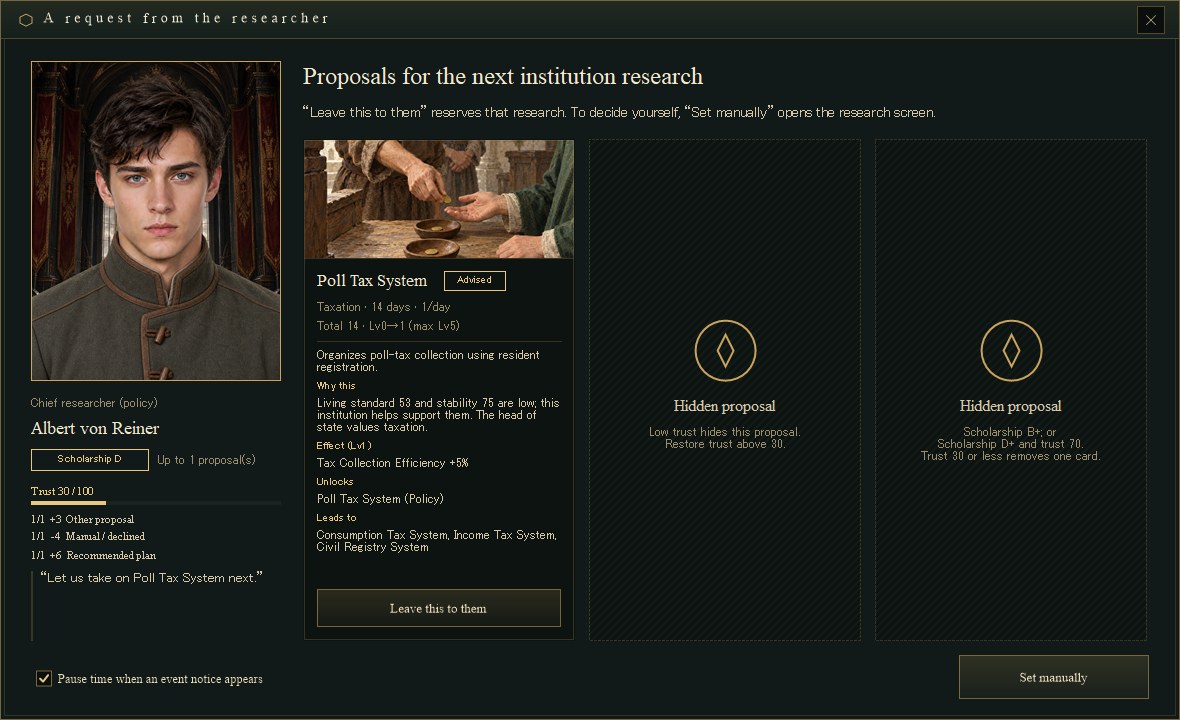
The same chief researcher at trust 30 (actual screen, Debug build). Only one proposal remains. The hidden cards explain why: “Low trust hides this proposal. Restore trust above 30.” and “Scholarship B+; or Scholarship D+ and trust 70.”
A researcher request stores its card count and trust when it is issued, so reopening the window or loading a save never adds or removes proposals that have already arrived.
Trust drifts back, and neglect costsAt midnight on the first of each month, trust moves 1 point back toward 50. While a proposal stays unanswered, trust drops by 2 (times the personality factor) for every 30 days. Several open proposals still count once per role, and a remainder of less than 30 days carries over. Periods with no open proposal cost nothing. Each role keeps its own starting date so the same period is never counted twice.
When an officer's replacement, dismissal or death is confirmed, that tenure's trust is discarded. Appointing the same person again starts a new tenure at 50.
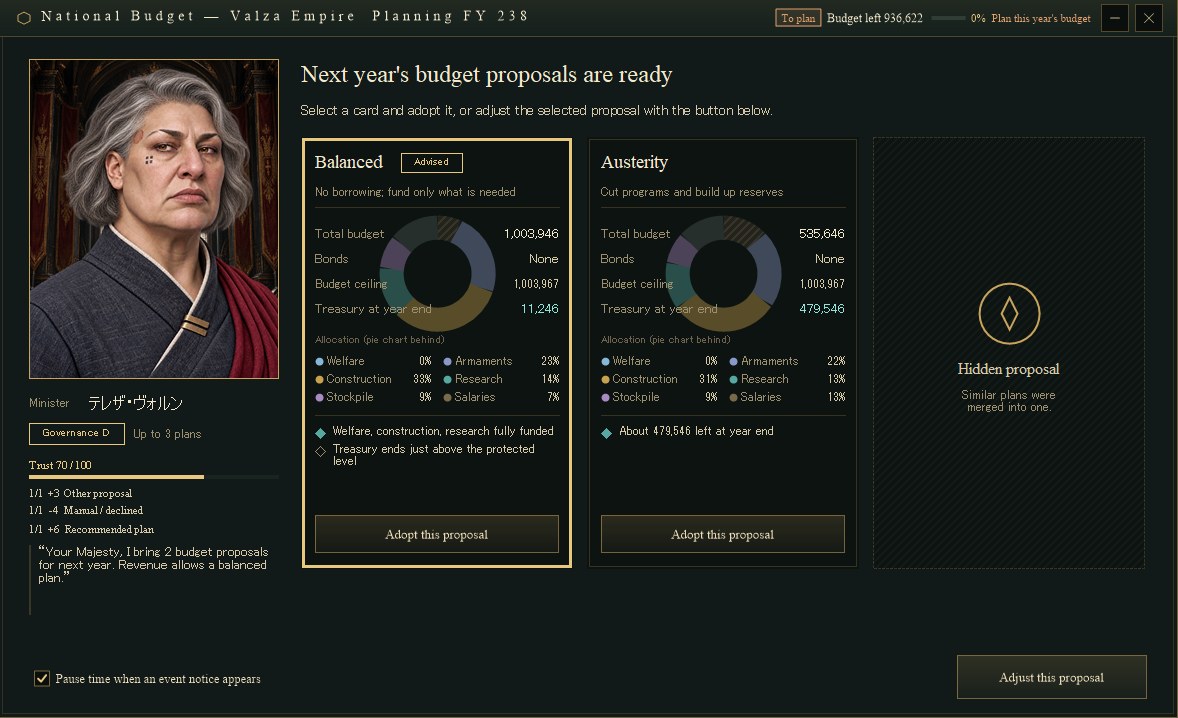
The yearly budget proposal window (actual screen, Debug build). With a Governance D minister at trust 70 there are three slots, but similar plans were merged, so the third card is hidden. The minister's name is not yet translated in this window of the English UI. The personnel page also shows the current value, such as “Trust 70 / 100”, on each national role.
What changed from the plan, and what is still to comeThe resignation event from #75, where an officer whose trust runs out offers to resign, is not part of this implementation. Trust affects only the number of proposals; it does not add money, resources or research speed.
What we checkedWe launched the Debug build without showing it on screen and, for four combinations of ability and trust (grade D at trust 30, 50 and 70, and grade E at trust 70), checked during capture that the budget proposals, domestic proposals and the policy and technology researcher requests show the expected 1, 2, 3 and 2 cards, in both Japanese and English. Unit tests were added for the calculation, answers, the monthly update and the end of a tenure.
About the imagesAll images are cropped from actual game screens of the updated Debug build, launched off screen with trust values set by the verification procedure. People, country names and numbers come from the test state and may change with later tuning.
The plan article: DEVELOPMENT PLAN #75 — Trust in Your Officers: How You Answer Shapes Their Next Proposals
Researcher proposal cards: DEVELOPMENT SNAPSHOT #74 — The Researcher Brings Proposals: Cards That Grow with Skill
Previous article: DEVELOPMENT PLAN #91 — Digging Floating Stones from Ruins: The Finite Relics Behind Every Airship
Check the files currently available and the development status on the download page