DEVELOPMENT PLAN #103 — Over the Guns: Sortie and Return for Flying Warships
Contributed by: Takeshi Miyaoka on Sunday, November 15 2026
Last modified on Sunday, November 15 2026
This is a development-plan article: it describes something we want to build next. Nothing described here is implemented yet, and the details are still under consideration and may change before implementation.
The skies of Ashwind Chronicle belong to ships of the line, corvettes and brigs held aloft by floating stones. On the ground, anti-aircraft guns and air-defense networks are taking shape, and air missions such as gunship sorties now trade fire with enemy air defense at their destination. The warships themselves, however, still cannot "sortie, cross enemy skies and come home". Tonight's plan lets flying warships launch from their docks, fly over the air-defense net and return. It expands improvement item AAD-004 (flying-warship operations and air defense).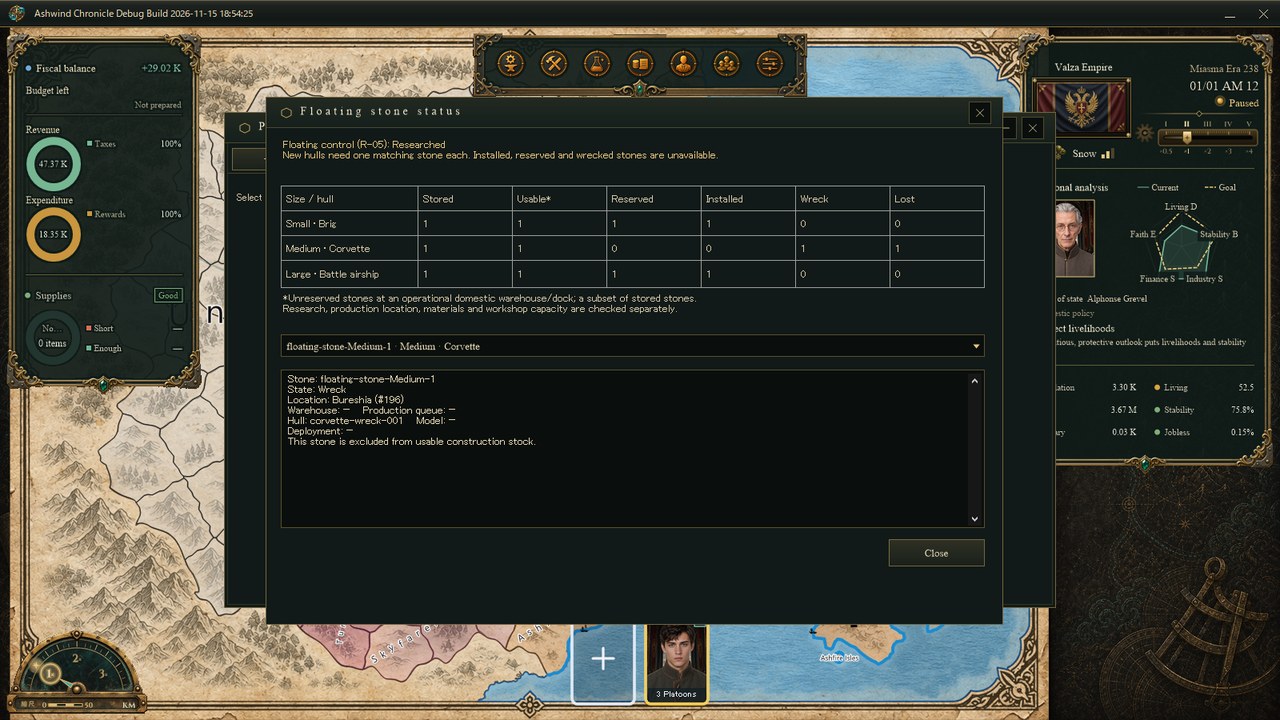
The current floating-stone status list (the actual screen of a Debug build, with screen-check data). It counts stones by size as stored, usable, reserved, installed, wreck and lost, and shows the selected stone's state, location and hull. Here the stone of a lost corvette remains as wreckage. There is not yet any record of a ship itself sortieing, flying and returning.
Where things standIn the current game, the pieces of air warfare fit together like this:
- Air missions such as gunship sorties meet enemy air defense on the first midnight after they reach the destination province stored in their route. The mission's altitude (200 m if none is given) is compared with the reach of air-defense sites in that province (300 m for fixed emplacements, 450 m for fortresses), and hostility and visibility (fog, smoke, terrain) are checked.
- An engagement ends in one of four results: destroyed, forced landing, aborted or minor damage. The loss chance p is "effective AA ÷ (effective AA + the aircraft's defense)": destroyed with probability p², forced landing and aborted each p × (1 − p), and minor damage otherwise. Ammunition spent and crew lost are settled exactly once per engagement.
- On the defending side, the defense section of the region panel shows effective AA, ammunition and the latest engagement result (this air-defense engagement is being finished as improvement item AAD-002).
- Ships of the line, corvettes and brigs are tracked through their deployed unit entries and the floating stone each hull carries (the floating-stone list in image 1). When a ship is lost, its stone remains as wreckage.
- There is, however, no record of a warship itself leaving its dock, flying to a destination and coming back, so warships never pass through the air-defense check.
As long as the biggest ships in the sky are untouched by the guns below, neither the side building air defenses nor the side sending ships out has a real decision to make.
The plan: the decision to send a shipWe want you to pick a ship in dock, choose a destination province, a mission (reconnaissance, advancing as a carrier, ground support and so on) and a cruising altitude, and launch it.
- At launch, the game checks crew, fuel and ammunition (and, for a ship of the line, its embarked gunships) and holds them for the duration of the operation.
- Speed is set, as for gunship missions, by the type's cruising speed and the weather factor, and the expected arrival is shown.
- On the first midnight after arrival, the ship's altitude and defense (armor and protection of vital parts) go into the existing air-defense check. We want to use the same formula as for gunships.
- Altitude becomes a lever. Flying high clears fixed emplacements (300 m), but fortresses (450 m) still reach. Each ship would have a ceiling, flying higher would burn more fuel, and missions such as ground support would require flying low.
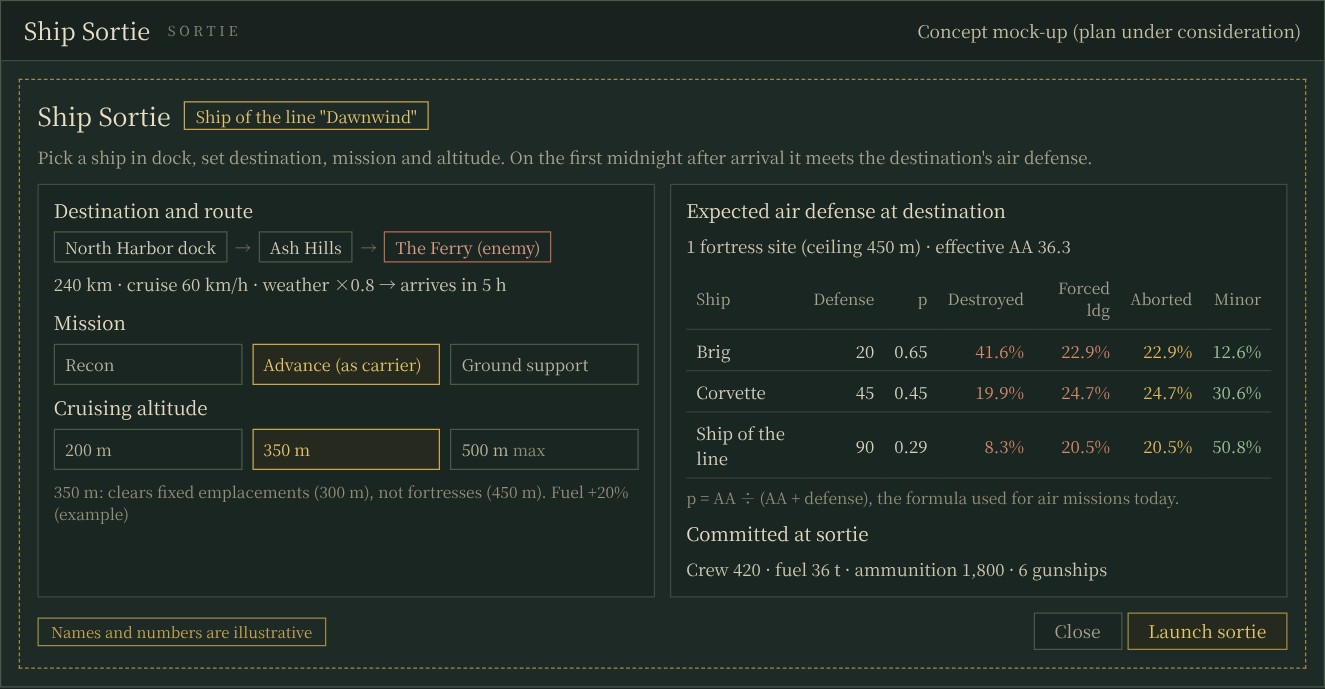
Concept mock-up (plan under consideration): a sortie window where you choose route, mission and altitude, and compare the expected air defense at the destination by ship class. Names and numbers are illustrative.
Say the target is a fortress with the effective AA of 36.3 we used as an example in plan #89. If we tentatively give brigs a defense of 20, corvettes 45 and ships of the line 90, the loss chance p is 0.65, 0.45 and 0.29. With today's formula a ship of the line would be destroyed 8.3% of the time, force-land 20.5%, abort 20.5% and take minor damage 50.8%, while a brig's chance of being destroyed rises to 41.6%. Small ships should be at real risk over a strong network, and even big ships should not be safe (the defense values are illustrative and not decided).
Results and what follows- Minor damage: the mission continues, and the ship is repaired at its dock or an arsenal after returning (linking to the rear-arsenal repairs introduced in #100).
- Aborted: the ship turns back through today's return handling.
- Forced landing: the ship is lost, but its crew are not counted as casualties. Its floating stone stays as wreckage in the province where it came down. We want to connect this to stone recovery (improvement item BTL-015), so that a stone lost over enemy territory becomes something to fight over.
- Destroyed: the ship and its remaining crew are lost, and the stone becomes wreckage.
Ammunition spent, crew lost, the ship lost and the fate of the stone are settled exactly once in the same engagement record, and never counted twice on reload or when the same day is replayed.
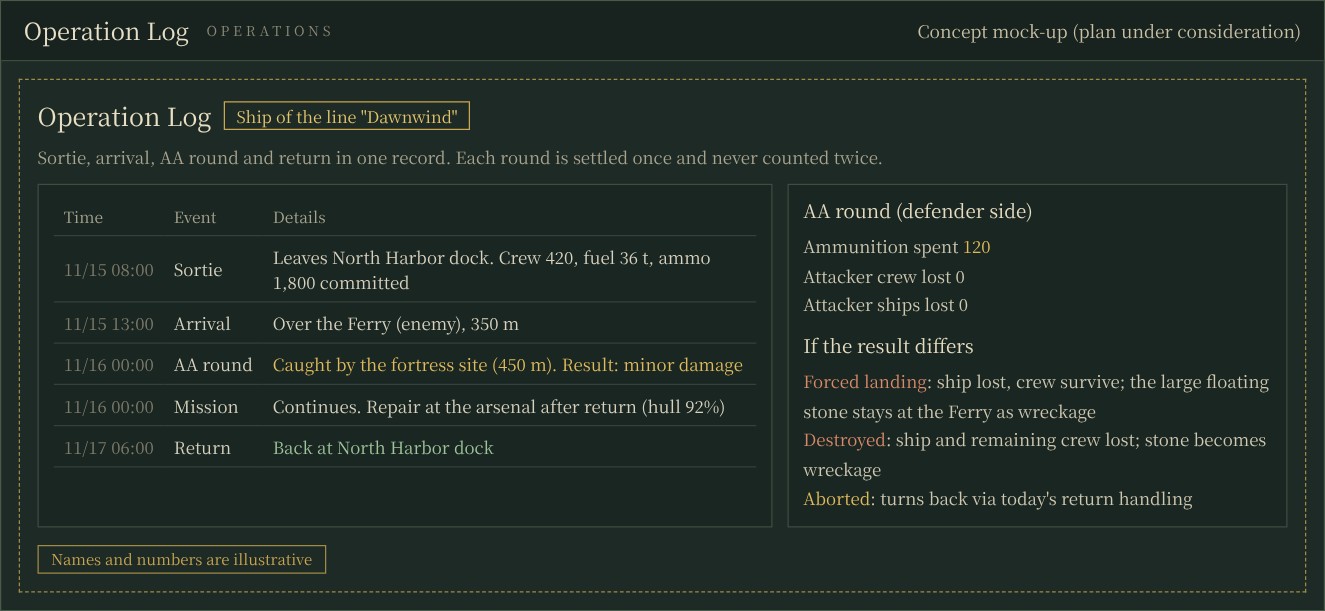
Concept mock-up (plan under consideration): an operation log that ties sortie, arrival, the air-defense engagement and return into one record, with how each other result would be handled. Names and numbers are illustrative.
Implementation steps and links to other systemsAfter the air-defense engagement for air missions (AAD-002) is finished, we plan to proceed in this order:
- An operation record for each ship (the hull, its crew, sortie, flight and return) and saving it.
- Accepting a sortie from a dock and securing crew, fuel and ammunition.
- Passing the ship's altitude and defense to the existing air-defense check on the first midnight after arrival.
- Settling ammunition, crew, the ship and the stone wreckage once in the same engagement record.
- Return and repair.
- The sortie window and operation log (Japanese and English).
- Checking that losses never pile up after save and reload or when the same engagement is replayed.
From the attacker's side, this combines naturally with sabotaging the air-defense net (plan #97): knock out a spotter post or command post, then send the ships in. And because the number of ships is capped by floating stones, losing even one carries real weight.
Tell us what you thinkWhen you send a big ship over an enemy air-defense net, what information would help you decide? Does choosing between buying safety with altitude and flying low to get the job done sound interesting? We would also like to hear your thoughts on escorts and on picking routes around strong defenses.
About the imagesImage 1 is an actual game screen, captured from a Debug build launched without showing a window, using screen-check data (the stones and hulls are test entries). Images 2 and 3 are mock-ups that illustrate the plan; they are not game screens.
Related: DEVELOPMENT PLAN #89 — Meeting Raids from the Ground: Linking Guns, Spotters and Command, DEVELOPMENT PLAN #97 — Breaking the Air-Defense Net from Within, DEVELOPMENT SNAPSHOT #100 — From Plan #87 to the Game: Field Repair Caps and Arsenal Repairs
Check the files currently available and the development status on the download page