DEVELOPMENT PLAN #115 — Private Freighters Abroad: International Flights, Shared Holds, Hired Docks
Contributed by: Takeshi Miyaoka on Saturday, November 21 2026
Last modified on Saturday, November 21 2026
This is a plan article introducing something I would like to develop. Nothing described here is implemented yet; the ideas are still under consideration and may change before they are built.
Tonight continues the story of freight in the sky. This morning's article (#114) covered restoring and building ports. In the air, private freighters can already carry goods inside the country, but only as a small charter: one shipper per flight, the owner's own home dock, and domestic routes only. I would like to grow that into shared holds that combine several shippers on one flight, berthing contracts at docks owned by other businesses, and international flights to neighbors with a trade treaty. The idea is tracked as improvement item WLD-022 (international flights, shared holds and third-party docks for private air freight).
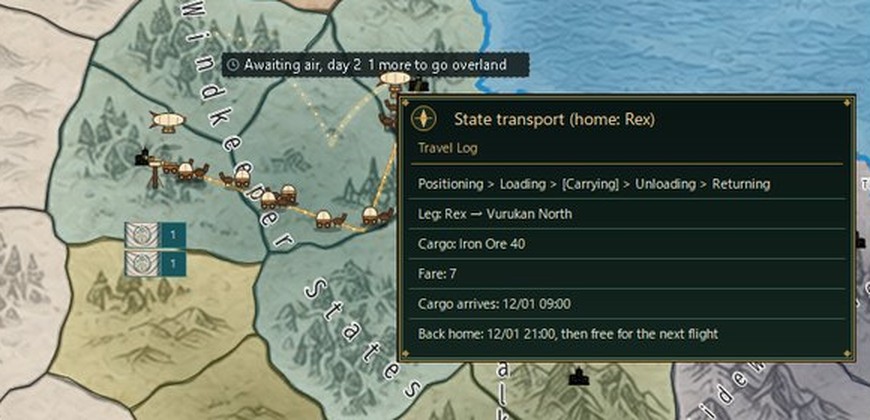
Image 1: The current game screen. A state dock's transport flies a domestic air route, and its travel log shows the positioning, loading, carrying, unloading and returning stages (a crop of the actual Debug-build screen captured on November 16 and shown in #106).
Where things stand: private charters are one flight, one shipper, one country- State cargo is carried by transports from state docks (#67). On the map you can follow them by their arcs and travel logs (#106, Image 1).
- On the private side, a capitalist can found a private air business, build a private dock, buy a transport from a state warehouse and register it. Building a dock takes 336 hours of work by 10 workers per unit of size.
- A registered aircraft can charter-carry raw materials for private facilities inside the country. The rules: one shipper and one aircraft per flight, only the owner's aircraft and home dock, domestic with a single currency, and at most a 1,200 km circuit from the home dock and 10 work units of cargo.
- The fare is a fixed quote: the cost of fuel, crew wages, the dock share and maintenance materials, times 1.10. It is settled once when the cargo arrives, and the aircraft stays busy until it is back home.
- State bases, docks owned by other businesses, international transport and shared holds are out of scope today.
Trade between countries already runs on trade treaties with yearly quotas per item and direction (#48), and prices and tariffs are settled with the exchange rate fixed at dispatch.
What is missing: small loads, and the other side of the borderA load that uses only 2 of the 10 work units still has to hire a whole flight. That is expensive for a small workshop, and the carrier flies mostly empty. Places beyond the 1,200 km circuit, or customers across the border, are out of reach for private freighters. I would like air freight to grow as a private business, not only a state service.
Plan 1: posting flights and sharing the hold- A carrier posts a flight with its loading province, up to two unloading points on the same circuit, and a departure date. Shippers book space by work units.
- The rate per work unit would be today's fixed charter quote divided by "hold capacity × 0.8". At 80% full the quote is covered; anything above is the carrier's profit.
- If the hold is less than half full at the deadline (0:00 the day before departure), the carrier chooses: fly at a loss, or cancel and return every booking.
- Each shipper's fare is settled when its cargo arrives. If part of the cargo is lost, to weather for example, the loss is shared by work units and fares are not reduced (the same idea as today's charter).
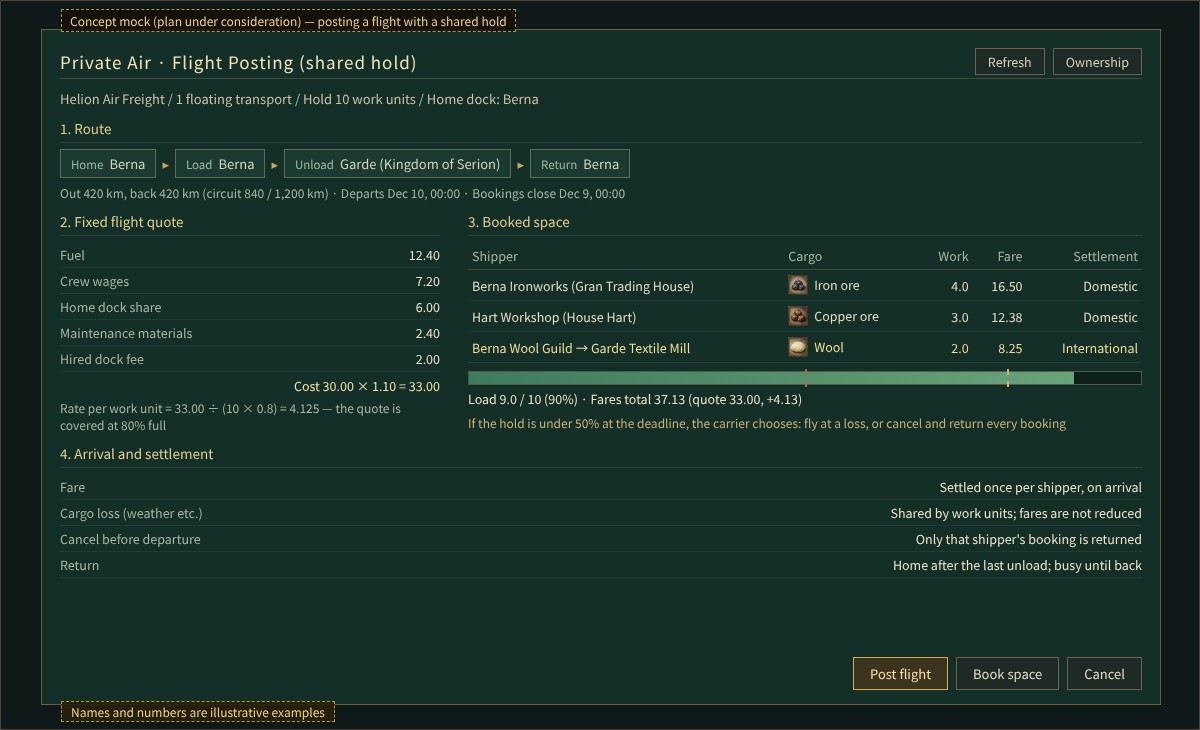
Concept mock (plan under consideration). For a flight quoted at 33.00 the rate is 33.00 ÷ 8 = 4.125. Three shippers with iron ore 4.0, copper ore 3.0 and wool 2.0 fill 90% of the hold, and the fares total 37.13, 4.13 above the quote. Names and numbers are illustrative and this is not the game screen (the resource icons are the game's images).
Plan 2: hired docks and berthing contracts- A carrier signs a berthing contract with another business's private dock at a fee the owner sets per hangar size per day. While berthed, the aircraft uses one of that dock's hangar slots.
- The fee is part of the flight quote and is paid to the dock owner. Owning a dock becomes a business of renting space.
- At the berth, fuel can be bought from that country's state warehouse, so the aircraft can fly on from the refueling point. Maintenance stays at the home dock.
- Only countries with a trade treaty in force can be destinations. The yearly quota for the item and direction is used at dispatch.
- The price and tariff ride on today's international settlement, with the exchange rate fixed at dispatch. The fare is set in the carrier's currency and converted in the same settlement when the shipper uses another currency.
- In the destination country, the aircraft lands at a private dock it has a berthing contract with.
- No flights go to countries without a treaty, so air freight does not become a smuggling loophole. Countries at war are neither destinations nor overflown.
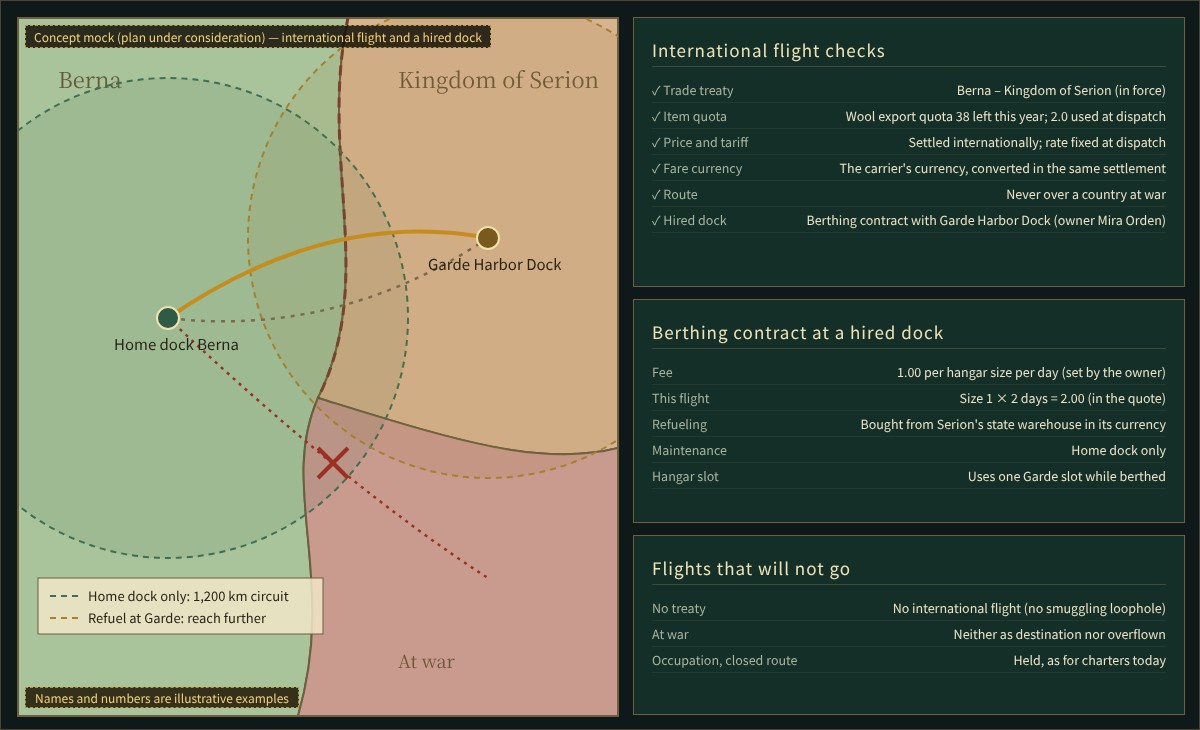
Concept mock (plan under consideration). An international flight from the home dock at Berna to Garde Harbor Dock next door. The circles on the left show the rough range; refueling at Garde lets the aircraft reach further. A route into a country at war cannot be chosen. The right side shows the international checks and the berthing contract. Country names, people and numbers are illustrative.
Steps, and how it connects to other systems- Domestic shared holds: add space booking and fare sharing on top of today's charter quote, booking, settlement and return.
- Domestic hired docks: berthing contracts, renting hangar slots, and refueling at the berth.
- International flights: connect treaty quotas, international settlement and docks abroad on top of steps 1 and 2.
At each step I plan to check cancellation, handover, settlement, the return home, and that saving and reloading never counts anything twice before moving on. When the sky raiders plan (#107) arrives, shared-hold flights should be targets too. The numbers (0.8 for the rate, 50% for cancelling, two unloading points) are the current proposal and will be checked again before implementation.
Tell me what you thinkDo shared holds for small loads, and renting out a dock as a business, sound interesting to play? I would also like to hear about limiting international flights to treaty partners, and letting the carrier decide whether to fly a flight that is less than half full.
About the imagesImage 1 is the actual game screen: a crop of the same capture used in #106 (November 16, the Debug build started without showing it on screen, from a verification state built from the initial master data with a test flight placed). Images 2 and 3 are mocks that explain the plan and are not the game screen. The flight posting panel, the route diagram and the check panels were drawn for the mocks; only the resource icons are the game's images.
Related articles: DEVELOPMENT SNAPSHOT #106 — Freight in the Sky and at Sea: Airships and Ships on the Map, #67 (state air cargo), #107 (sky raiders and corvette escorts), #114 (restoring and building ports)
Check the files currently available and the development status on the download page