DEVELOPMENT SNAPSHOT #46 — The January Budget: Planning Room for Next Year
Contributed by: Takeshi Miyaoka on Tuesday, October 06 2026
Last modified on Tuesday, October 06 2026
A national budget is more than a single “available money” number. It has to cover recurring obligations while leaving room for new plans. The Annual Budget Planning screen brings those concerns together: fixed allocation, discretionary limit, spending, commitments and remaining budget, alongside forecast revenue for the rest of the year, available cash and the maximum discretionary amount.
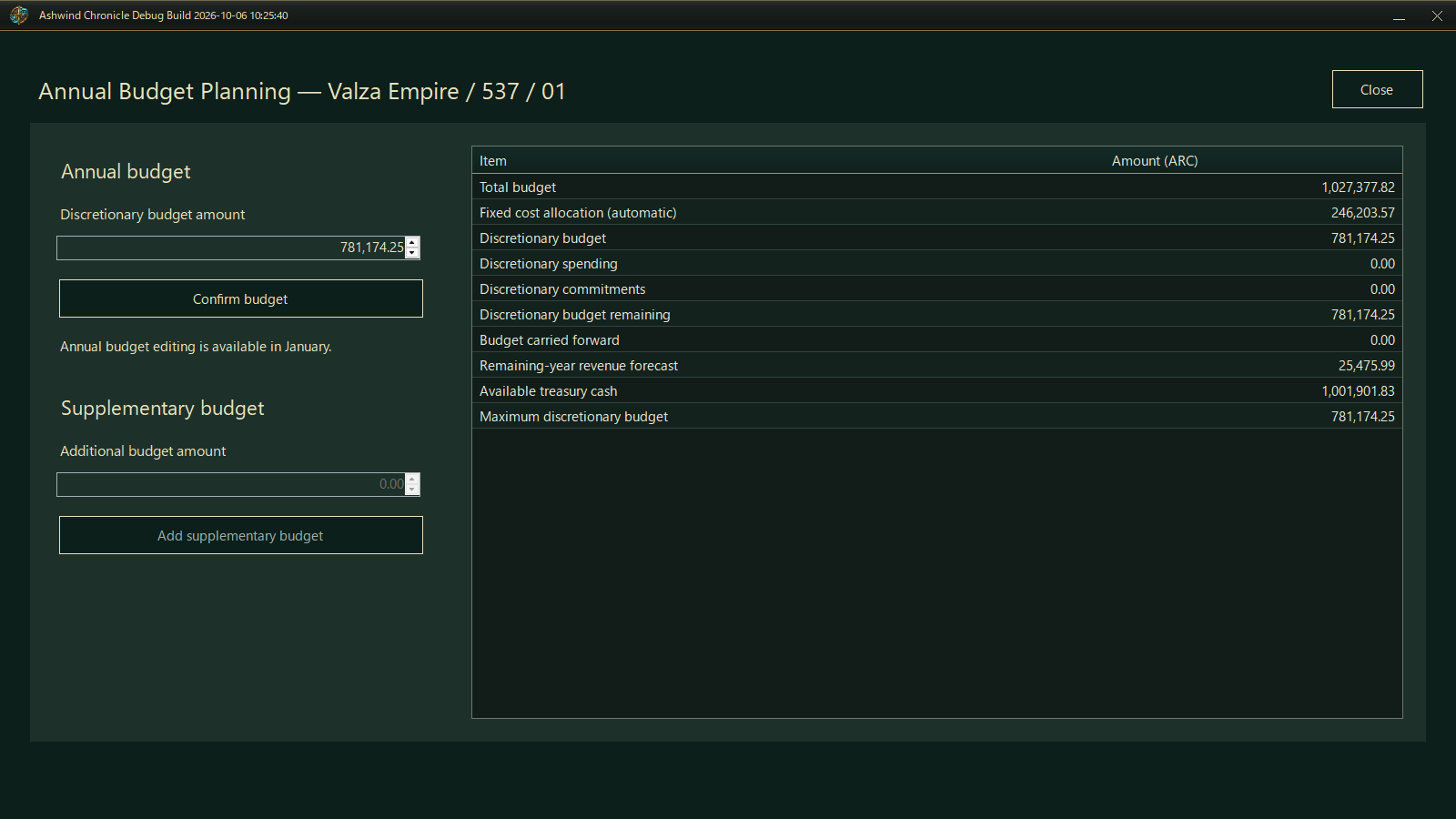
Ordinary annual-budget editing is available only in January. The maximum-limit calculation looks beyond the cash balance: it considers forecast revenue over the remaining days and subtracts projected fixed costs. The forecast includes state-facility operating costs, debt due, arrears and a safety margin. The goal is to keep a large discretionary plan from being based on today’s balance alone.
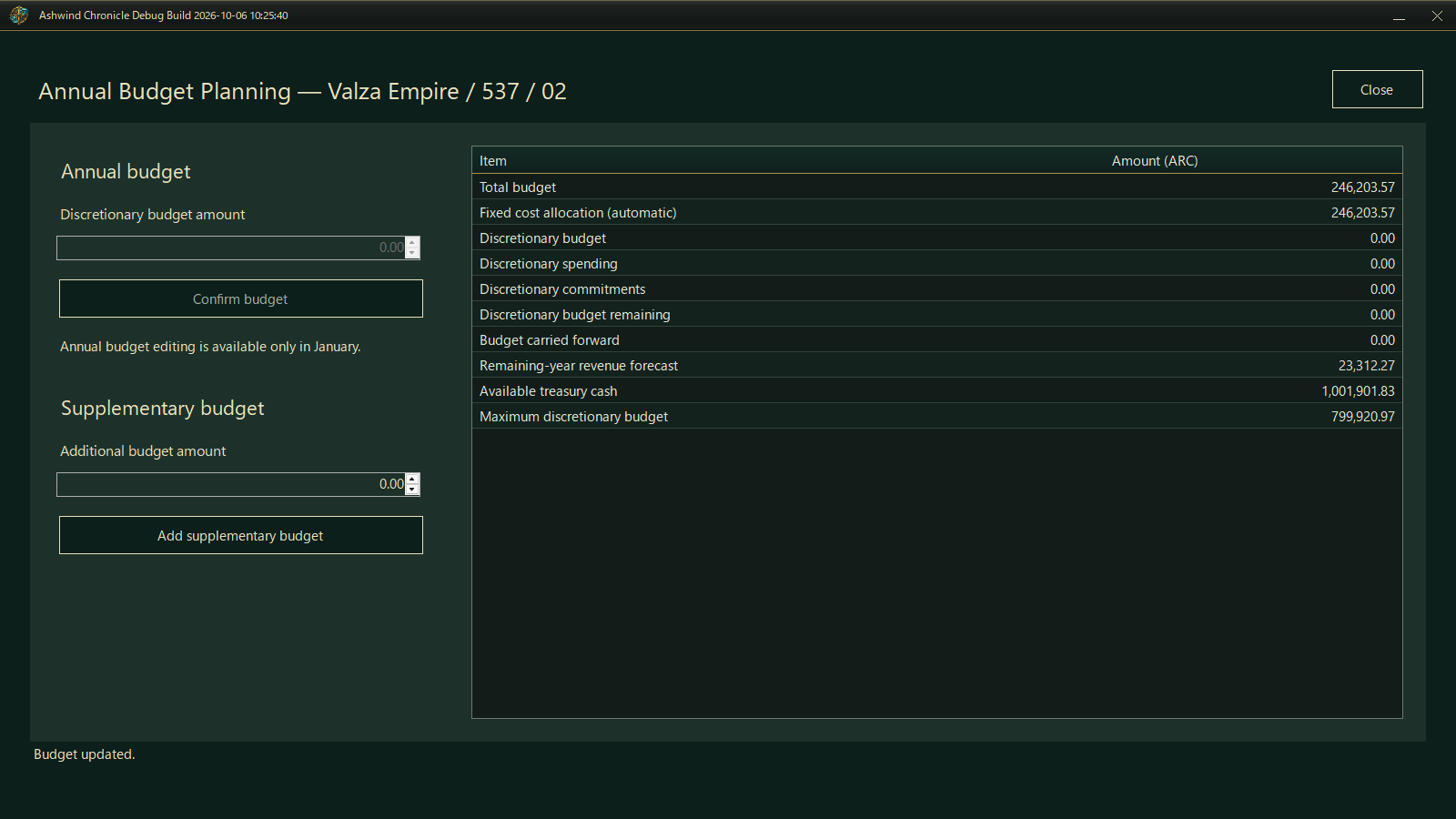
Supplement only when the forecast says it is neededPlans can meet reality mid-year. If the remaining budget is exhausted or fixed-cost estimates exceed the protected forecast, a supplementary budget can be considered. The amount must be positive, and the action is unavailable when no shortfall condition exists. Our Debug checks also verify that applying a supplement does not create treasury cash, and replaying the same operation cannot apply it twice.
Unused discretionary budget does not automatically become next year’s money in full. The carryover is capped at the smaller of the unspent budget and available treasury cash. This boundary prevents budget headroom from conjuring cash or letting the same resources be counted twice.
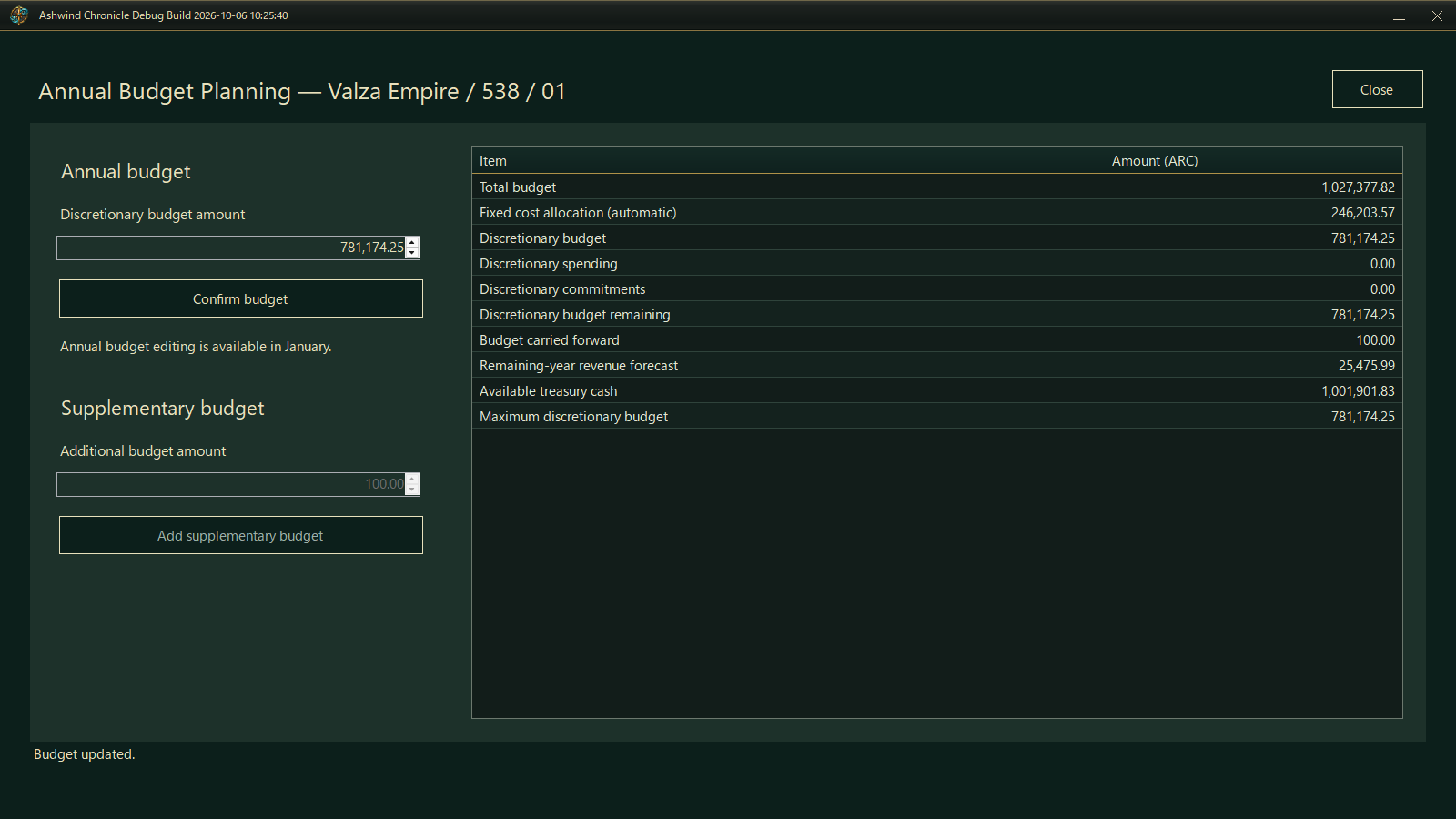
All three images are captures from Debug-only validation scenarios. Their dates and amounts are test-fixture data, not a player’s saved game or a claim about a live country. The checks run against an in-memory test map and confirm that ordinary game data is not overwritten.
This planner is a small policy choice at the heart of a strategy game: how do you protect essential costs without closing off a country’s future? If you would like to explore Ashwind Chronicle, visit the download page. Our previous snapshot, #45, “A Brass Dial for the Map”, looks at a compact tool for reading distance and zoom at a glance.
When a year ends with budget remaining, what would guide your carryover decision: a cash safety buffer, or the plan you want to pursue next year?