DEVELOPMENT SNAPSHOT #72 — From Plan to Build: Bank Loans Let Private Owners Expand
Contributed by: Takeshi Miyaoka on Saturday, October 31 2026
Last modified on Saturday, October 31 2026
Two days ago, a plan article (#70) described an idea under consideration: banks lend the deposits they collect to businesses, and private owners build more facilities on their own. The next day the plan was implemented as improvement item FIN-020.
This article shows how the plan turned out, using the actual screens. Where the plan article had mock-ups, this one has a working game. 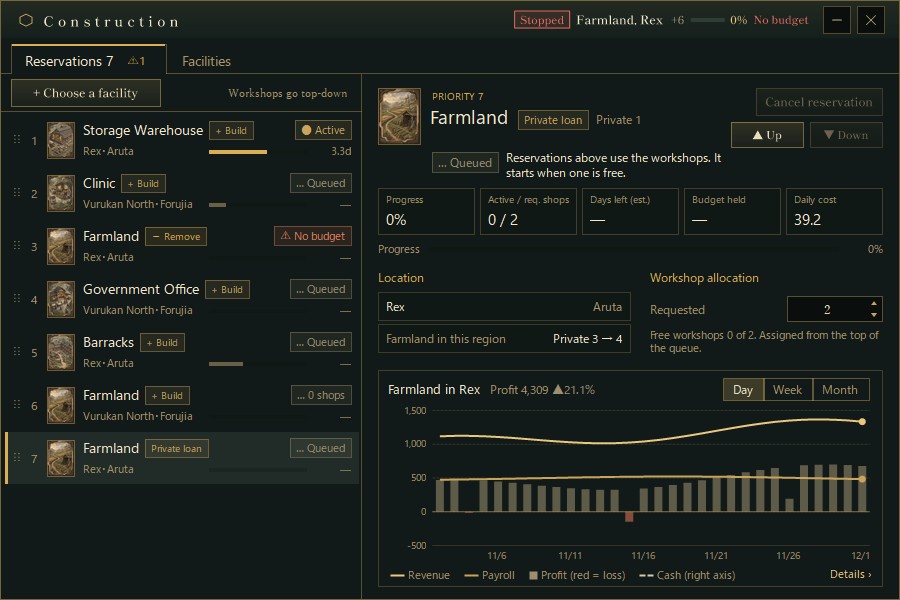
The construction screen, captured for verification in a development debug build. Reservation 7 is farmland that a private owner is adding with a bank equipment loan. It carries a "Private loan" tag, and "Cancel reservation" is disabled. "Farmland in this region: Private 3 → 4" shows that one more privately run farmland will exist when it is finished. Country, places and numbers come from a verification setup and may change.
At the start of the month, profitable producers of scarce goods borrowThe check runs at midnight on the first of every month, in the same step that completes facilities. It works like this:
- Candidates: private production facilities that make a resource whose demand recently went unmet in the country's supply-and-demand records, whose owner is operating, has a positive average profit over the last 14 days, and is not already building an expansion.
- Screening: only owners with an existing credit score of 0.6 or more can borrow.
- Rate: the discount rate plus 1% for a score of 0.8 or more, otherwise plus 2%.
- Amount: the construction cost minus the cash on hand beyond 14 days of working capital. Owners borrow only the shortfall.
- Lender: a bank in the same province, otherwise in the same region, private banks first.
- Limit: at most two per region per month.
The owner sets aside the construction cost in their own account, and a private construction joins the end of the reservation queue. It can be reordered but not cancelled, and it does not use the national budget. When it is finished, that owner has one more facility.
The main differences from the plan: shortages are judged from the country-wide supply-and-demand records rather than a regional supply ratio, and "one expansion loan per owner at a time" became the condition "not already building an expansion".
Who borrowed, how much, and at what ratePick a facility on the Facilities tab of the construction screen and open Management: below the manager table, a "Bank equipment loans" section lists, per province, the balance, rate, credit score and the further borrowing limit (and days overdue, if any). 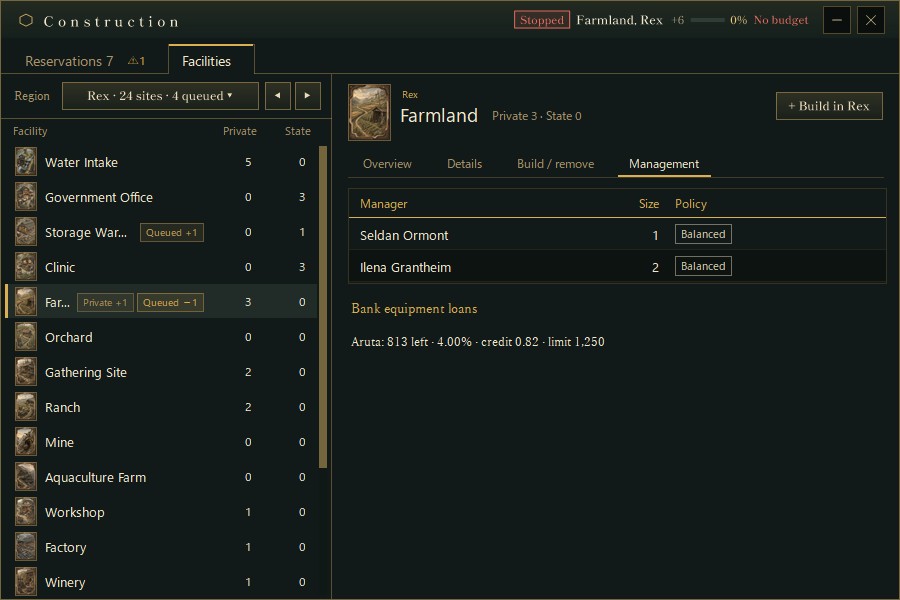
The Management tab in the same build. In the verification setup an owner in one province has 813 outstanding at 4.00%, with a credit score of 0.82 and a further limit of 1,250. Because 0.82 is at least 0.8, the rate is the 3% discount rate plus 1%.
On the economy page of National Analysis, a bank lending row (balance, number of loans and number overdue) now sits under the discount rate, together with an Allow/Stop switch for the national policy "private equipment loans". It is allowed by default; a country that stops it gets no new expansion loans.
Where the money movesLoans move real cash between accounts, not just numbers in a ledger. When a loan is made, the principal moves from the lending bank's account to the owner's account. Repayments come from the part of the owner's account that is not set aside. Interest received goes into the bank's equity; if a loan stays overdue for 30 days and defaults, the remaining principal is the bank's loss. Each loan settles at most once a day, and 30 days of settlement history are kept.
Who gets paid when construction finishes was also sorted out: the cost is split by the number of active workshops used; the share from state workshops goes to the treasury, and the share from privately run workshops goes to their managers.
Private construction may use up to 30% of the workshopsPrivate construction uses the same workshops as the state's. So that private expansions in a country with lasting shortages do not fill the queue and stall state projects, private construction may use at most 30% (rounded down) of the country's active workshops. Anything beyond that is taken from the private constructions at the back of the queue and given to state projects. In a country with fewer than four workshops, private construction does not progress. 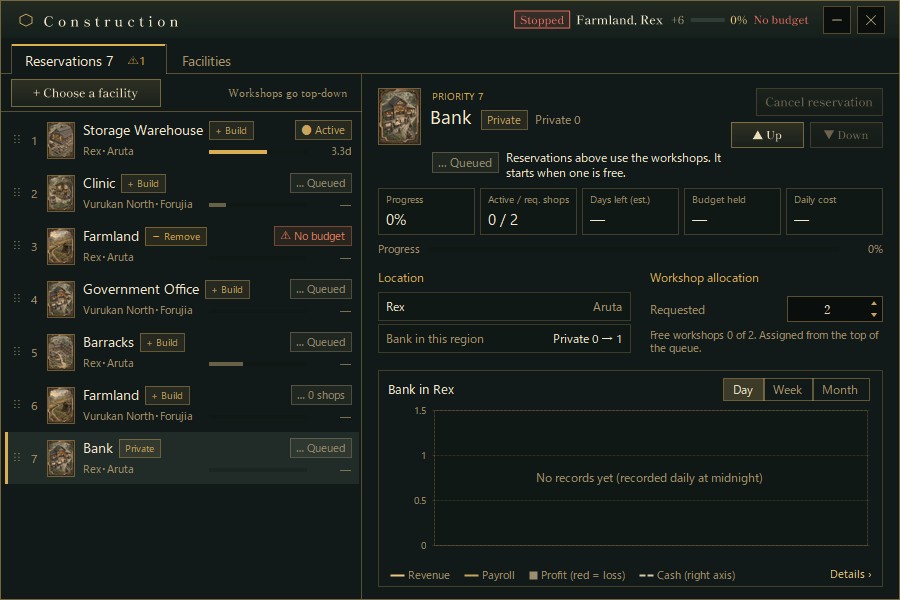
In the same build, a money changer building a bank (the promotion introduced in #69), shown with a "Private" tag. The 30% limit and the rule for who is paid the construction cost apply to this construction as well.
A later change to ratesLater the same day (FIN-021), countries at monetary policy level 3 got a policy rate set by the state, and the base for deposit rates, bond rates and equipment loan rates became the 30-day average of the short-term rate. Countries below level 3 still use the discount rate as before.
About the images and numbersAll images were captured from a development debug build using a verification setup. Country, places, people, amounts and rates are still being tuned and may change. How many loans and defaults appear after several months on the real master data is still to be checked.
The plan behind this feature: DEVELOPMENT PLAN #70 — Turning Deposits into Workshops: Bank Loans for Private Expansion
Where the banks came from: DEVELOPMENT SNAPSHOT #69 — When a Money Changer Becomes a Bank: Deposits, Discount Rate, Bonds
Previous article: DEVELOPMENT SNAPSHOT #71 — The Minister Brings the Budget: Allocations, Bond Terms, Midyear Top-Ups
See the files currently available and the development status on the download page