DEVELOPMENT SNAPSHOT #98 — Birth Rates from Day One: Demography in the National Analysis
Contributed by: Takeshi Miyaoka on Friday, November 13 2026
Last modified on Friday, November 13 2026
The National Analysis window lists birth rate, death rate, life expectancy and natural change for the whole nation and for each region. Right after starting a new game, though, some regions showed only "—" in these columns, and no values appeared until the first month boundary. Yesterday two changes closed that gap from both sides. This morning I'll walk through them with actual screens.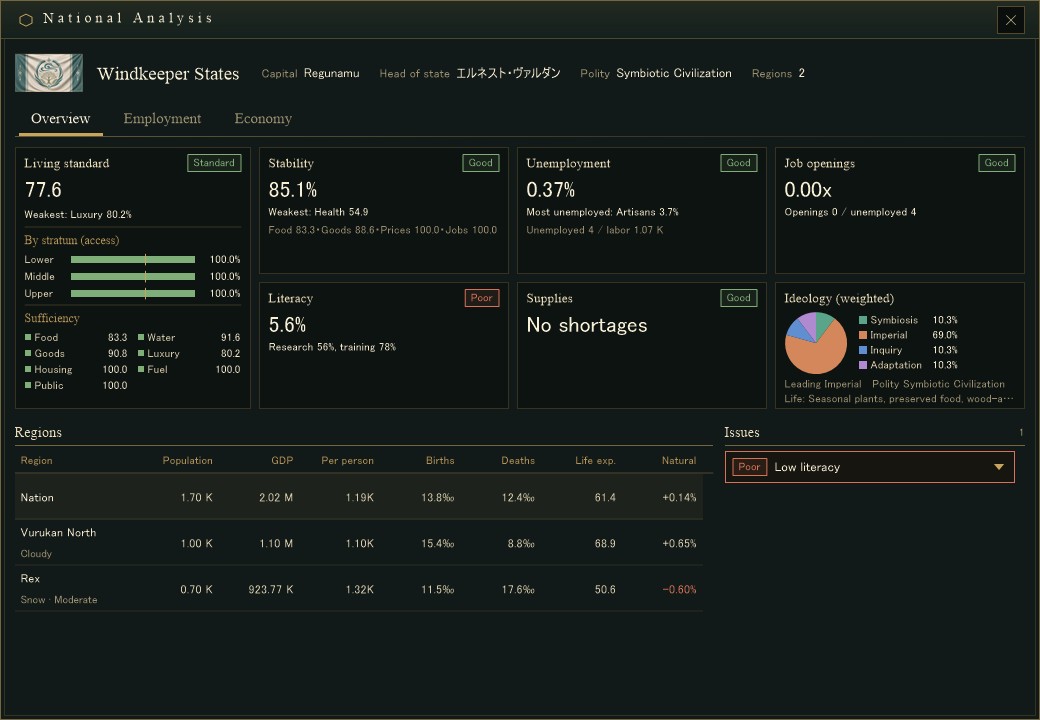
The National Analysis overview right after starting a new game (an actual screen from the Debug build). In the Regions table at the bottom, births, deaths, life expectancy and natural change are filled in for the nation and both regions.
Why the columns were emptyPopulation changes once a month, with births and deaths calculated for each five-year age cohort (the system introduced in #53). The monthly pass also records these rates for each region. A new game's opening data, however, is made by running 60 days of economy before the start. That pre-run only runs the daily economy and never goes through the monthly population pass. So regions added later in the opening data had no demography record, and older regions still carried stale values from the master data dated after the opening month. Because the opening month counts as already updated, no record was made until the first month boundary, and the National Analysis showed "—".
Fix one: estimate it on the screen sideWhen the National Analysis is built, a region that has never received a monthly update now gets an estimate from the same calculation as the monthly pass, using its current population, age structure, living standard and food sufficiency. This calculation only reads: it changes neither the document's values nor the population. If a region has no population-policy settings yet, it uses defaults on the spot without creating a record.
Fix two: record the opening month in the opening dataThe other change goes to the root. At the end of the pre-run, the opening month's demography is now recorded with the same monthly calculation, without moving the population. Birth and death carry-over fractions and the population update month stay as they were, and values dated after the opening month are cleared from regions with no population, so stale numbers no longer pass as opening values. The opening data version went from 13 to 14, so it will be rebuilt the next time a new game is started.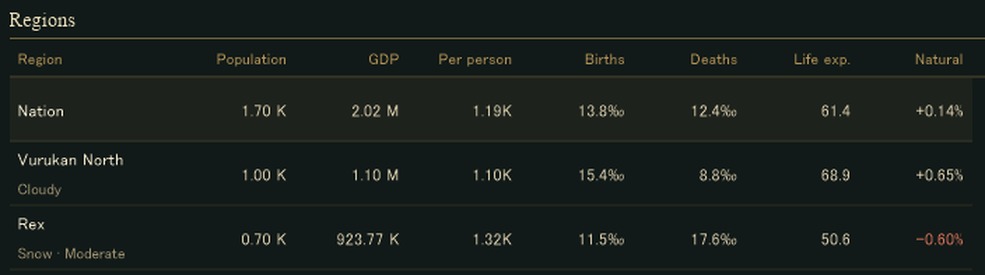
A closer look at the Regions table. Vurukan North has a birth rate of 15.4‰, a death rate of 8.8‰ and a life expectancy of 68.9 for +0.65%; Rex has 11.5‰, 17.6‰ and 50.6 for −0.60% in red, so differences inside one nation are visible. In the opening data used for this capture, Vurukan North did not yet have an opening-month record, so its row comes from the screen-side estimate.
Both paths use the same calculation, so values are produced the same way whether they come from a record or an estimate. Automated tests check that recording the opening month moves no one in the population or age structure, that stale values are cleared from empty regions while carry-over fractions remain, and that the estimate does not rewrite a region's settings or records.
The employment page, tooOn the Employment page, the nation's birth rate, death rate, life expectancy and natural change sit below the age-cohort bars. These also show values from the start.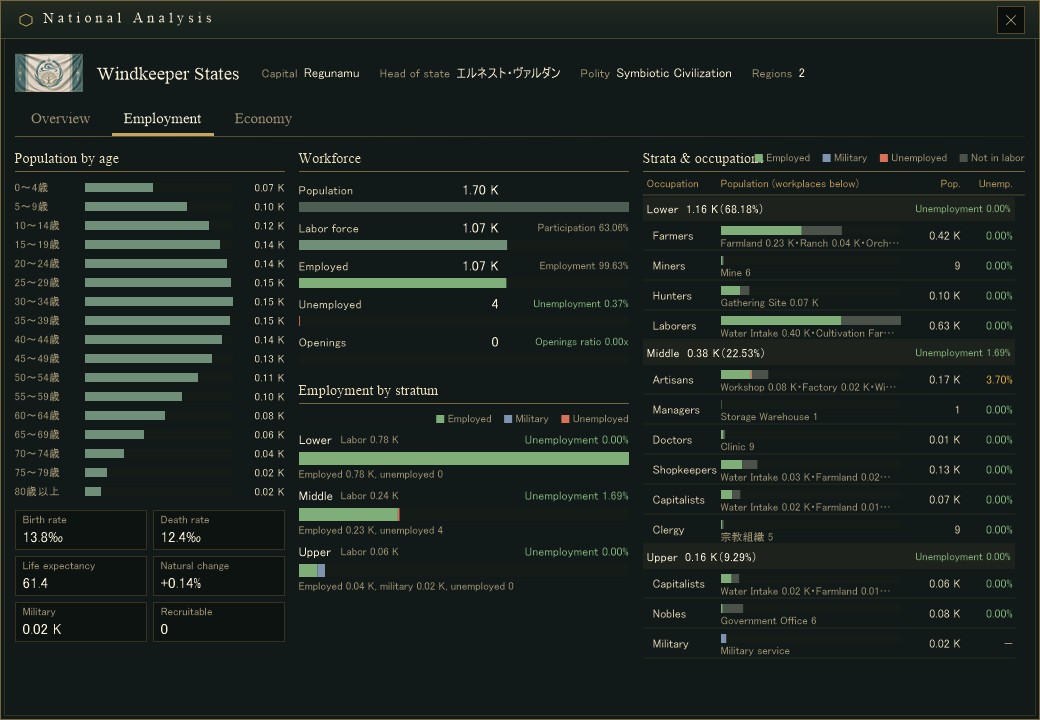
The Employment page in the same state (an actual screen from the Debug build). At the lower left: birth rate 13.8‰, death rate 12.4‰, life expectancy 61.4 and natural change +0.14%.
About the imagesAll images are actual game screens, captured by starting the Debug build without showing its window, in a verification state started from the initial master data (image 2 is a crop of image 1). Nation, person and region names and values belong to the verification state and may change with later tuning. Some labels and names, such as the age cohorts and the head of state, are still shown in Japanese in the English UI.
The population system: DEVELOPMENT SNAPSHOT #53 — A Population That Ages: Five-Year Cohorts, Births, and Deaths
Check the files currently available and the development status on the download page