DEVELOPMENT SNAPSHOT #69 — When a Money Changer Becomes a Bank: Deposits, Discount Rate, Bonds
Contributed by: Takeshi Miyaoka on Thursday, October 29 2026
Last modified on Thursday, October 29 2026
Draw up the budget, look ahead at tax rates, share money out to welfare: the recent snapshots have made it much clearer where a country's money goes. But the money businesses earned simply sat in their own hands, and the state had no one to borrow from.
This round of development adds the machinery that holds money and puts it to work: a money changer in each region taking business deposits, banks unlocked by research, an official discount rate set by each country (FIN-013), money changers that build their own bank once deposits pile up (FIN-014), and government bonds underwritten by those banks (FIN-011). 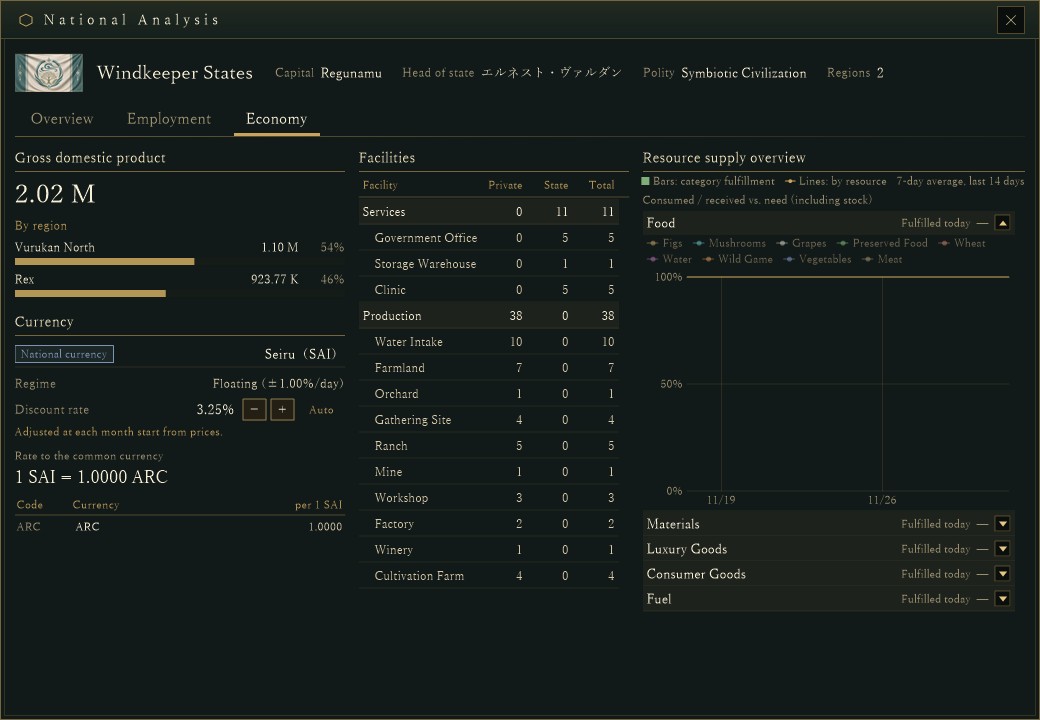
The Economy tab of National Analysis for the Windkeeper States, captured for verification in a development debug build (2026-10-28). The Currency section now has a discount rate row; here it is on automatic, adjusted at each month start from prices. Values are still being tuned and may change.
First, money changers: somewhere to park spare cashA new game places one money changer in every populated region. A money changer is not a bank but an individual merchant. Everything deposited stays as cash in that person's account; nothing is lent out. The deposit limit is 100 times the country's annual income per person, reviewed at each month start.
The depositors are private businesses. At each month start a business deposits half of whatever cash it holds above its working capital (30 days of standard daily costs), and on any day its cash falls below 14 days' worth it withdraws enough to get back to 14 days. Cautious owners spread deposits across their own region and regions next to it by land; the rest put everything with the single place offering the highest rate. A business that winds up withdraws everything first.
Deposits only move cash from one place to another; no new money is created, and the country's money supply total does not change. Since businesses start the game with about 14 days of cash, deposits begin only once they have built up some profit.
The discount rate: the anchor for deposits and bondsDeposit rates are anchored to each country's official discount rate. It is fixed at 3% a year until the country researches the monetary policy program; after that the country sets it between 0.5% and 15% in 0.25% steps.
A country that has not set it by hand compares an index of essential-goods prices with the previous month at each month start. If the annualized rise is above 3% the rate goes up 0.25%; below 1% it goes down 0.25%; within a 1% band around 2% it stays put. AI countries follow the same automatic rule.
The player can set the rate with the − and + buttons on the Economy tab; once set by hand it no longer moves on its own, and Auto returns it to automatic adjustment. Money changers and banks review the deposit rates they offer against the discount rate at each month start.
The banking program: state banks and private banksThe finance branch of research gains a Banking program (it requires the central bank program and takes 60 days). It unlocks a new facility, the Bank. Until the bank has its own artwork, it borrows the government office picture.
A bank built by the state becomes that province's state bank. When the first one is completed, the state invests 10% of its treasury cash as capital. The minimum reserve ratio is 10% and the capital ratio 8%, so a bank can put up to 12.5 times its capital to work. Each bank facility can hold ten times what a money changer can. A province with a privately owned bank facility gets a private bank, and both kinds become places where businesses can deposit, just like money changers.
When deposits pile up, the money changer builds its own bankIn a country that has researched banking, a money changer whose deposits reach 80% of its limit starts building a bank right then. The check runs every day at midnight, in the same step that completes facilities, so it catches changers that already qualify when the research finishes as well as those that cross 80% later in the game. 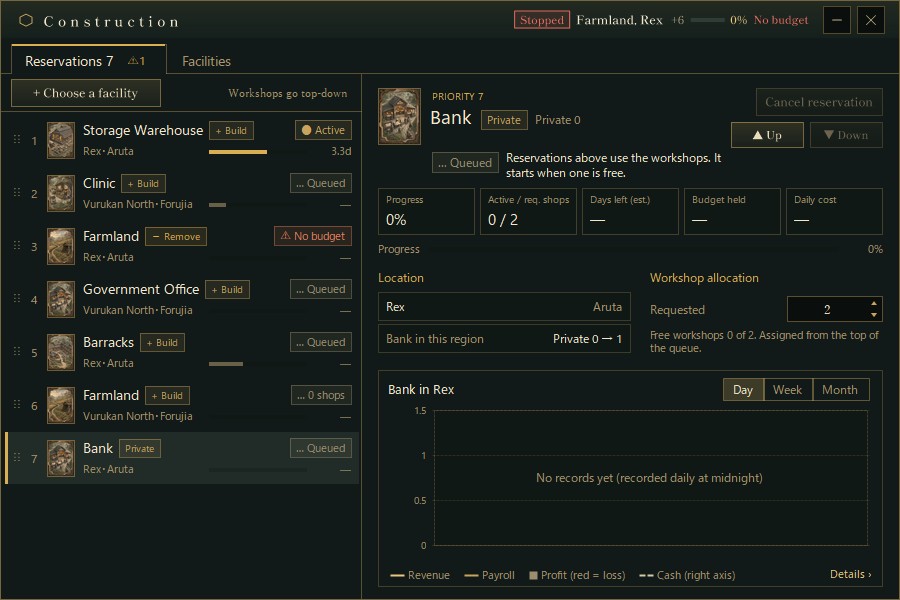
The Construction window in the same build. The bank started by the money changer in Rex sits seventh in the reservation list, marked Private. The details on the right show the region's private banks going from 0 to 1, with 2 workshops requested.
The bank goes up in the region's capital province, using the state's workshops, and joins the end of the construction queue. The player can reorder it like any other reservation but cannot cancel it. It does not touch the state budget: the building cost is provided to the money changer's owner when work starts, through the same mechanism used for business start-up funding, and is paid to the state treasury, as owner of the workshops, on completion.
The money changer keeps taking and paying out deposits while the bank is being built. On completion, one more private bank facility appears, and the money changer becomes a private bank under the same owner, keeping all its deposits. Its capital is 8% of the deposits it holds. No new money changer is placed in that region. This private construction is not counted as a planned state expansion; the facility list shows it separately as a private reservation.
Government bonds: issued from the budget screen, bought by banksOnce banks exist, the state can borrow. The Annual Budget Planning screen gains a Government bonds section where you choose the amount and the years to maturity and issue. 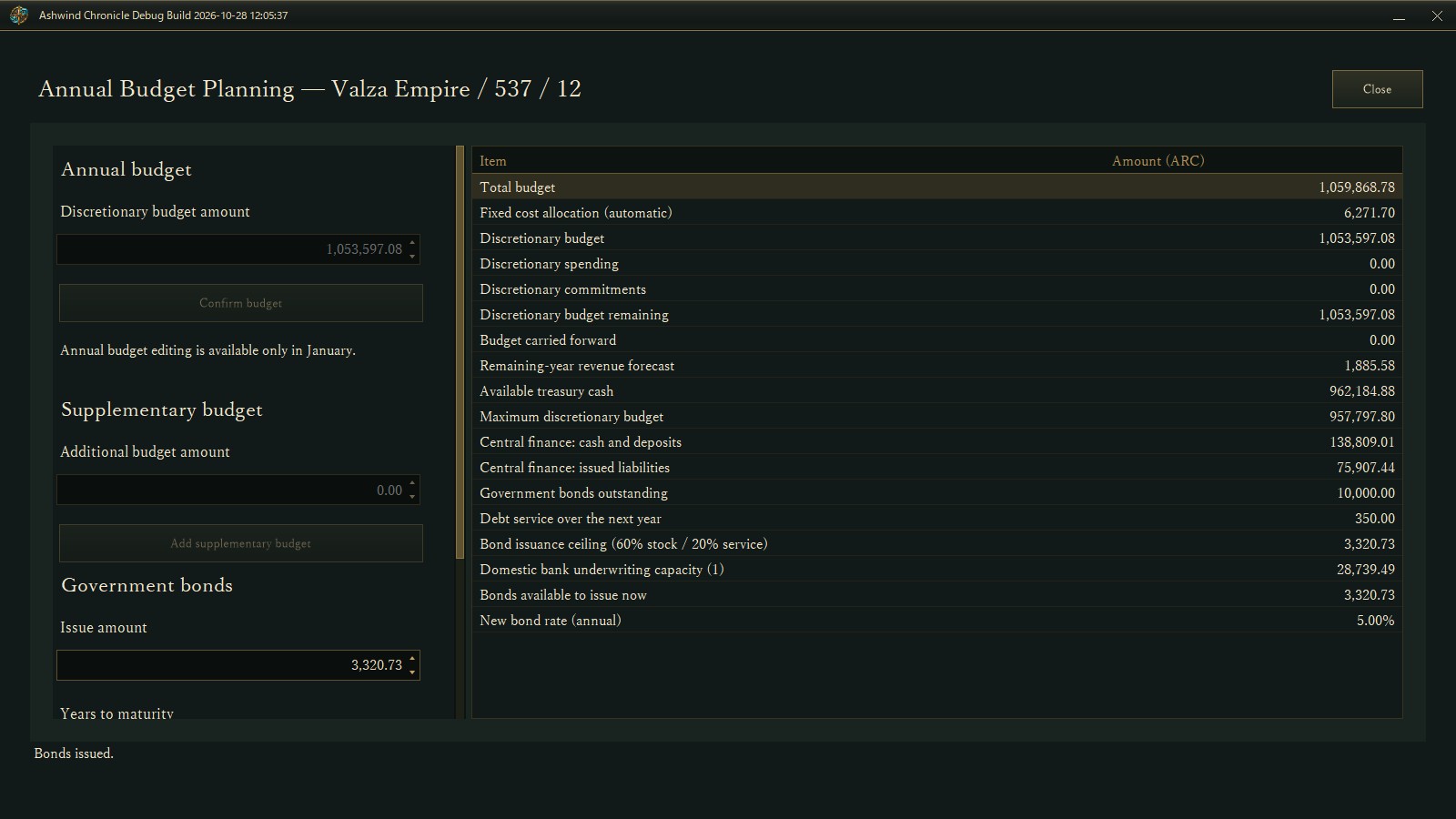
Annual Budget Planning in the same build, right after issuing 10,000 ARC of bonds: bonds outstanding 10,000, debt service over the next year 350, bonds available to issue now 3,320.73, and a new bond rate of 5.00%.
The issuance ceiling is the stricter of two limits: borrowing stays within 60% of the expected annual tax revenue, and principal and interest due over the next year stay within 20% of it. Only state and private banks in the same country and currency can underwrite, each up to 30% of its surplus after meeting its reserve and capital ratios. Money changers do not buy bonds.
Each issue gets one fixed rate: the discount rate plus 0.5%, plus 2% times outstanding debt divided by 60% of expected tax revenue (the markup is capped). In the image, the first bond was issued at 3.5%, adding a year's interest of 350 to debt service. With more debt outstanding, the rate for the next issue has risen to 5.00%: the more you borrow, the more the next loan costs.
A contract whose interest or principal cannot be paid on time counts days in arrears, and no new bonds can be issued while any are in arrears. While "automatic borrowing and refinancing" is allowed on the budget screen, the state refinances maturing principal it cannot pay with a five-year bond, and at each month start borrows the shortfall with a five-year bond if treasury cash falls below what it needs. Both stay within the issuance ceiling and the banks' underwriting limits.
A bank holding bonds adds the interest it receives to its capital. Since its cash has gone into bonds, depositors can withdraw only as much as the bank holds in cash; the rest stays on deposit to be withdrawn on later days. All of this runs in the midnight daily processing, so it was built, in line with the project's performance rules, without copying the whole game state.
About the images and numbersAll images were captured for verification in a development debug build. The bond issue, the discount rate setting and the bank construction were set up by capture scripts to check the screens. Country names, amounts and rates are still being tuned and may change.
How the budget is planned: DEVELOPMENT SNAPSHOT #46 — The January Budget: Planning Room for Next Year
The multi-year tax simulation: DEVELOPMENT SNAPSHOT #65 — See Five Years Ahead Before You Touch a Tax: Health Scores and Reform Plans
Previous article: DEVELOPMENT SNAPSHOT #68 — The Cabinet in One Window: Personnel Joins Domestic Affairs
See the files currently available and the development status on the download page