
DEVELOPMENT SNAPSHOT #65 — See Five Years Ahead Before You Touch a Tax: Health Scores and Reform Plans
- Sunday, October 25 2026
- Contributed by: Takeshi Miyaoka
- Views: 23
If you raise a tax a little, how many years will the treasury last? If you lower one, how much easier does life get? The old tax screen was a list of rate fields, and the only way to find out was to play a few months and see.
This round of development rebuilt Tax Policy as a single movable window. Move a slider and it recalculates, on the spot, the treasury five years ahead and four health scores: fiscal health, fair burden, economic vitality and social stability. An appointed Minister also proposes reform plans. 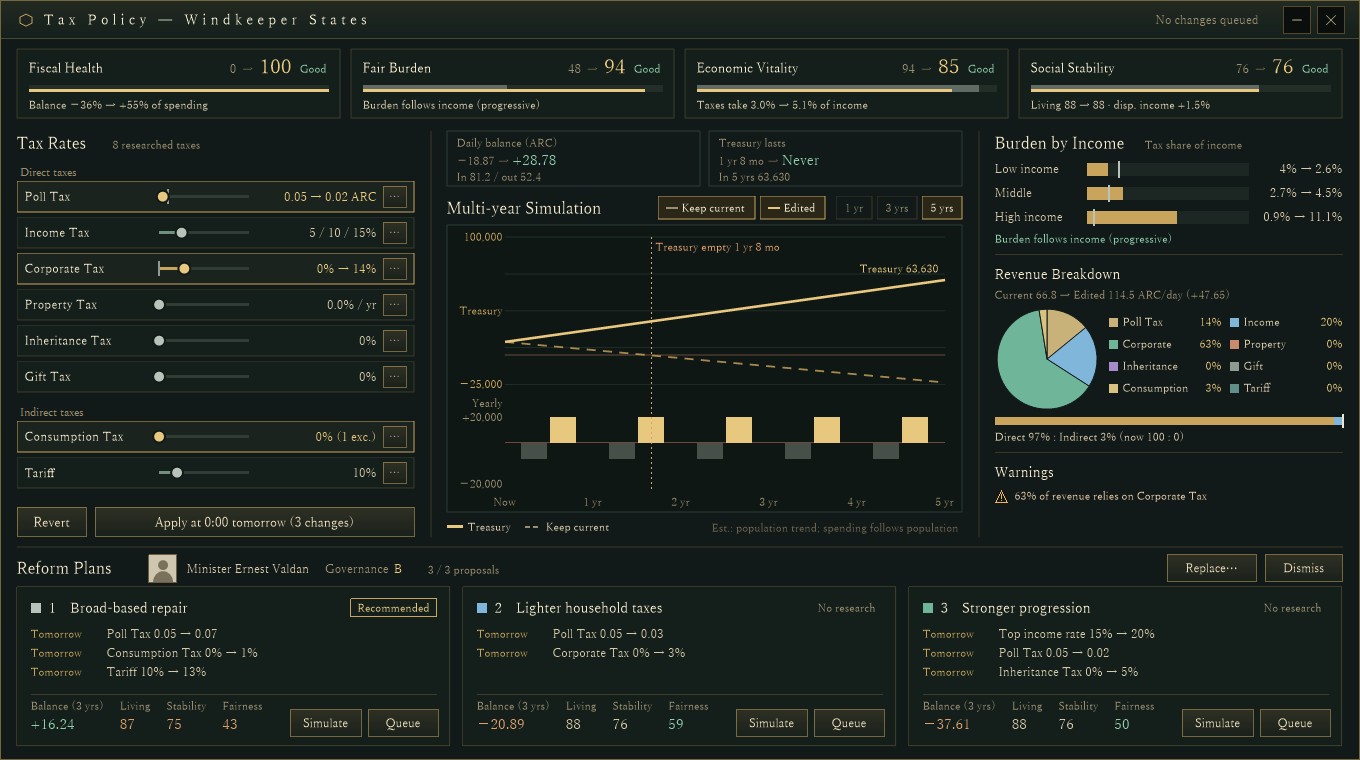
The Tax Policy window of the Windkeeper States, captured for verification in a development debug build (2026-10-24). All eight taxes are researched for this capture, and three changes are drafted. The treasury, which would run out in 1 yr 8 mo, now never runs out, and a Minister with Governance B proposes three plans in the bottom row. Values are still being tuned and may change.
A treasury with 1 yr 8 mo leftIn this state the country takes in less than it spends: the daily balance starts at −18.87 ARC. The multi-year simulation in the middle can show 1, 3 or 5 years. It adds each month's balance to the current treasury, scaling income and spending with the past 12 months of population growth (capped at ±5%). The first month below zero is marked as the month the treasury runs out. It is an estimate, not a forecast of future booms or wars.
The dashed line is "keep current". The solid line is the draft. In the image above, lowering the Poll Tax from 0.05 to 0.02 ARC and raising Corporate Tax from 0% to 14% (plus one consumption-tax exception) turns the daily balance to +28.78 and leaves 63,630 in the treasury after five years.
Move a slider, change the next five yearsFiscal Health rises from 0 to 100. Because the Poll Tax falls, the low-income burden drops from 4% to 2.6%, and Fair Burden rises from 48 to 94. Economic Vitality, however, falls from 94 to 85, and the warning box notes that 63% of revenue relies on Corporate Tax. Improving one thing moves another, and you can see that before anything takes effect.
The scores are deliberately simple. Fiscal health comes from the balance as a share of spending, capped at 35 if the treasury runs out within five years. Fair burden comes from the gap between high- and low-income burdens. Vitality comes from household taxes plus business taxes (counted 1.5×) relative to income. Stability is the estimated stability one year out.
Drafts do not apply immediately. "Apply at 0:00 tomorrow" queues them for the next game day's midnight economy pass. Until then, the real budget does not change.
Reform plans from your MinisterThe bottom row holds reform plans. Once a Minister is appointed, they propose one to three plans depending on their Governance grade. Ministers can be appointed, replaced or dismissed from this window, and their ability is shown only as a grade such as "Governance D". 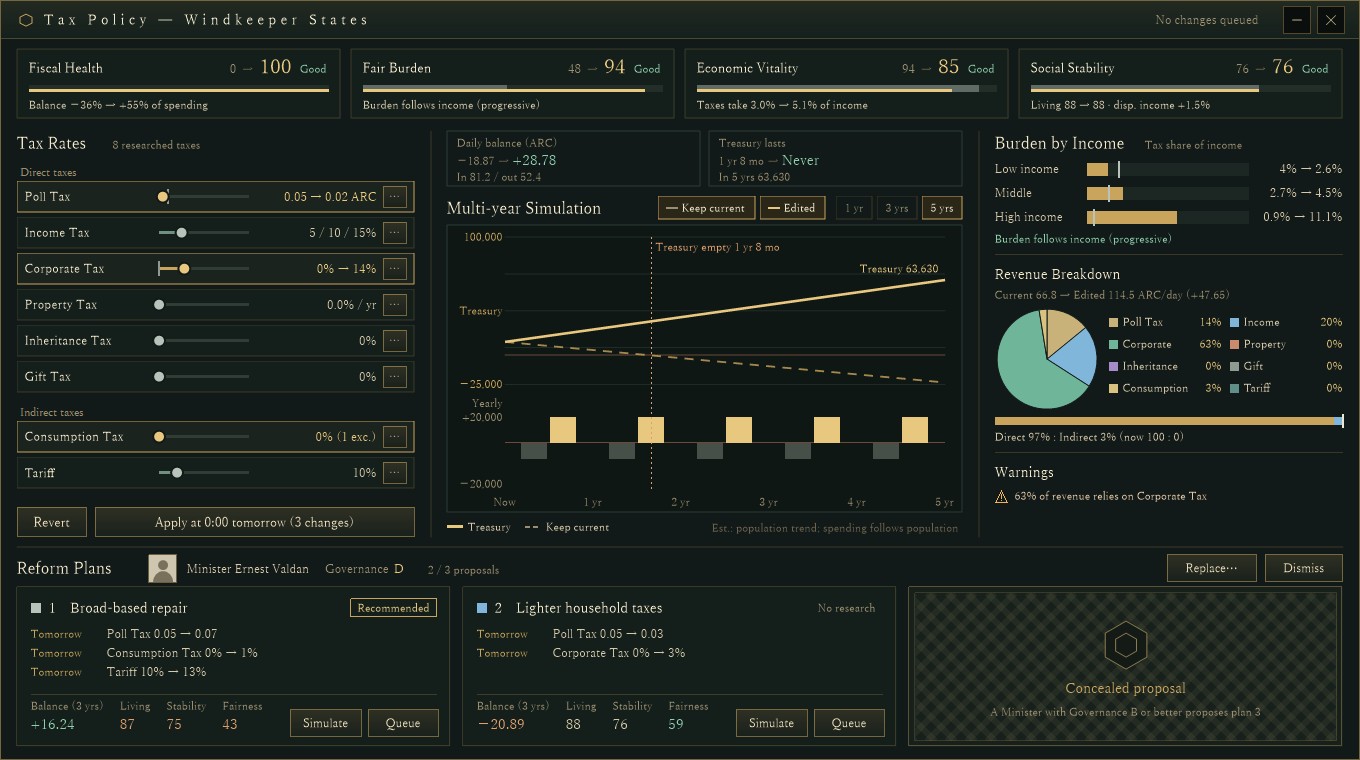
The same build with a Minister whose Governance was set for verification. At grade D, two plans are shown; the third stays a "Concealed proposal" until a Minister with Governance B or better is appointed.
Plans are built from candidates such as lighter household taxes, stronger progressivity, fiscal repair and a broader tax base, and ranked by the sum of the four health scores over a five-year simulation. Plans that need taxes not yet researched lose a few points. Each plan shows the balance, living standard, stability and fairness after three years. "Simulate" overlays it on the graph, and "Queue" schedules it for 0:00 tomorrow just like your own draft. In the image, "Broad-based repair" gains +16.24 in three years but drops fairness to 43, while "Lighter household taxes" keeps living at 88 at a cost of −20.89. Which one fits your country is your call.
Per-tax detailsThe "…" button beside each tax opens its details. For income tax you can set the annual allowance, three brackets and regional adjustments. These changes also go into the draft and are queued together from the Tax Policy window. 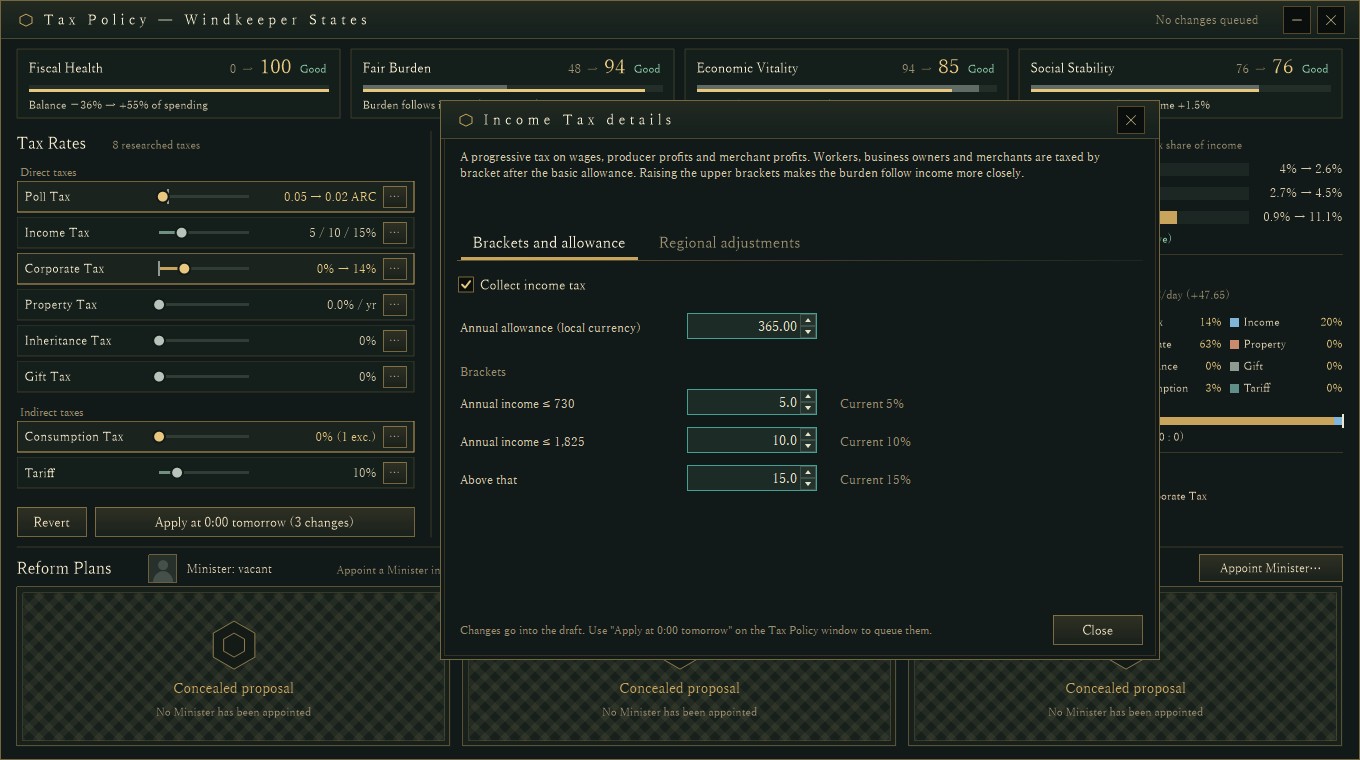
Income tax details in the same build: an allowance of 365, 5% up to 730, 10% up to 1,825, and 15% above that.
About these images and numbersAll images were captured for verification in a development debug build. The fully researched taxes, the Minister's ability and the drafted rates were set by a capture script to check the screen. In normal play, taxes are unlocked through research and Ministers are chosen from your own country's people. Country names, character names, rates and the score formulas are all still being tuned.
How the national budget itself is planned was covered earlier: DEVELOPMENT SNAPSHOT #46 — The January Budget: Planning Room for Next Year
Previous article: DEVELOPMENT SNAPSHOT #64 — A Research Tree You Can Read: Faster Opening, Visible Links, and Why You Can't Reserve
Check the currently available files and development status on the download page