DEVELOPMENT PLAN #83 — The Ruler's Charge: Quarterly Goals from the Head of State
Contributed by: Takeshi Miyaoka on Thursday, November 05 2026
Last modified on Thursday, November 05 2026
This is a development plan article about something we would like to build next. Nothing described here is implemented yet; the ideas are still under consideration and may change before they are built.
With today's work, a country's domestic policy now follows its head of state's personality, and the National Analysis chart under the calendar at the top right of the map shows the country's current state together with the head of state's goals. For now, though, those goals are only something to look at. Tonight we look at an idea where the head of state reads the gap to those goals and sets a charge every quarter, and meeting or missing it changes the head of state's approval. It has been filed as improvement item DOM-041.
Where things stand: goals are visible, but nothing happens yetNational Analysis is a pentagon chart of five items — Living, Stability, Industry, Finance and Faith — each scored 0–100 and graded S to E. Since today's change it always overlays the country's current state (a green line with a light fill) and the head of state's goals (a gold dashed line). The goals are defined for each of the 16 personality types; an ESTJ head of state, for example, leads a country that aims to "Restore Finances", targeting Finance 95 and Stability 90. The ruler of the empire in the image has a cautious, protective outlook and leads a country that aims to "Protect livelihoods"; right now Faith falls far short of the goal (grade E). 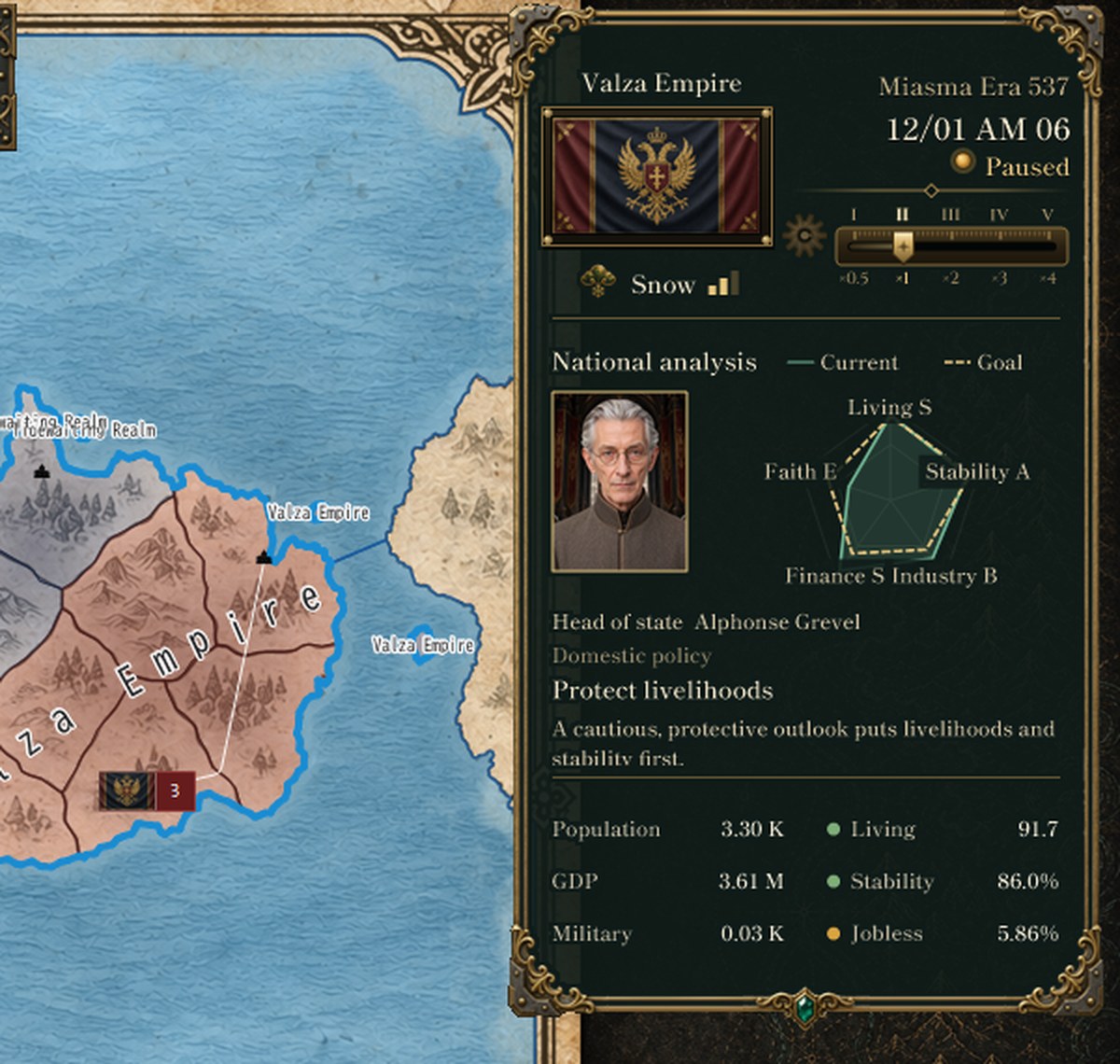
Image 1: the map screen of a development debug build (development version of November 5), captured with the verification procedure. Under the calendar at the top right are the head of state, the National Analysis chart and the domestic policy.
By specification, however, the goals are display-only: getting closer or drifting away changes no scores and nothing about the country. The chart shows the gap, but which item the head of state cares about most, and what to do by when, is left for the player to read.
What we want to make more interestingUnlike the officers who bring personnel and research proposals (#75), the head of state is not someone the player appoints. Still, a sense of "running the country under this ruler" would make the same country play differently depending on who leads it. By turning the dashed goal line into homework with a deadline, we would like budget, tax and welfare decisions to follow a clear thread: "this quarter, this is what we raise".
Idea 1: a "Head of State's Charge" every quarterAt 0:00 on the first day of each quarter (January, April, July and October 1), the head of state would pick the one item with the largest gap between goal and current value and set it as a charge.
- The charge: the current value plus half the gap, by at most 10. If Finance stands at 58 against a goal of 95, the charge is "Raise Finance 58 → 68".
- The deadline: the last day of the quarter. National Analysis under the calendar would highlight that item's axis in gold, mark the charge with a diamond, and show the days left and a progress bar.
- When there is none: if every item already meets its goal, no charge is set that quarter.
Capping the step keeps each charge to something reachable in three months, rather than asking for the whole goal at once. 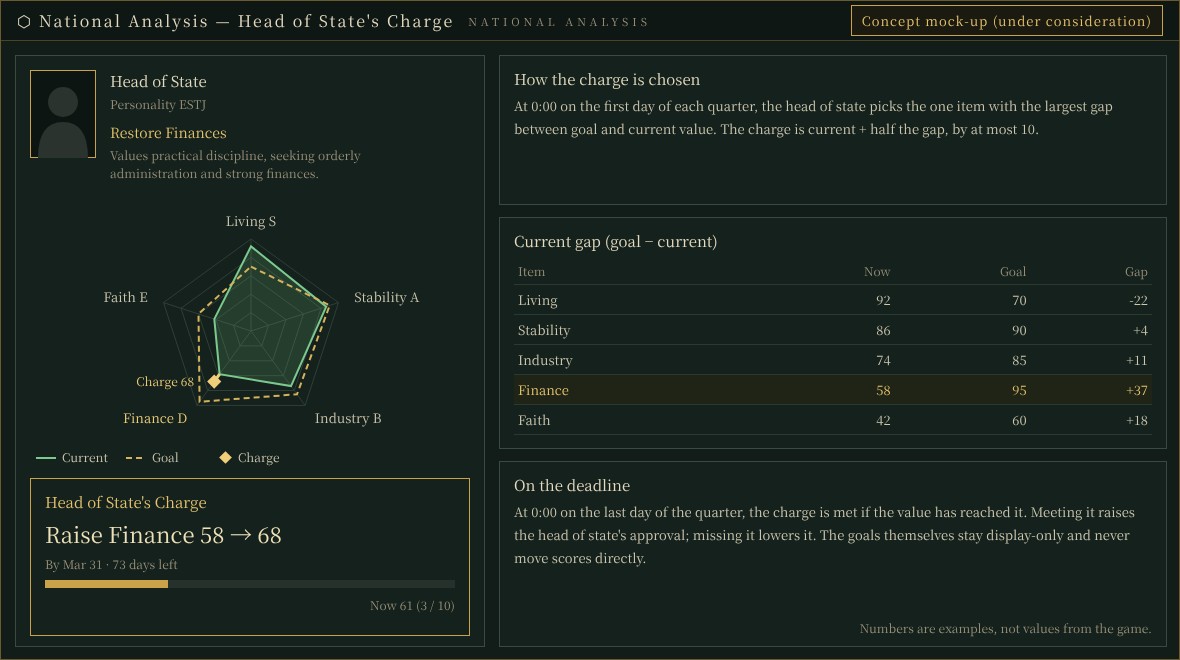
Concept mock-up (under consideration). Numbers are examples, not values from the game.
Idea 2: approval that moves with the resultOn the deadline, the charge is met if the item has reached the charge value, and missed if not; the head of state's approval (0–100, starting at 50 on taking office) would move by ±10. While approval is 70 or above, every region's target stability would rise a little; at 30 or below, it would fall a little. It would not create money or goods directly — just a quiet effect on how settled the country is.
Each new charge and each result would arrive as a notification with the head of state's portrait and a short remark, along with the last four quarters. The remarks would be prepared text for each personality and result. When the head of state changes, the approval and charge are discarded and the new ruler starts at 50. 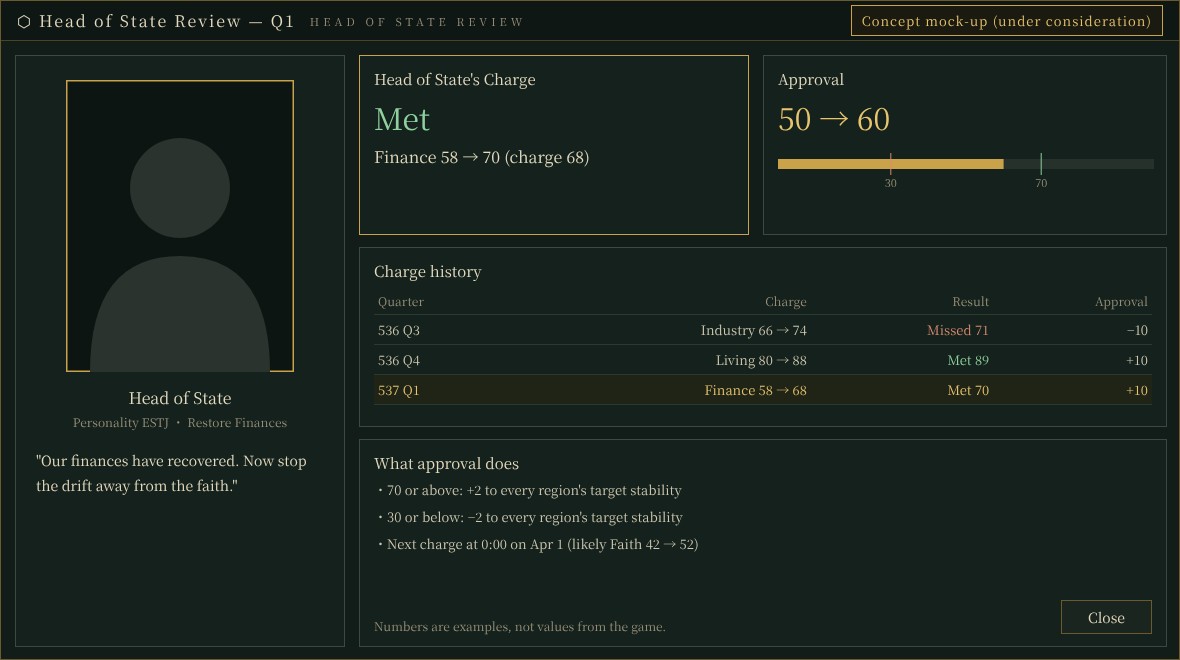
Concept mock-up (under consideration). The portrait is replaced with a silhouette; numbers are examples.
Implementation steps and how it connects to other systemsThe planned order is: (1) saving the charge and approval and judging them each quarter, (2) the adjustment to target stability, (3) the display under the calendar and the notifications (Japanese and English), and (4) tests that recalculating the same day never changes approval twice and that a change of ruler discards them. The checks run only on the first and last day of a quarter, once per country, so daily processing stays light.
This changes the current domestic policy rule that goals are display-only and have no effect, so the specification would be revisited when it is adopted. The ways to meet a charge are the systems that already exist or are being planned — the minister's budget and tax reform proposals (#80), a purse for welfare (#81) and more. We would like the charge to be the reason to choose which of them to use this quarter.
Tell us what you thinkDoes a charge every quarter feel right, or would one bigger charge a year be more fun? And when charges keep being missed, should it lead to something heavier than lower approval — even a change of ruler? We would love to hear your thoughts.
Image 1 was captured from a development debug build with the verification procedure; images 2 and 3 are concept mock-ups (under consideration). Numbers are examples, not values from the game.
This morning: DEVELOPMENT SNAPSHOT #82 — Donuts on Both Sides: Rebuilding the Map HUD
Working with officers: DEVELOPMENT PLAN #75 — Trust in Your Officers: How You Answer Shapes Their Next Proposals
Previous plan: DEVELOPMENT PLAN #81 — A Purse for Welfare: A Social Security Tax on Wages
See the files currently available and the development status on the download page