DEVELOPMENT PLAN #127 — Contracting Out Public Services: Private Hands for Short-Staffed Clinics
Contributed by: Takeshi Miyaoka on Friday, November 27 2026
Last modified on Friday, November 27 2026
This is a development plan: it describes something we would like to build next. None of the mechanics below are implemented yet, and the details are still under consideration and may change.
Government offices, storage warehouses, clinics and schools are "state service facilities": the state builds them and the state hires their staff. In the facility screen, the Installations panel has a bar for the state and private shares, but today it always reads "State 100%". That bar was kept for the day part of the public services could be handed to private operators. Tonight's plan is that "contracting out": paying a private business to run a clinic that cannot find enough staff. We have added the ideas below to improvement item ECO-011 (contracting out part of the public services).
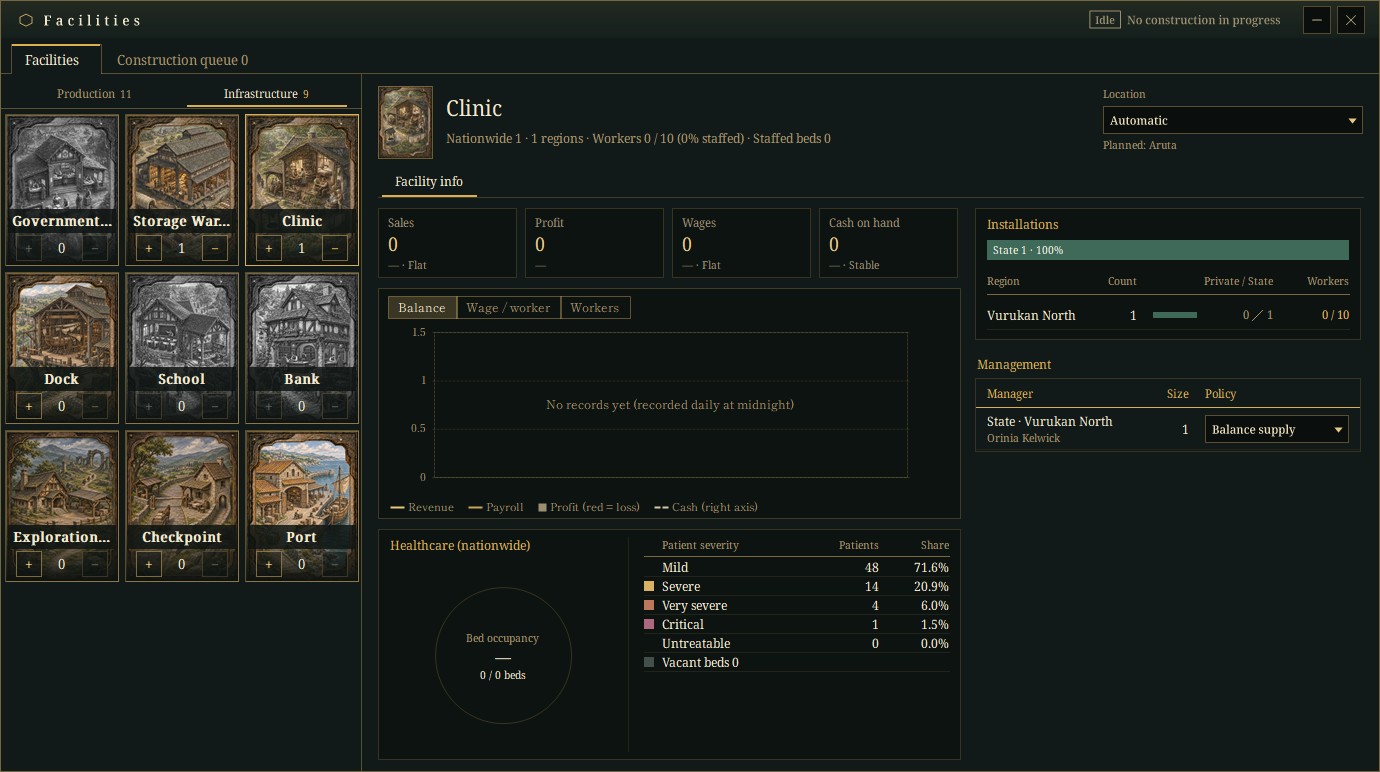
Image 1: The clinic in today's facility screen (captured from the November 23 main Debug build, launched without showing a window, right after starting a new game, so there are no records yet). The Installations panel at the top right has a bar for the private and state shares, but this service facility reads "State 1 · 100%", and the management table has only the state row.
Where things stand: the state builds service facilities and hires their staff- Service facilities do not make goods to sell. They give the country administration, storage, medical care or schooling. They have no sales, and the state pays their wages.
- Their job openings follow the state split: 85% main workers, 13% state supervisors and 2% state sales staff. Government offices are the exception: the first post in each office is a noble director, and the rest are noble posts and the civil-servant posts opened up by research.
- What a service facility achieves depends on how fully it is staffed. A clinic's effective capacity, for example, is "nominal capacity × min(staffing rate, medicine rate)": with half the staff, it treats half as many patients even with plenty of medicine.
- Openings at workplaces tied to scarce resources are filled first, and among equals the best-paid go first. In provinces short of workers, service posts can end up last in line.
When a service facility cannot fill its posts, the player can only wait or, for government offices, revise the staffing limit. Private businesses can recruit through their own job openings, but there is no way to let them run a public service. The private side of the Installations bar stays empty.
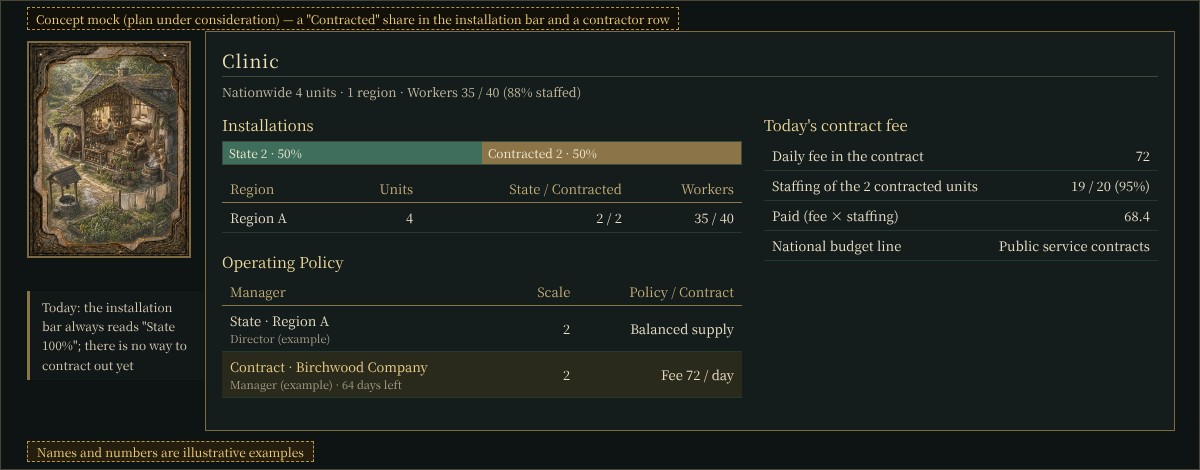
Image 2: Concept mock (plan under consideration). The facility information after contracting out 2 of 4 clinics. The Installations bar shows the state and contracted shares in two colors, the operating policy table gains a contractor row (business, days left on the contract, fee), and the right side shows today's fee (daily fee, staffing, amount paid). Only the clinic card on the left is game art; the rest is a mock. Names and numbers are illustrative examples.
Idea 1: a contract to run, not to own- For each province and facility type, we would like the player to choose how many state units to contract out and for how long (30, 90 or 180 days). The state keeps ownership; only the running of the units is handed over.
- In government offices, the director's post (a noble) stays with the state and only the other posts can be contracted out. Military facilities are excluded.
- Workers at contracted units are hired through the contractor's private job openings and counted as private employment. The service they provide (care, storage, administration and so on) counts with the same formula as state staff.
- Unlike selling a facility outright (plan #113, ECO-008), the units return to the state when the contract ends.
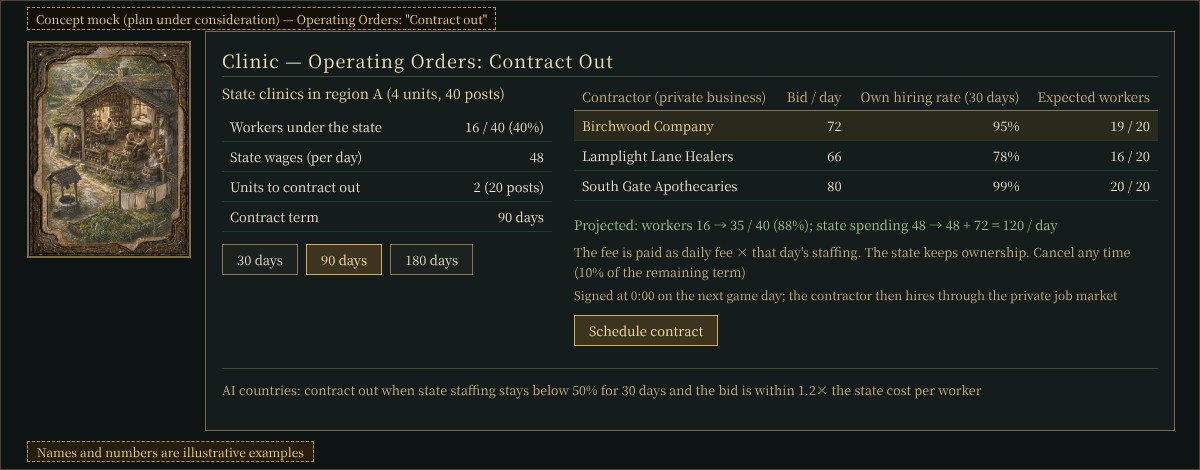
Image 3: Concept mock (plan under consideration). The "Contract out" operating order. In this province the state fills only 16 of 40 posts, and 2 units (20 posts) are being contracted out for 90 days. Bids from three private businesses are listed with each one's own hiring rate over the last 30 days and its expected workers. Only the clinic card on the left is game art; the rest is a mock. Names and numbers are illustrative examples.
Idea 2: compare bids and choose a contractor- Up to three private businesses in the province (not idle or being wound up) submit bids. The idea for a daily bid is "posts contracted × the province's private daily wage × (1 + overhead)", with overhead between 10% and 25% depending on how cautious the manager is.
- Next to each bid we show how well that business fills its own openings (staffing rate over the last 30 days) and the workers it is expected to bring. We would like the choice to be between a cheap contractor that struggles to hire and a dearer one that delivers.
- In the example in image 3, paying Birchwood Company 72 a day is expected to raise the workers from 16 to 35 (88%), while state spending rises from 48 to 120 a day.
- The fee is paid every day as "daily fee × that day's staffing of the contracted units", so days with empty posts cost less. It appears in the national budget as a "public service contracts" line.
- A contract ends when its term runs out (with a notice 7 days before, and no automatic renewal), and the player can cancel at any time (paying 10% of the remaining term as a penalty, in the current idea). It also ends if the contractor goes idle or is wound up, or if the state fails to pay for 3 days in a row. The posts at returned units go back to state job openings.
- AI countries would contract out for 90 days when state staffing stays below 50% for 30 days and the cheapest bid is within 1.2 times the state's cost per worker.
- A record of each contract (province, facility, units, term, contractor, daily fee), with signing, expiry and cancellation at 0:00.
- Job openings for contracted units under the private split, and the service counted from their workers with the state formula.
- Daily bids and how candidate contractors are chosen.
- The pay-for-results fee and the "public service contracts" budget line.
- The facility screen in Japanese and English: the Installations bar, the contractor row in the policy table, today's fee and the "Contract out" order.
- Contracting by AI countries, and checks that contracts and payments are never doubled after saving and reloading or replaying a day.
This comes after the government office staffing review (ECO-010, now awaiting the owner's approval). It is separate from the business accounts of state production (plan #125, ECO-013): contract fees are paid from the national budget. The daily cost grows only with the number of contracts, and contract and payment records are kept for 30 days. The numbers (30 to 180 days, 10 to 25% overhead, a 10% penalty, the AI's 50%, 30 days and 1.2 times) are still being considered.
Tell us what you thinkWould you pay a private business to run an understaffed clinic, or keep it public and wait for staff? Which public services would you like to hand over, and which should the state keep for itself (tax collection at government offices, say)? We would love to hear from you.
About the imagesImage 1 is the actual game screen. Images 2 and 3 are mocks that explain the plan; they are not game screens. Only the clinic card inside the mocks is game art.
Related posts: the tax chart and staffing limits of government offices in #122, the plan to sell state facilities in #113, the plan for state business ledgers in #125, and this morning's port managers in #126.
See the downloads page for released files and development status