
DEVELOPMENT PLAN #113 — Selling the State Factory: Privatization by Auction
- Friday, November 20 2026
- Contributed by: Takeshi Miyaoka
- Views: 18
This is a plan article introducing something I would like to develop. Nothing described here is implemented yet; the ideas are still under consideration and may change before they are built.
Tonight's plan is privatization: selling facilities owned by the state to private buyers. When the budget is tight, a state factory could be put up for auction and handed to the trading house or capitalist who bids the most. The treasury gets the money and sheds the wages and repair costs, but it can no longer run that factory by state policy. I would like to add that choice between cash today and industry held by the state. The idea is tracked as improvement item ECO-008 (selling state facilities to the private sector).
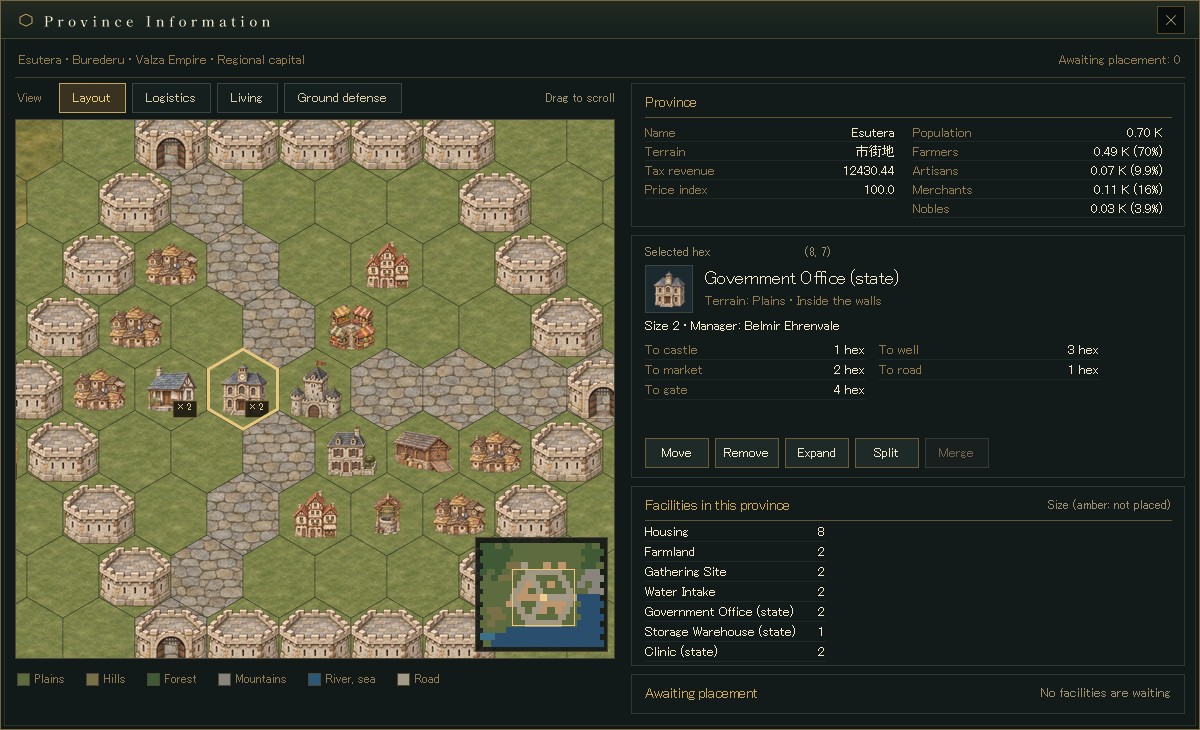
Image 1: The current game screen. A state Government Office (size 2) is selected on a regional capital's city map. The panel shows its manager and the Move, Remove, Expand, Split and Merge actions.
Where things stand: state and private run separatelyEach facility type in each province has a state-owned size and a private size.
- State facilities run under state operating policy, and each has a manager appointed by the state. Yesterday's update (item WLD-021) lets state facilities be split into, or merged from, management units, and the city map places one hex per unit (Image 1).
- Private facilities are run by a business per province and facility type. Each business has an owner-manager (a capitalist) who keeps part of the profit as retained earnings and takes the rest as owner funds. Managers have an optimism and a caution trait, and a business can expand with a bank loan (#72).
- The business rules say the same person never owns more than one business.
Moving facility size between state and private exists only in the developer master data editor. In the game, a state facility, once built, cannot be sold.
What is missing: the state cannot let goAfter a state facility is built, its wages, operating costs and repairs simply keep falling on the treasury. Even with a running deficit or growing bonds, the state cannot turn the asset into cash. On the private side, a growing trading house has no way to buy a state factory and expand. I would like the game to offer the familiar historical move of selling state works to private hands to repair public finances.
The plan: announce the sale, then a 7-day auction- Unit of sale: one state management unit at a time. A Sell off action on the state facility hex of the city map and on the facility screen row lets the player choose a rate (50-100% in 10% steps) and announce the sale.
- Minimum price: book value × rate. Book value works as for private facilities: the acquisition cost, reduced a little every day over the useful life.
- Bidding: private businesses of that country (including those in other provinces and of other facility types) and capitalists may bid for 7 days. A bidder's limit is its cash plus the extra amount it could borrow as a bank facility loan.
- How bids are set: what private facilities of the same type earned per unit per day over the last 30 days (operating profit) × size × 365 days, times an optimism factor (0.8 + 0.4 × optimism). Optimistic managers bid higher, up to their funds limit. Bids below the minimum price do not count.
- Award: at 0:00 on the closing day the highest bidder wins. The money goes to the treasury and the size moves from the state to the winner's business. Workers keep their wages, and the hex on the city map stays where it is with a new owner. State stock is not part of the sale; it moves to the national warehouse.
- No sale: without a bid at or above the minimum, the unit stays state-owned and can be announced again at a lower rate.
- Excluded: military facilities such as barracks, arsenals, air-defense sites and docks, and units that are out of order, reserved for construction or removal, occupied, or in a province at war on the ground.
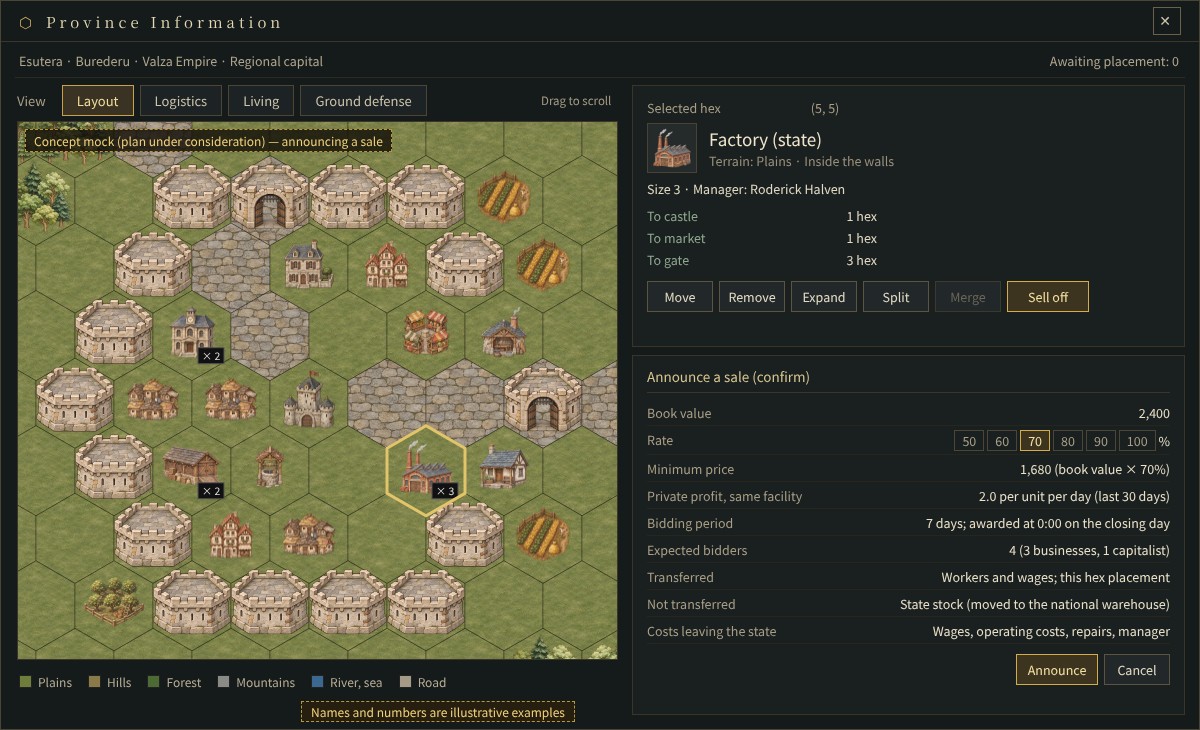
Concept mock (plan under consideration). A state Factory (size 3) is selected and Sell off has opened the confirmation. At a 70% rate, a book value of 2,400 gives a minimum price of 1,680. Names and numbers are illustrative examples, not the game screen (the buildings use the game's city-map images).
The plan: showing the resultAfter the close, I would like to list who bid and how much. In the mock, a factory earns 2.0 per unit per day, so a year of size 3 is 2,190. Grain Trading House, with optimism 0.75, offers 2,190 × 1.1 = 2,409, which fits within its funds limit of 2,700. Norden Trading House, with optimism 0.10, is capped at its funds limit of 1,400, below the minimum price of 1,680, so its bid is invalid. Of the winning 2,409, the 1,209 its cash cannot cover is paid with a bank loan.
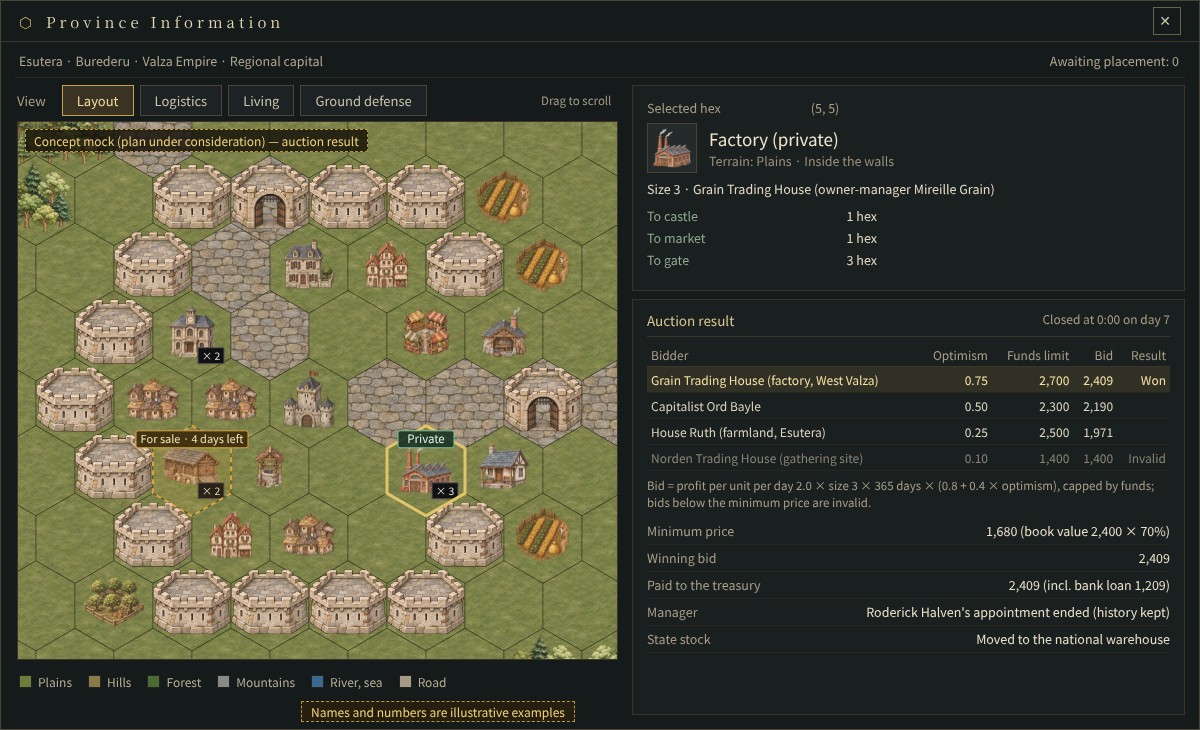
Concept mock (plan under consideration). After the close, the same hex has become a private factory, and the panel lists the bids and the payment to the treasury. The storage warehouse on the left carries the mark of another unit on sale (4 days left). Names and numbers are illustrative examples.
AI countries, and what changes in the specificationAI countries would sell too. The idea is that when a budget deficit persists, or bonds exceed 80% of the issue limit, the country announces its least profitable non-military state unit over the last 30 days at a 70% rate, at most one a month. I would like a world where a country in fiscal trouble lets factories go and its trading houses grow.
This plan relaxes the business rule that one person owns at most one business, only for businesses won at such an auction, so that a trading house can buy a factory in another province. Each owner keeps one pool of owner funds, which receives dividends and pays for bids.
Implementation steps and how it fits with other systems- Preparing book values: of the 24 facility types in the current initial master, only 7 (school, bank and five air-defense sites) have an acquisition cost; mines, farmland, workshops, factories and others are still 0. That would make the minimum price 0, so the first step is to fill in acquisition costs and useful lives for the facilities that can be sold.
- Announcement and bidding: management units (WLD-021) become the unit of sale, and a unit on sale cannot be split, merged, moved or removed. Bidder candidates come from the day's business and capitalist indexes, so the 0:00 daily processing does not rescan every business.
- Settlement: the payment, size, business, facility asset, end of the manager's appointment, transfer of employment and the hex owner are settled together, exactly once under a fixed ID, so saving and reloading never counts a sale twice.
- Screens and AI: the confirmation, the on-sale mark and the result on the city map and the facility screen, then the AI conditions for announcing a sale.
Work would start after the split and merge of state management units (WLD-021) settles. The numbers (rate range, 7-day period, the bid formula, the AI conditions) are current proposals and will be checked again before implementation.
Tell me what you thinkDoes selling a state factory to repair public finances sound like an interesting choice to play? I would also like to hear about the bid list and the rule that optimistic managers pay more. And would you use the reverse, the state buying out a private factory (nationalization), if it existed?
About the imagesImage 1 is the actual game screen, captured by starting the Debug build without showing it on screen and opening the city map from the initial master data (no player save was used). Images 2 and 3 are mocks that explain the plan and are not the game screen. The buildings use the game's city-map images; the Sell off action, the announcement panel, the auction result and the private and on-sale marks were drawn for the mocks.
Related articles: DEVELOPMENT SNAPSHOT #110 — From Plan #109 to the Game: The Capital City Map, DEVELOPMENT SNAPSHOT #104 — Facilities at a Nationwide Glance: One List, Queue Cards, Named Houses, DEVELOPMENT SNAPSHOT #72 — From Plan to Build: Bank Loans Let Private Owners Expand
Check the files currently available and the development status on the download page