
DEVELOPMENT PLAN #125 — State Business Ledgers: Funding a Workshop That Ran Dry
- Thursday, November 26 2026
- Contributed by: Takeshi Miyaoka
- Views: 22
This is a development plan: it describes something we would like to build next. None of the mechanics below are implemented yet, and the details are still under consideration and may change.
Today (November 26), state production became self-financing. State mines, workshops, factories and the like now hold a business account for each province and facility type: sales come in, inputs and wages go out, and whatever is left goes to the treasury. None of this is visible on screen yet, and once an account runs dry the state has no way to put it back on its feet. Tonight's plan is to show a "ledger" for state businesses on the facility screen and let the state add capital to the ones that run out of cash. We have filed it as improvement item ECO-013 (state business ledgers and additional capital).
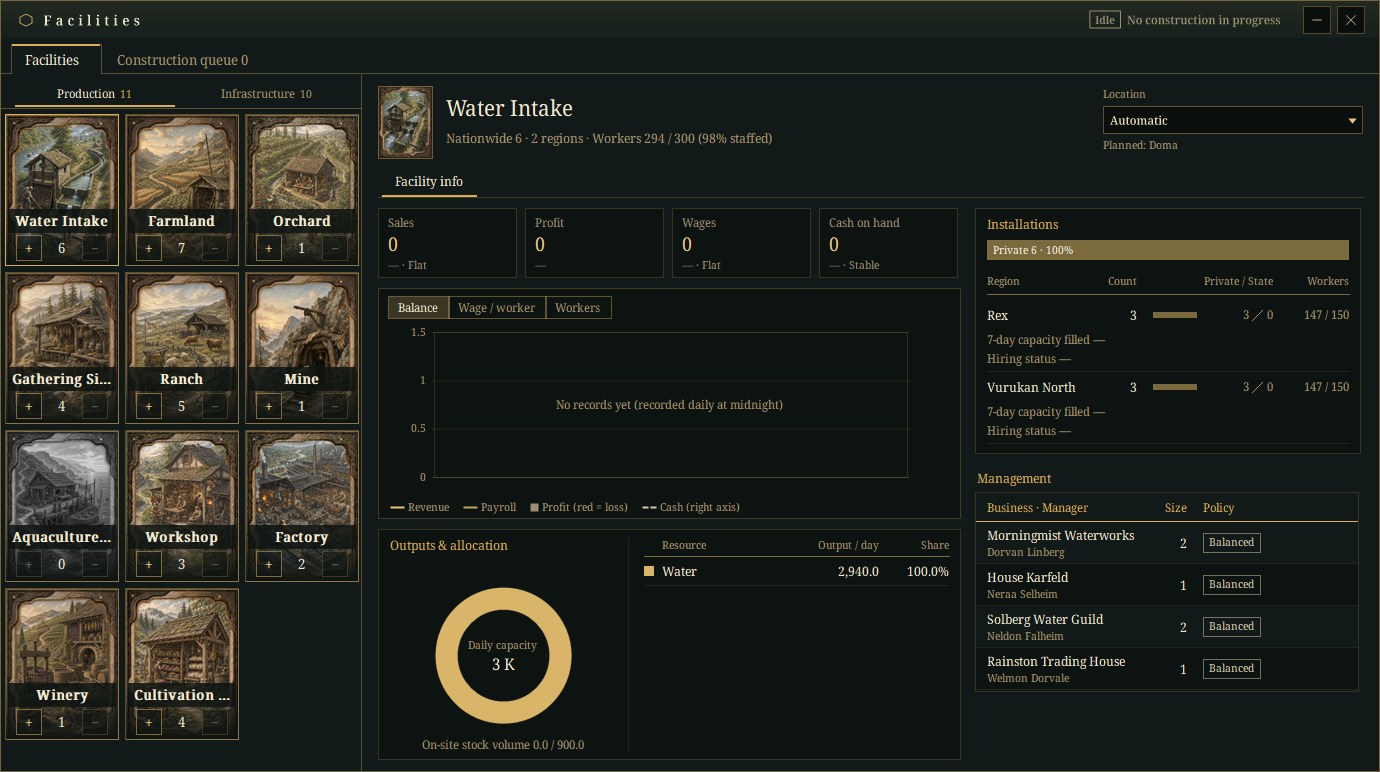
Image 1: the facility screen today (a Debug build of main from November 25, started without showing a window, right after a new game, so nothing is recorded yet). There are cards for sales, profit, wages and cash on hand, and an earnings graph, but "cash on hand" covers private businesses only. State account balances and remittances to the treasury appear neither here nor anywhere else.
Where things stand: state businesses got their own purse- As of today, every state production facility has a dedicated business account per country, province and facility type. When it opens, the treasury funds it once with working capital equal to that day's planned inputs and wages.
- Sales are paid into the account, and inputs, haulage and wages are paid out of it. The account keeps a reserve of one day's wages at full staffing plus one day's inputs, and remits anything above that to the treasury the same day. Accounts with unpaid wages skip the remittance.
- State production allocation (supply-and-demand mode) now also sizes its purchases to what the account can actually afford.
- However, an account that has been funded once is never funded again, even if its balance reaches zero.
When input prices rise or sales fall, the account shrinks, purchases are cut, output drops and wages go unpaid. The only way back is through sales; even with cash in the treasury, the state cannot step in. Nor can the player see which state businesses are filling the treasury and which are about to stall (the region view shows an estimated state business balance, but not the accounts of individual businesses).
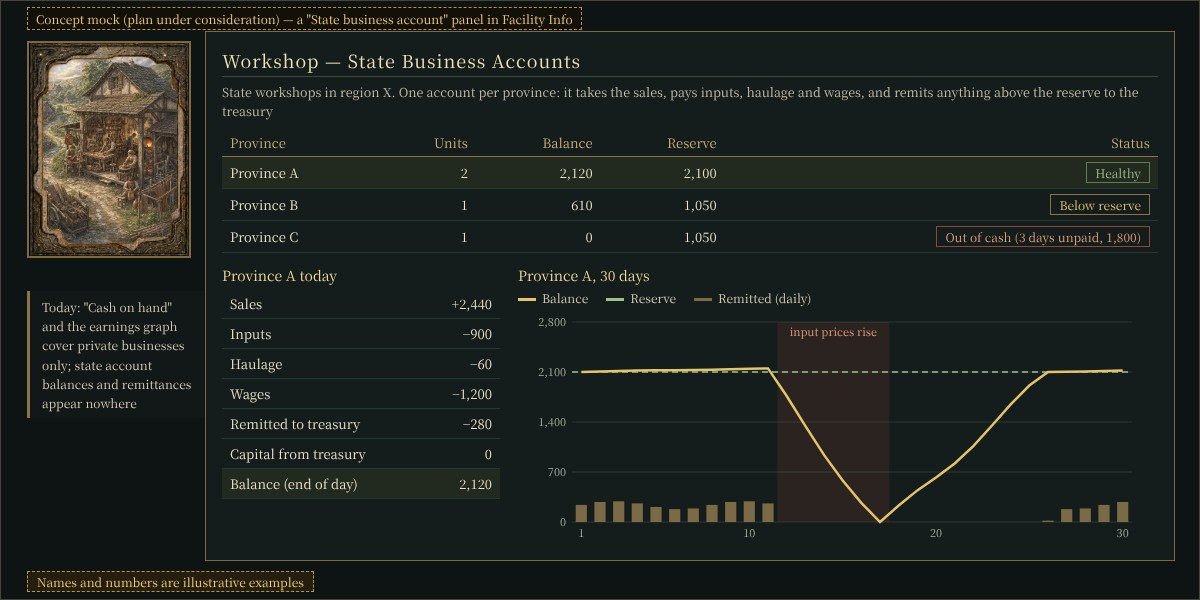
Image 2: concept mock (plan under consideration). A "State business accounts" panel in Facility Info, with each province's balance, reserve and status, the selected province's movements for the day, and 30 days of balance and remittances. The workshop picture on the left is the game's card art; everything else is a mock. Names and numbers are illustrative examples.
Idea 1: a ledger on the facility screen- For facilities with state units, we would like Facility Info to show a "State business accounts" panel: one row per province with units, balance, reserve and status. Status is Healthy (balance at or above the reserve), Below reserve, or Out of cash (wages unpaid, with the number of days and the amount).
- Selecting a row shows the day's movements (sales, inputs, haulage, wages, remittance to the treasury, capital from the treasury, end-of-day balance) and 30 days of balance and remittances.
- The data would ride on the existing facility operating record (daily, weekly and monthly buckets kept for 30 days, 12 weeks and 7 months) as three extra values, so no new history is added.
- Example: two state workshops selling 2,440 a day with 900 of inputs, 60 of haulage and 1,200 of wages keep a 2,100 reserve and remit 280. During six days when inputs rise from 900 to 1,500, they run at a loss: the balance falls from 2,100 to almost nothing and remittances stop.
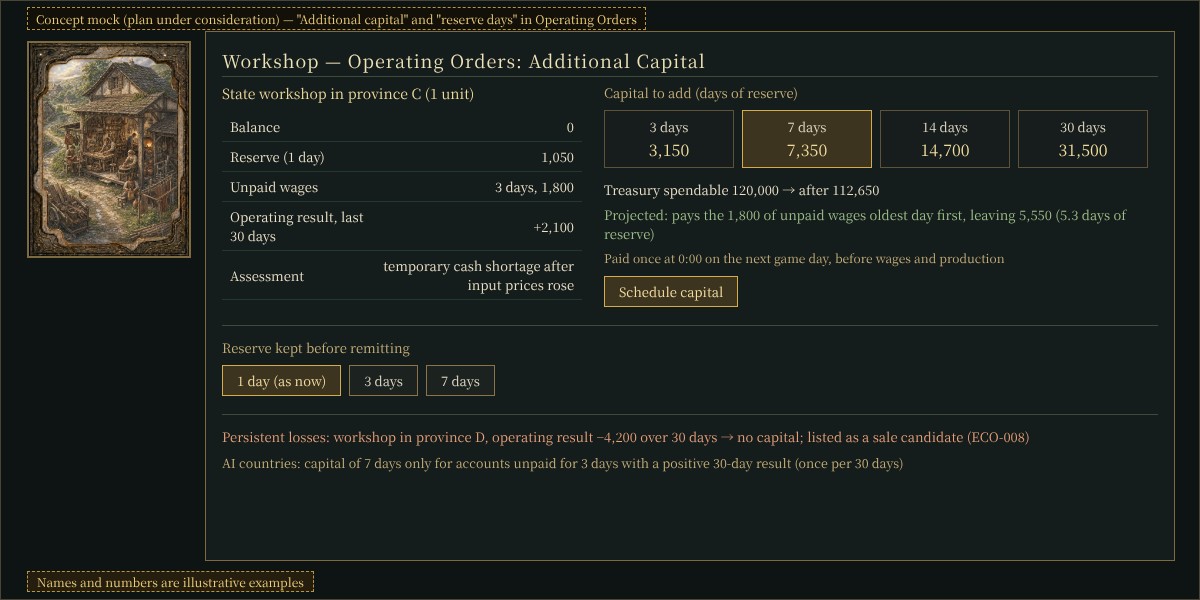
Image 3: concept mock (plan under consideration). "Additional capital" and "Reserve kept before remitting" in Operating Orders. Adding seven days of reserve to the cash-starved workshop in province C would pay its unpaid wages oldest day first and leave the rest in the account. The workshop picture on the left is the game's card art; everything else is a mock. Names and numbers are illustrative examples.
Idea 2: additional capital, and how much to keep before remitting- We would like Operating Orders to offer "Additional capital": pick a province's account and an amount of 3, 7, 14 or 30 days of reserve. The capital would be paid once at 0:00 on the next game day, before wages and production, within what the treasury can spend; if there is not enough, nothing is paid and the player is told why.
- The new cash first goes to unpaid wages, oldest day first. This depends on improvement item FIN-027 (paying state wage arrears one day at a time) being done first.
- The reserve kept before remitting could be set to 1 day (as now), 3 days or 7 days. A thicker reserve copes better with price spikes, at the cost of slower income for the treasury.
- Businesses with a negative operating result over the last 30 days (sales minus inputs, haulage and wages) would be flagged as running persistent losses and become candidates for sale (plan #113, improvement item ECO-008). The player chooses whether to put money in or sell to private owners.
- AI countries would add seven days of capital only to accounts with three days of unpaid wages and a positive 30-day result (a temporary shortage), at most once per account every 30 days. Accounts losing money over the month get nothing.
- Three values in the operating record (state account balance, remittances, capital) and the status rules.
- The ledger panel in Facility Info (Japanese and English).
- Scheduling additional capital, paying it at 0:00 and applying it to unpaid wages.
- The number of reserve days kept before remitting.
- Conditional capital for AI countries, the loss flag and the link to sales (ECO-008).
- Audit and save/reload checks, and tuning the numbers with long-run simulations.
This changes an adopted rule ("an account funded once is never funded again"), limited to capital the player explicitly adds and the AI's conditional capital. The daily work would scale with the number of accounts (provinces × facility types), and the ledger panel is built only when the screen is opened. Replaying a day or saving and reloading must never pay the same capital twice. The numbers (1/3/7 reserve days, 3–30 days of capital, the AI's 3 days, 7 days and once per 30 days) are proposals.
Tell us what you thinkWould you rather rescue a cash-starved state business from the treasury, or sell it while it is still losing money? If there are other numbers you would want in a state business ledger (input price trends, earnings per worker and so on), please let us know.
About the imagesImage 1 is the actual game screen. Images 2 and 3 are mocks that explain the plan, not game screens; only the workshop card art in them comes from the game.
Related posts: the plan for selling state facilities is #113, the facility output donut is #116, this morning's dock screen is #124, and last night's plan is #123.
See the downloads page for released files and development status