
DEVELOPMENT SNAPSHOT #58 — Building a School Is Only the Start: Allocating Seats for Literacy and Research
- Sunday, October 18 2026
- Contributed by: Takeshi Miyaoka
- Views: 6
Building schools does not automatically mean that learning is taking place. In Ashwind Chronicle, each campus earns effective seats when it reaches the midnight operating step with teachers, paper, and funding in place. You can also decide how those seats are divided between primary education and specialist education or research. This snapshot follows the real Debug screens to show the system between “a school exists” and “people can learn.”
These are QA screen examples captured from the actual Debug build. The campus counts and states are test data, not values from a normal save.
Unlocking construction is only the first stepPublic Education Lv1 unlocks individual school construction, but researching the policy does not create a building by itself. A construction reservation is still needed before a campus can become part of a region’s education capacity. In the first screen, the school tab explicitly shows that no campus exists yet—keeping the policy requirement separate from the presence of a school.
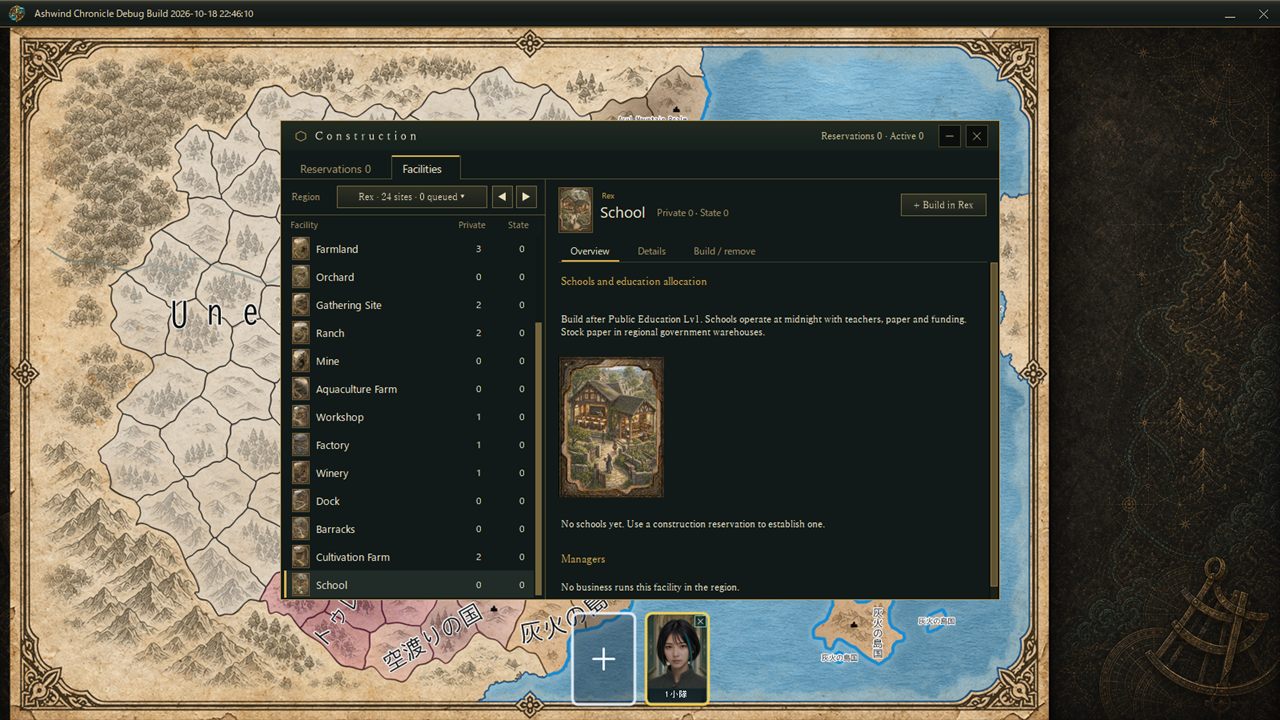
Debug screen: a region with no school yet. Unlocking the policy does not create a campus automatically.
A campus must then reach the midnight operating step with teachers, paper in a regional government warehouse, and operating funds available. If teachers are missing, paper has not arrived, or funding is insufficient, its seats do not count as active education capacity for that day. The Debug view distinguishes stopped campuses, those awaiting the next midnight operation, and those suspended for missing materials.
One seat cannot be counted twiceEach operating campus has capacity for its level. Its detail panel lets you set the share reserved for primary education. The remainder can serve specialist education and research; the same seat is not counted once for literacy and again for research. Higher campus levels open more advanced stages, but upgrades require the matching Public Education level—and levels 3 and above also require Vocational Education Lv1.

Debug screen: a QA example with several campus states, showing active, stopped, pending, and materials-short campuses separately.

Debug screen: the allocation control for a Lv5 campus. Set the primary-education share; the remainder serves specialist education and research.
From population structure to literacy and researchLiteracy is not a single flat bonus. The simulation starts from each region’s population structure, then calculates how much of the population not already literate is covered by effective school seats assigned to primary education. The resulting national literacy rate also feeds research speed and training/job-search efficiency. That makes a school decision about more than its construction cost: population by region, teacher employment, paper supply, funding, and seat allocation all matter together.
Schools are not a prerequisite for every basic policy or technology. They gate the higher education stages and selected research requirements, while basic public education and basic technology remain available without a campus. For a related look at how research capacity differs from realized production, see DEVELOPMENT SNAPSHOT #55.
A school is not a building that produces results the moment it appears. It is infrastructure that opens seats for learning only when people, materials, funding, and time come together. Next time you inspect a campus, look beyond its count: which region has effective seats, how many are available, and what kind of learning are they assigned to?