
DEVELOPMENT PLAN #73 — Banks Compete on Rates: Short- and Long-Term Prime Rates
- Saturday, October 31 2026
- Contributed by: Takeshi Miyaoka
- Views: 7
This is a development plan article about something we would like to build next. Nothing described here is implemented yet; the ideas are still under consideration and may change before they are built.
This morning's article (#72) showed bank equipment loans letting private owners add facilities. As the next step, this plan (improvement item FIN-022) would end the current "same rate from every bank" setup: each bank would publish its own lending rates, and banks would compete on them. 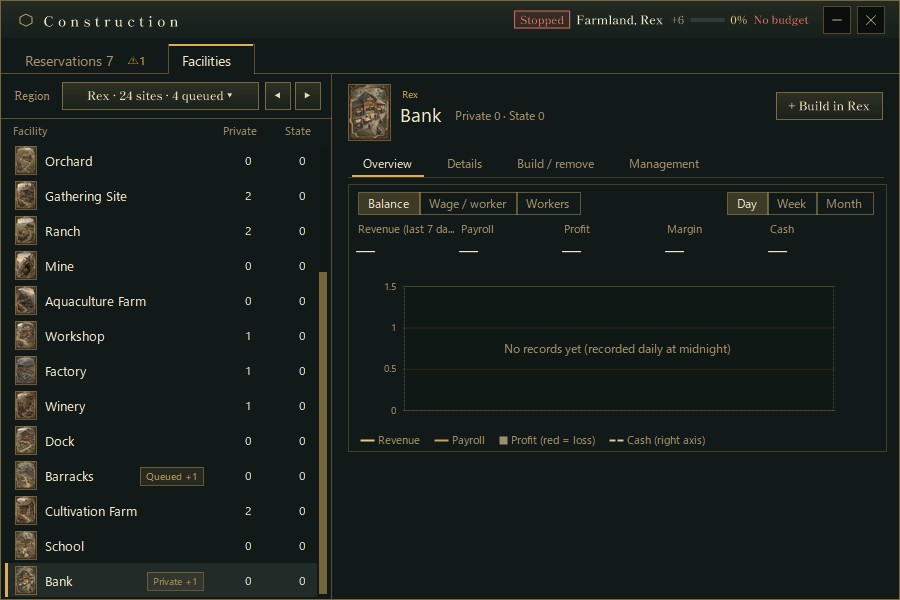
The construction screen today (captured for verification in a development debug build). Selecting Bank on the Facilities tab shows charts of revenue, wages and workers on the Overview, but there is no place to see what rate that bank lends at. Country, places and numbers come from a verification setup.
Today: the rate depends only on the state rate and creditToday an equipment loan's rate is the state rate (the discount rate, or for countries at monetary policy level 3 the 30-day average of the short-term rate) plus a credit spread based on the borrower's score (+1% for 0.8 or more, +2% for 0.6 or more). The lender is a bank in the same province, otherwise in the same region, with private banks first.
Banks, however, are not all alike. Banks with more room to invest (that want more deposits) offer higher deposit rates, and each bank has a different cushion above the minimum 8% capital ratio. None of that shows up in the loan rate today: every bank lends at the same rate, and there is no difference between short-term and long-term lending.
What we want to make more interestingIn countries where private banks have grown, we would like the differences in how banks raise money and how strong they are to show up as different lending rates. A bank paying high deposit rates would lend at higher rates; a bank with a comfortable capital cushion could lend cheaply. Borrowers go to the cheaper bank, so cheaper banks lend more and earn more interest. The goal is that you can follow, on screen, how a change in the state rate reaches businesses through each bank's rates.
The plan: banks publish two rates at the start of each monthWe are considering this: once private banks hold at least 50% of the deposits held by all banks and money changers in a country, every bank (state and private) publishes two rates at the start of each month. A country that has started keeps publishing even if the share later falls below 50%. Until then, rates are calculated as they are today.
- Short-term prime rate: the annual rate for loans of a year or less to the most creditworthy borrowers. Funding cost (the higher of the bank's deposit rate and the state rate), plus a 1% operating cost, plus a capital cushion charge (+1% at exactly 8% capital ratio, 0% at 16% or more, linear between), rounded up to 0.125%.
- Long-term prime rate: the rate for loans longer than a year: the short prime plus the bond term spread (the 5-year minus the 1-year bond rate) plus 0.25%.
For example, with a 3.00% state rate and a 0.60% term spread, a private bank paying 3.25% on deposits with a 14% capital ratio would have a 4.50% short prime and 5.35% long prime, while a state bank paying 2.50% with a 10% capital ratio would have 4.75% and 5.60%. The private bank pays more for deposits, yet its capital cushion lets it lend more cheaply. 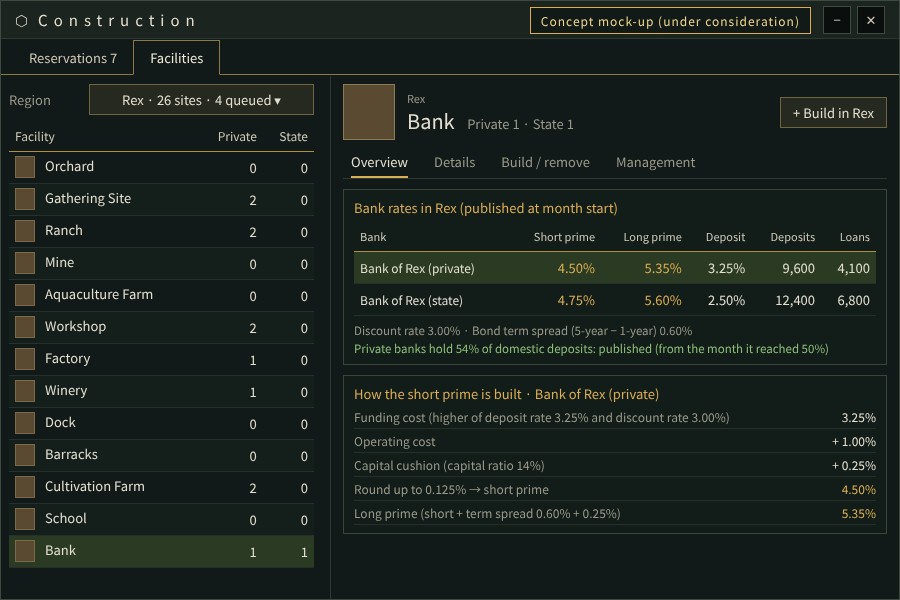
Concept mock-up (under consideration). The Bank overview would list each bank in the region with its short prime, long prime, deposit rate, deposits and loans, plus a breakdown of the short prime. The numbers are illustrative.
Borrowers choose the cheaper bankWe would like a loan's rate to be set at signing — the short prime for loans of a year or less, the long prime for longer loans, plus a credit spread (0% for a score of 0.8 or more, +1% for 0.6 or more) — and fixed in the contract. Today's equipment loans (365 days) would use the short prime. Borrowers would borrow from the cheapest bank in the same province (otherwise the same region), with private banks first at equal rates. 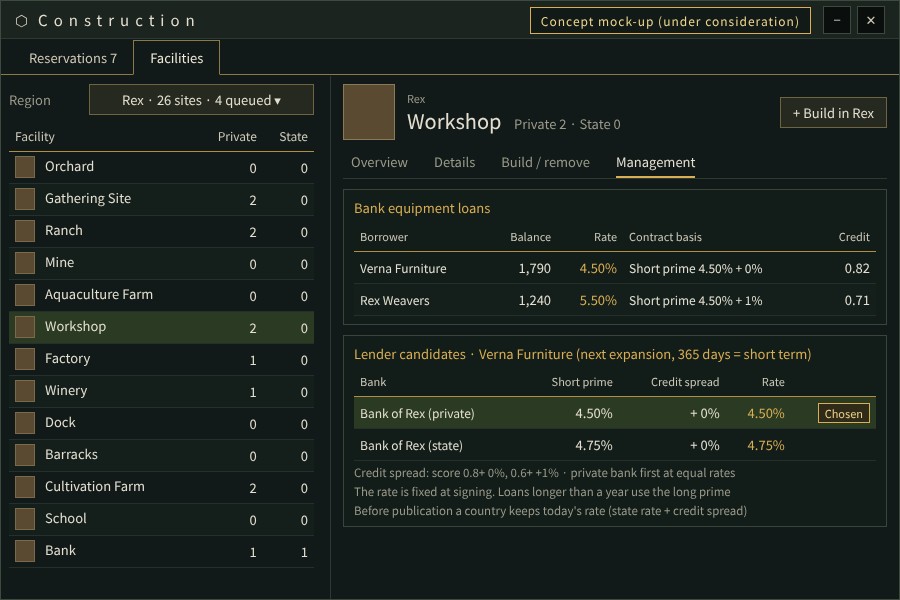
Concept mock-up (under consideration). The "Bank equipment loans" rows on the Management tab would show the contract basis (which prime rate plus how much), and an owner up for expansion would see the candidate lenders side by side.
Only each bank's short and long prime and the publication date would be saved; the history would go into the country's monthly records, with no daily history.
Steps, and how it fits with other systemsIts prerequisite, the interest-rate stages (FIN-021: standing lending, interest on reserves, the policy rate and the short-term rate), is already implemented, so this item is ready to start. The order we have in mind: (1) the publication condition and the short/long prime calculation, (2) switching the contract basis and choosing the cheapest lender, (3) the bank table on the Overview and the rows on the Management tab. Countries that have not started publishing keep today's calculation, and contracts already signed keep their rates.
Beyond this, long-term loans for larger expansions and banks competing for deposits are possible directions, but we would start with "each bank has its own rate, and you can see it on screen".
Tell us what you thinkHow far would you like to follow rate differences between banks on screen? Is the table enough, would you want the short prime breakdown, or would you rather learn "why this bank is expensive" some other way? Your feedback will help shape the screen.
Image 1 was captured for verification in a development debug build; images 2 and 3 are concept mock-ups (under consideration). Names and numbers are illustrative, not actual game values.
This morning: DEVELOPMENT SNAPSHOT #72 — From Plan to Build: Bank Loans Let Private Owners Expand
The loan plan: DEVELOPMENT PLAN #70 — Turning Deposits into Workshops: Bank Loans for Private Expansion
Where banks began: DEVELOPMENT SNAPSHOT #69 — When a Money Changer Becomes a Bank: Deposits, Discount Rate, Bonds
Check the download page for currently released files and development status