
DEVELOPMENT SNAPSHOT #88 — Watching the Sky: Ground Air-Defense Research, Guns and Emplacements
- Sunday, November 08 2026
- Contributed by: Takeshi Miyaoka
- Views: 21
Ground air defense, protecting the land from the sky, is now registered in the game as research, gun models and facilities: four research stages from Ground air observation to Integrated fortress air defense, five guns (fixed, mobile, fire-controlled and fortress), and five facilities such as observation posts and ammunition stores. Each of the nine new research cards also has its own artwork, and research cards were redesigned as "framed picture on the left, text on the right". 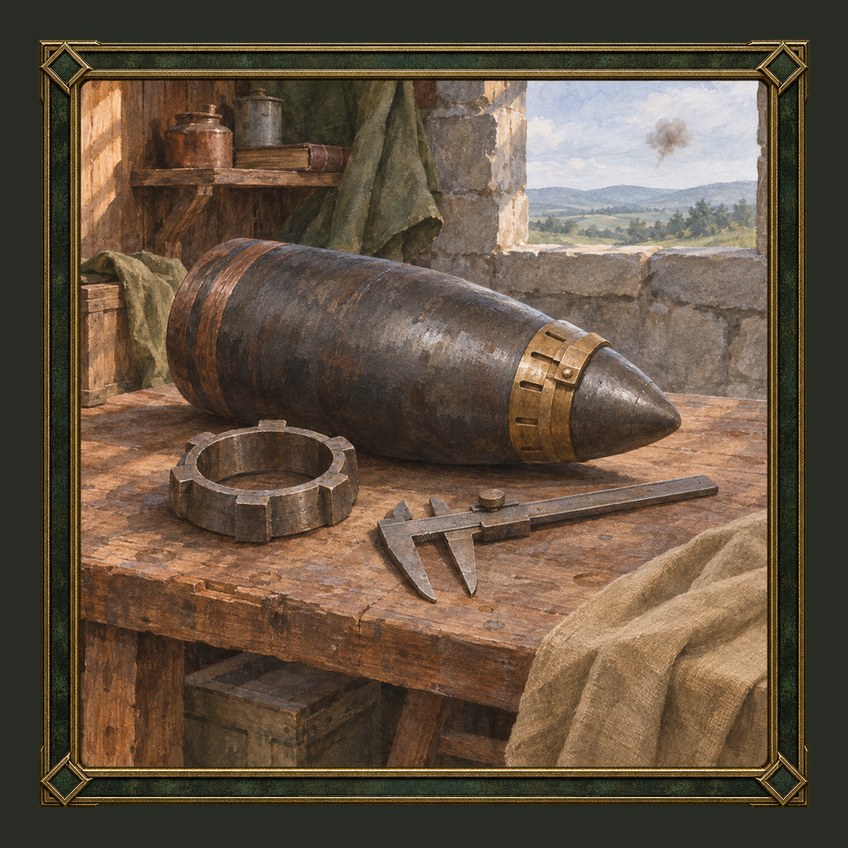
Card artwork for Airburst gunnery, the second research stage. The official repository image is shown with the shared research-card frame laid over it, the same way the game composes it at display time.
Four research stages, starting with "seeing"The ground air-defense research sits in the Weapons category of technology development, in this order. Maximum level 5, era start years, the penalty for researching ahead, and per-level cost and duration follow the same rules as other research.
- Ground air observation (initial era, base 12 days, 0.25 ARC per day)
- Airburst gunnery (early era, 24 days, 0.25 ARC)
- Predictive fire control (middle era, 48 days, 0.50 ARC)
- Integrated fortress air defense (late era, 84 days, 0.75 ARC)
The first stage is knowledge only and unlocks no gun by itself. The line runs from eyes on the sky to airburst shells, fire calculation, and finally coordinating a whole fortress.
Five gun models, each needing its own model developmentFive basic models shared by all four civilizations are registered. Production needs the matching research plus the model's own development (base: Tier 2, 20 days at 2 ARC per day; Tier 3, 40 days at 3 ARC; Tier 4, 60 days at 4 ARC).
- Fixed anti-aircraft gun (Tier 2): 20 work, iron 4, copper 1, timber 2, air attack 20
- Mobile anti-aircraft gun (Tier 2): 30 work, iron 5, copper 2, timber 3, air attack 14
- Fire-controlled fixed AA gun (Tier 3): 40 work, air attack 30
- Fire-controlled mobile AA gun (Tier 3): 60 work, air attack 21
- Fortress AA battery (Tier 4): 6 guns and at least 24 crew, 300 work, iron 48, copper 24, timber 18, air attack 180
Each gun needs a crew of four. The mobile guns cost more to make because of their carriage and towing gear, but they can travel with a platoon. The fortress battery combines six fire-controlled fixed guns and adds work and materials for dispersal and integration. 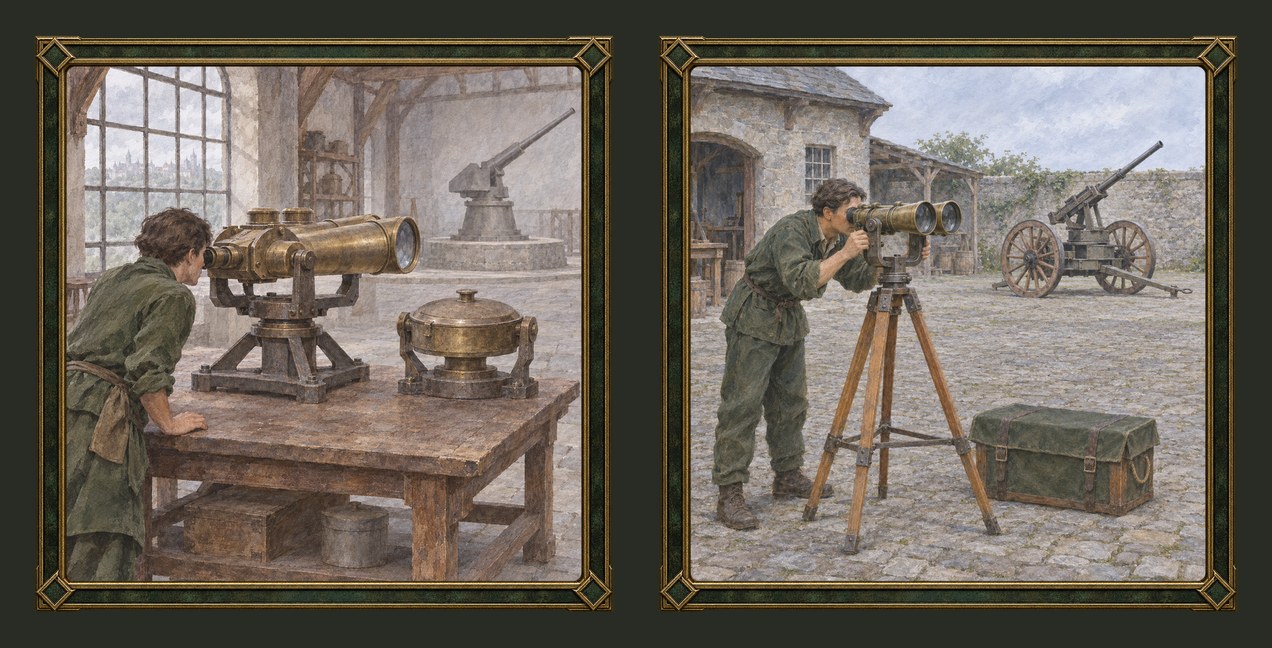
Card artwork for developing the fire-controlled fixed gun (left) and the fire-controlled mobile gun (right): checking the optical instruments that aim each gun.
Only mobile guns join a platoonA mobile gun can be chosen as one of a platoon's support equipment types (up to three per platoon). Fixed guns and the fortress battery belong to the "fixed deployment" class and never appear as squad or platoon support choices, so the same gun is never counted both in a city emplacement and in a platoon. The platoon window itself was covered in #76.
Improved fire control applies only to derived variants: about 10% more air attack and production work, plus one iron. It does not raise attack against ground targets, and equipment already built is not upgraded automatically.
Five facilities, and building them adds no gunsThe Construction screen now lists five facilities. In parentheses are the required research and the reference construction cost.
- AA observation post (Ground air observation, 20 ARC)
- AA ammunition store (Airburst gunnery, 30 ARC)
- AA command post (Predictive fire control, 40 ARC)
- AA emplacement (Airburst gunnery, 40 ARC)
- Fortress AA emplacement (Integrated fortress air defense, 240 ARC)
Emplacements and fortress emplacements list the observation post, ammunition store and command post as their components. Building a facility, however, does not grant guns, crew or ammunition. The Construction screen says so in Japanese and English, and facilities whose research is not finished cannot be built. Deploying guns, actually firing and damaging aircraft are not in the game yet. This step lays the groundwork: what to research, what to make, and where to build. 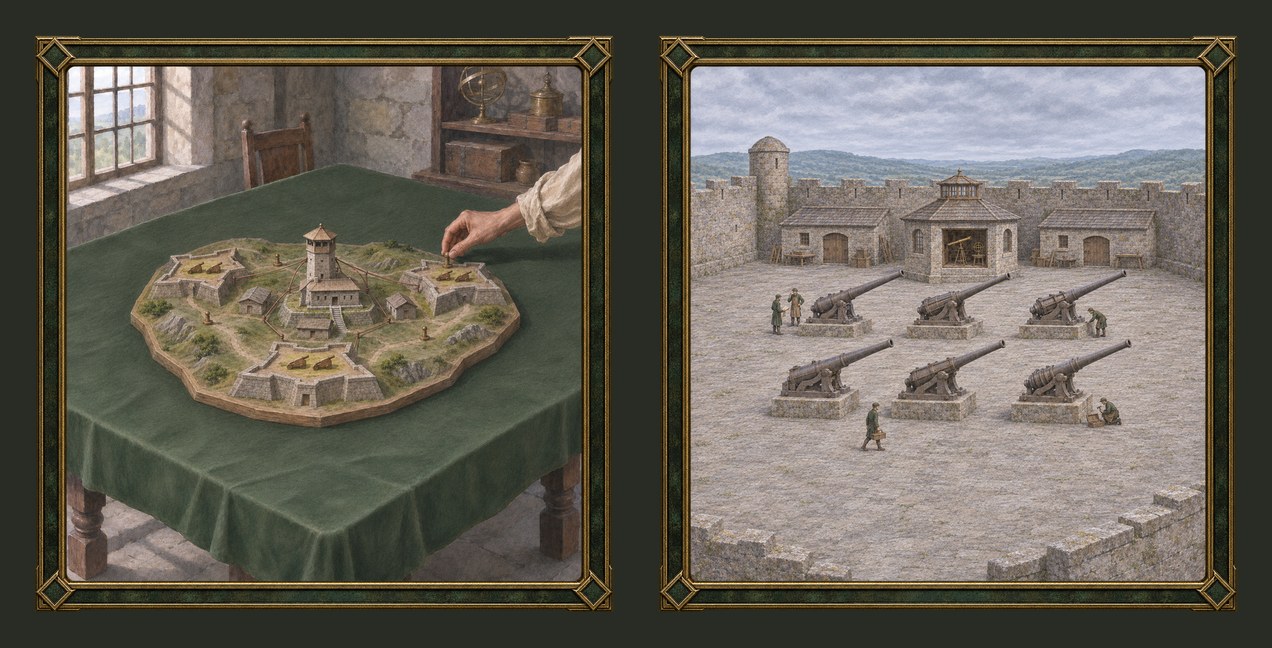
Card artwork for Integrated fortress air defense (left), a fortress model on a planning table, and for developing the Fortress AA battery (right), six guns in a test yard.
Registered without touching existing savesThe air-defense definitions are added when data is loaded. The registered version is saved, so reloading the same data never registers them twice. Research progress, equipment stock, deployments and facility counts are never increased, and production or construction is refused until the research is done. We also checked through the real game screens that merely opening the research and construction screens changes no research or stock.
Framed artwork on research cardsEach of the nine research items got its own artwork, with a separate subject for each: observation, airburst shells, a calculating machine, a fortress model, prototypes set up or towed, testing optics, and a six-gun test yard. The pictures contain no text; research names, durations and budgets are drawn by the game in Japanese or English.
The research card was also redesigned. A card is 360×176px with the whole framed picture, 128px square, on the left and the level, name, duration and budget on the right; the name and the duration/budget each wrap to two lines. Previously the picture was cropped as a wide card background, which could cut off its key part or put text over it. Now the picture is never cropped, and the shared research-card frame is laid over it at display time. Research without a picture uses the full card width for text and shows no empty frame. The research tree screen was covered in #64.
About the imagesThe images are six of the nine official air-defense research pictures registered in the repository, each composed with the shared research-card frame in the same layout the game uses at display time (picture inset, frame on top). They are not captures of the game screen. Numbers are the values calibrated at registration and may change with tuning.
Previous article: DEVELOPMENT PLAN #87 — Where Broken Gear Gets Fixed: Field Repairs and Rear Workshops
See the files currently available and the development status on the download page