
DEVELOPMENT PLAN #99 — Tariffs Collected at the Checkpoint: Trade Routes and Who Gets Through
- Friday, November 13 2026
- Contributed by: Takeshi Miyaoka
- Views: 17
This is a development-plan article: it describes something we want to build next. Nothing described here is implemented yet, and the details are still under consideration and may change before implementation.
Today the social security tax on wages (first proposed in plan #81) arrived in the Tax policy screen. With one more tax in place, tonight's plan revisits another pillar of the tax system: tariffs. Right now, once you set a tariff rate, it is always collected in full, everywhere. We want tariffs to be collected only in regions that have a new facility, the checkpoint, and only as well as that checkpoint can manage. The same checkpoint would also let you stop people from entering or leaving the region. This fleshes out improvement item TAX-018 (a checkpoint facility for tariff collection and controlling who comes and goes).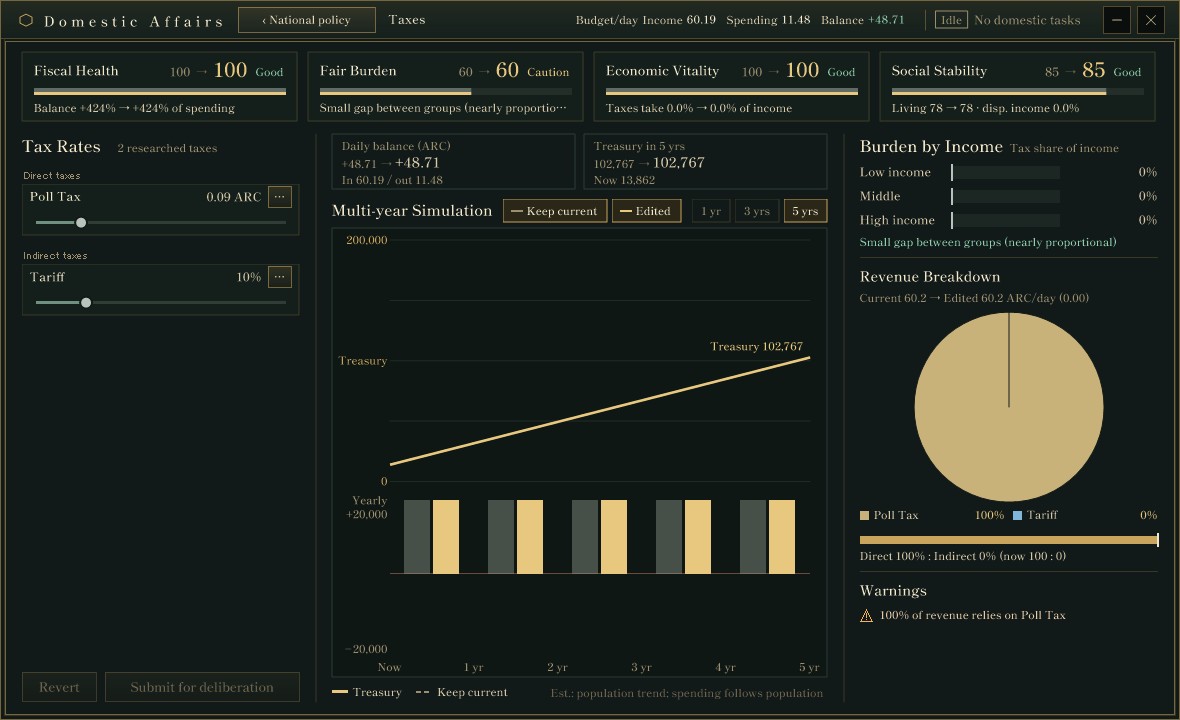
The current Taxes screen in Domestic Affairs (an actual screen from the Debug build, using small verification data for screen checks). Under Tax Rates on the left, the tariff is an indirect tax set at a national rate (10% here); changes go through deliberation before they take effect. This verification data has no imports, so tariffs are 0% of the tax revenue breakdown on the right.
Where things standTariffs are one of the taxes available from the very start of the game. In the current game:
- The import tariff is 10% unless a resource has its own rate, and imports from a trade-treaty partner are capped at 5%. Each region can adjust national rates by a percentage (0–200%), and a tariff uses the adjustment of the destination region.
- A tariff is fixed in rate and amount when the goods are shipped; the importer's payment is held in escrow and paid to the treasury when the goods arrive. Small-scale smuggling from countries without a treaty is not taxed.
- There is no organization or cost involved in collecting tariffs: set a rate and every legal import pays it in full.
- People moving across borders (international migration) are governed by each nation's entry and exit permissions. Moving within a nation is free, and there is no way to close a single region to people coming and going.
So you decide how high the tariff is, but never where or how reliably it is collected, and the geography of trade routes means nothing for tariffs.
The plan: collect where a checkpoint standsWe are considering a new facility, the checkpoint, that handles customs and the movement of people, built in a region. A checkpoint has levels 1 to 3, is raised by upgrade construction, and uses upkeep and staff according to its level.
- Tariffs are collected on imports into a region with a checkpoint. The effective tariff is the rate you set × the checkpoint's collection rate; whatever is missed is not taxed. Regions without a checkpoint collect no tariff.
- The draft collection rates are 60% at Lv1, 85% at Lv2 and 100% at Lv3, subject to balancing.
- The same checkpoint can close the region to entry and to exit separately. This applies both to migration from abroad and to moves between regions within the nation.
- A low-level checkpoint cannot stop everyone, though. The draft shares it can stop are 60% at Lv1, 85% at Lv2 and 100% at Lv3; the rest get through.
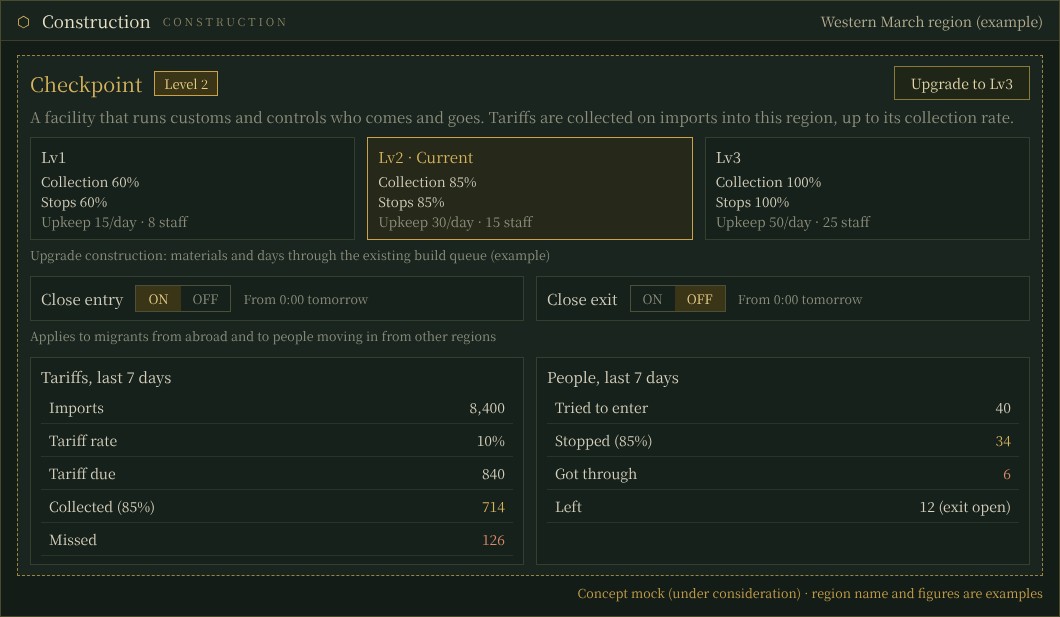
Concept mock (under consideration). Selecting a checkpoint in the Construction screen would show its level and upgrade, the entry and exit closures, tariffs collected and missed over the last 7 days, and how many people were stopped and how many got through. Region name and figures are examples.
For example, a region with 8,400 of imports over 7 days at a 10% rate owes 840 in tariffs. At Lv1 you collect 504 and miss 336; at Lv2, 714 and 126; at Lv3 you collect all 840. If entry is closed and 40 people try to come in over those 7 days, a Lv2 checkpoint stops 34 and 6 get through.
Where to build, and how far to upgradeWhat we hope this creates is a decision about placement and level. A checkpoint at the point where a trade route enters the nation covers all the imports beyond it. A busy port is worth upgrading; a quiet inland region may not need one at all. Taking example upkeep costs of 15, 30 and 50 per day for Lv1–3, a region importing 1,200 per day gains +30 in tariffs for +15 upkeep going from Lv1 to Lv2, which pays, but only +18 for +20 going from Lv2 to Lv3, which does not.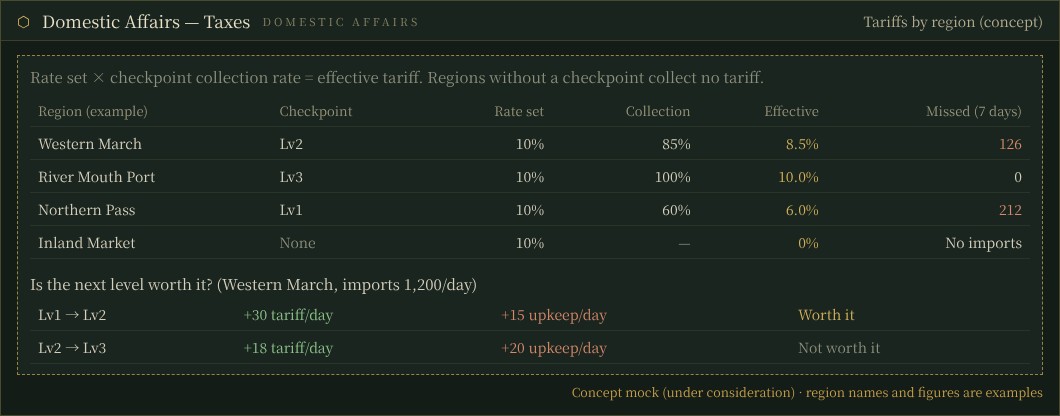
Concept mock (under consideration). The Taxes screen would list each region's checkpoint level, effective tariff and missed tariffs, and compare whether an upgrade pays. Region names and figures are examples.
We want closing a region to people to be a tool you use selectively too: closing the exit of a region whose workers you want to keep, or closing the entry of an unsettled border region. Close too much, and job openings go unfilled.
Implementation steps and how it connectsWork is planned to start once the social security tax that arrived today (TAX-012) has been reviewed. The steps we have in mind:
- The checkpoint facility (levels 1–3, upgrades, upkeep and staff) and its saving.
- Collection rates. The tariff fixed at shipment is multiplied by the collection rate of the destination region's checkpoint, and the missed part is recorded. Shipments already on the way are not affected retroactively.
- Entry and exit closures. They take effect at 0:00 the next day, and the check before a migrant departs decides the number stopped as the number of people × the share that can be stopped, in whole people.
- Migration of existing saves and opening data. Without a checkpoint, tariff income would suddenly drop to zero, so a Lv1 checkpoint is placed in each region a nation's trade routes pass through.
- The screens (Japanese and English) and AI nations' decisions (comparing expected tariff income with upkeep to decide on building, upgrading and closures).
How this might connect with catching smuggling runs (TRN-029) is an interesting question, but we will get the checkpoint itself working first.
Tell us what you thinkWould tariffs be more interesting if you chose where to collect them, or is the current approach of just setting a rate easier to follow? We would also like to hear when you would want to close a region to people coming and going.
About the imagesImage 1 is an actual game screen, captured by starting the Debug build without showing its window, using verification data for screen checks (the nation name and figures belong to that data). Images 2 and 3 are mocks that illustrate the plan, not game screens.
Related tax articles: DEVELOPMENT PLAN #81 (social security tax on wages), DEVELOPMENT SNAPSHOT #84 — Taxes Join Domestic Affairs: A Tax Plan You Can Delegate
Check the files currently available and the development status on the download page