
DEVELOPMENT SNAPSHOT #54 — Counting Every Person: Allocating Jobs Across Occupations and Regions
- Wednesday, October 14 2026
- Contributed by: Takeshi Miyaoka
- Views: 7
In DEVELOPMENT SNAPSHOT #53, we followed population cohorts as they aged, were born, and died. This time, we turn to the work those people do—and where they do it. Population and employment are not separate piles of people; they are two views of the same population.
The game displays many quantities in thousands (K), but a job allocation cannot employ a fraction of a person. 0.005K means five people. If those five are divided among three equally sized regional pools, rounding each pool independently can make the total drift to four or six.
Keeping the remainder in the totalThe allocation first works in whole people, then distributes the remainder so the sum across all pools stays exact. A regression test fixes the case of 0.005K of bonded labor split across three equal regional pools: 0.002K, 0.002K, and 0.001K. Together they still equal 0.005K. The display remains in K, while each share corresponds to an actual number of people.
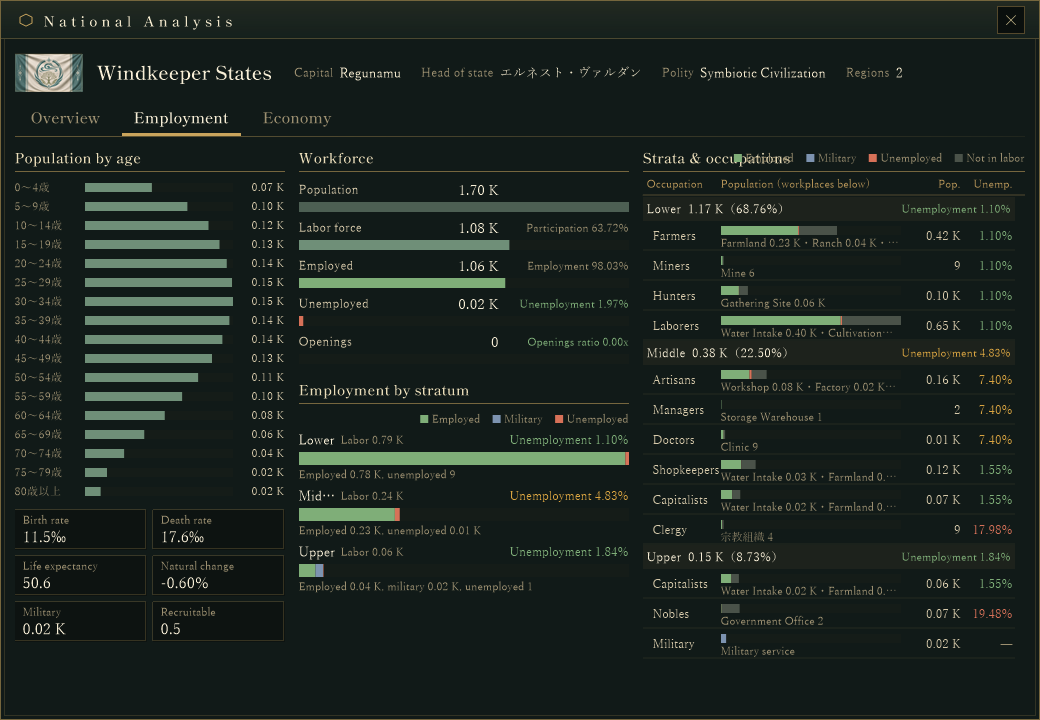
The occupational breakdown is checked in the same spirit. After accounting for strata population, workforce, dependents, and illness, tests verify that the detailed totals still match the source population. Unemployment is not rounded as an unrelated number; the tests also check that it remains consistent with the allocation. That consistency is what lets us interpret regional and occupational figures with confidence.
What the Debug screen showsThese are captures from the actual Debug build's National Analysis screen. Age groups, workforce, employed and unemployed totals, strata employment, and the occupation breakdown appear together. The values are a snapshot from a test save at capture time, not universal fixed values for every country.
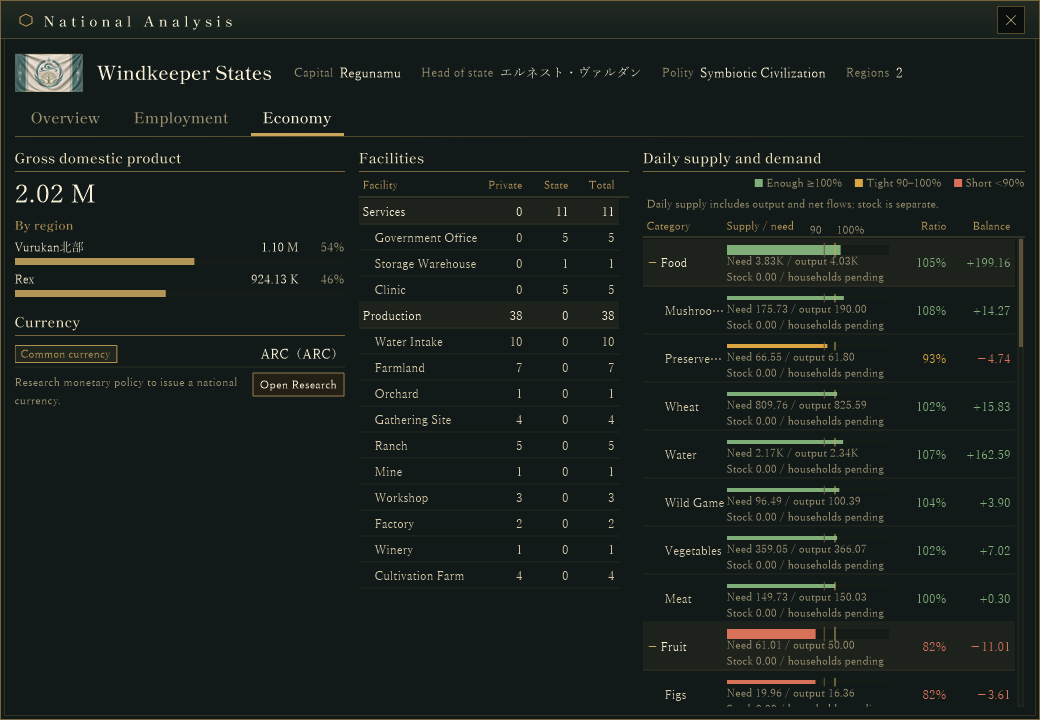
The overview provides a broader view of population and economic indicators. Moving between the employment details and this summary helps trace how one set of numbers relates to the whole country's population and production.
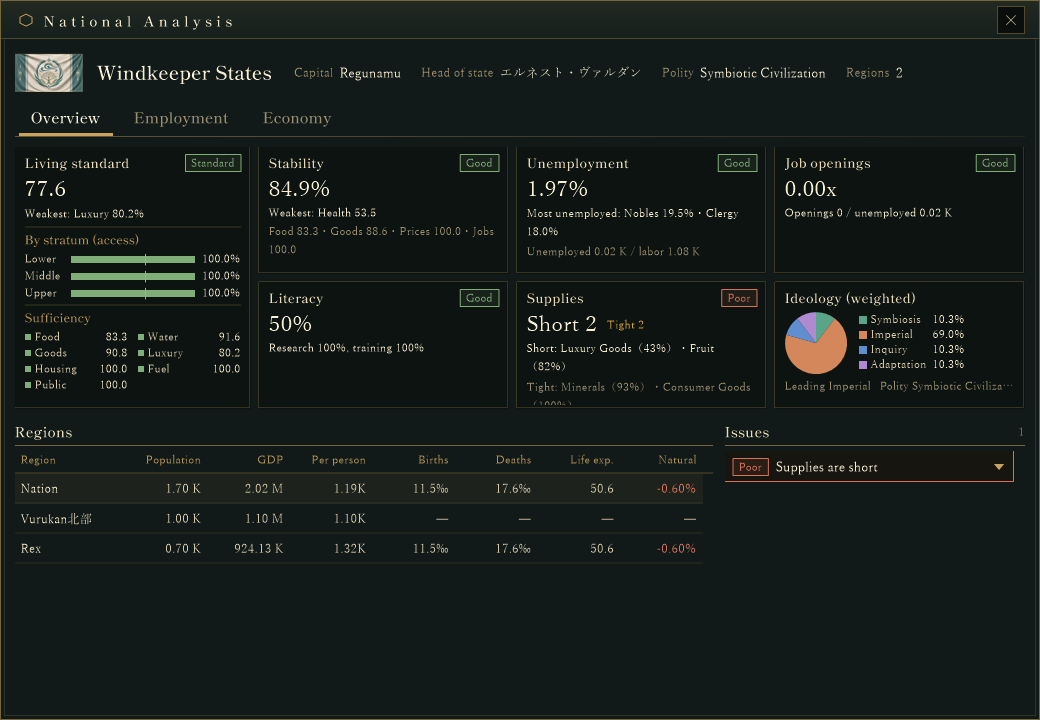
The implementation and regression tests verify three things: allocations to regions and occupations represent whole people; remainders are assigned without changing the grand total; and each stratum's breakdown adds back to its source population. This does not mean future employment policies or new occupations are finished—the snapshot covers the current allocation behavior and its regression checks.
For the preceding step in the story, read DEVELOPMENT SNAPSHOT #53. You can explore the current build on the Downloads page, or support the project.