
DEVELOPMENT PLAN #119 — Spore Sickness on the Road: Full Clinics and Quarantine
- Monday, November 23 2026
- Contributed by: Takeshi Miyaoka
- Views: 10
This is a development plan: it describes something we would like to build next. None of the mechanics below are implemented yet, and the details are still under consideration and may change.
Today (November 23), clinics started to provide beds according to the staff actually working in them, and the facility screen now shows patients by severity and how full the beds are. Yet in the current game the number of sick people barely moves. Tonight's plan is a forced event: an outbreak of "spore sickness" near the Sea of Corruption fills the clinics, travels along the roads into neighboring regions, and asks you whether to slow it with a quarantine at your checkpoints or keep trade flowing. It is filed as improvement item EVT-050 (Spore sickness outbreak).
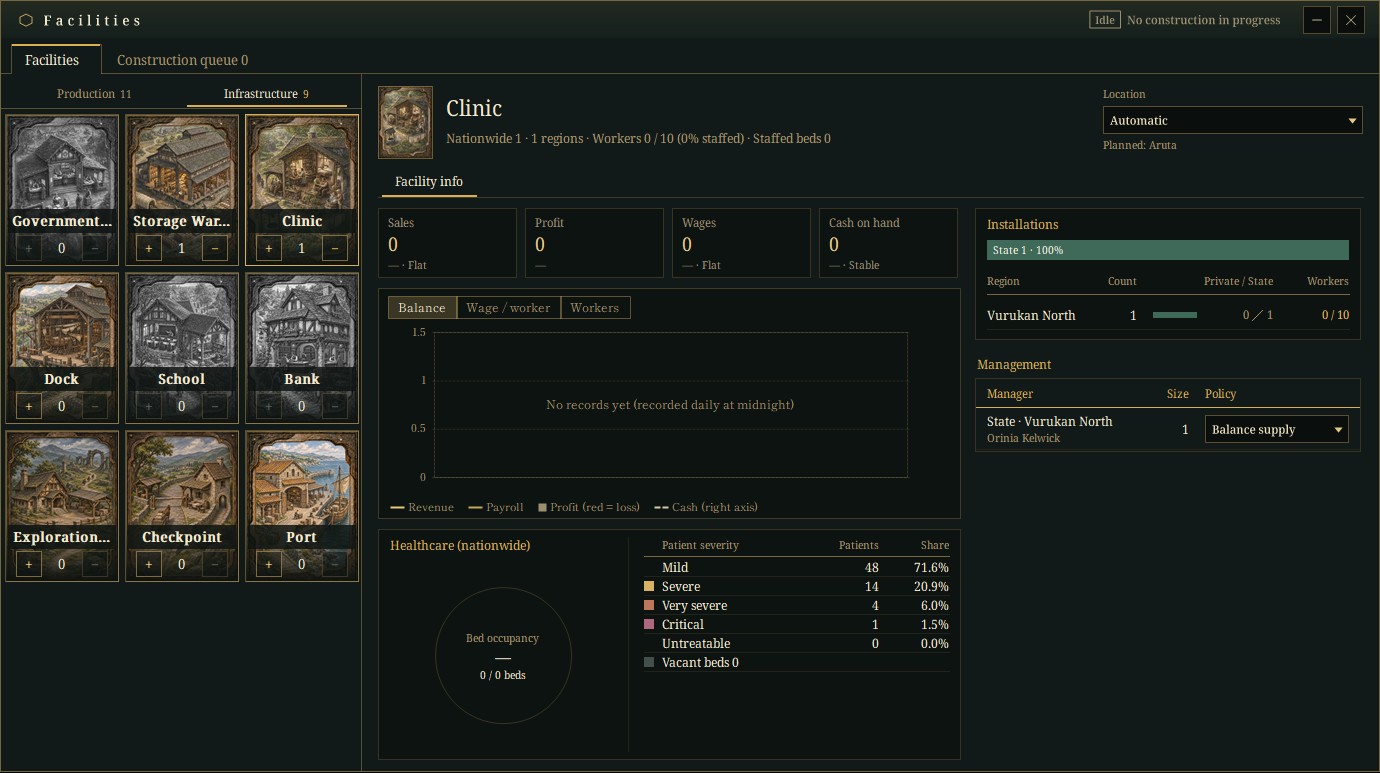
Image 1: the current game screen. Selecting the clinic on the facility screen shows its healthcare panel: patients by severity (mild, severe, very severe, critical, untreatable) and a bed-occupancy ring. Captured from today's main Debug build launched without showing a window, in a test state started from the initial master. In this state the clinic has no staff yet, so it has 0 beds.
Where things stand: sickness is steady- The number of sick people in a region comes from the working-age population times an illness rate. That rate is 6% a year with no clinic and 1.5% with clinic capacity matching the population, and hygiene research lowers it.
- Patients are split into mild 72%, severe 20%, very severe 6%, critical 1.5% and untreatable 0.5%, and beds go to the most serious cases first. Sick people drop out of the workforce.
- From today, the number of beds follows the staff actually working in the clinics (the facility screen from #104 gained the occupancy ring and the severity table).
- The population rules already set aside a separate record for deaths from war, epidemics and disasters, apart from natural births and deaths, but no epidemic happens in the game yet.
- Checkpoints (planned in #99 and since implemented) can open or close each region's entry and exit; people who are stopped turn back at the border in proportion to the checkpoint's efficiency. Today that is only used for jobs and housing.
Building and staffing clinics only lowers everyday death rates a little. We would like moments where having enough beds, and where you placed your checkpoints, turns into a real trade-off between lives and trade. After the insect stampede (#117), this would be the second forced event.
Idea 1: an outbreak starts near the Sea of Corruption- Once a day at midnight there is a 15% yearly chance of an outbreak (with at least 730 days between outbreaks). It starts in an inhabited region where the Sea of Corruption's influence is high.
- Each region gets an outbreak strength from 0 to 1, and its illness rate is multiplied by (1 + 3 × strength). The severity split and the most-serious-first bed allocation stay exactly as they are now.
- Strength changes every day: with enough beds it fades sooner; without them the peak is higher and longer. The more people have already fallen ill, the slower it spreads, so even untouched it ends within a few months.
- Of the severe, very severe and critical patients left without a bed, 1%, 5% and 20% die per 30 days, recorded as epidemic deaths in the population records.
- Each day the outbreak passes to neighboring regions, including other countries'.
- The country governing a region chooses in the notice between "Quarantine" and "Keep trading". Quarantine closes entry and exit at that region's checkpoints, weakening the spread by the checkpoint's efficiency.
- In exchange, imports arriving in that region are held back by the same share, so tariffs and supplies drop. A region without a checkpoint cannot quarantine.
- When the outbreak ends, the checkpoints return to their earlier orders. You can change your choice at any time.
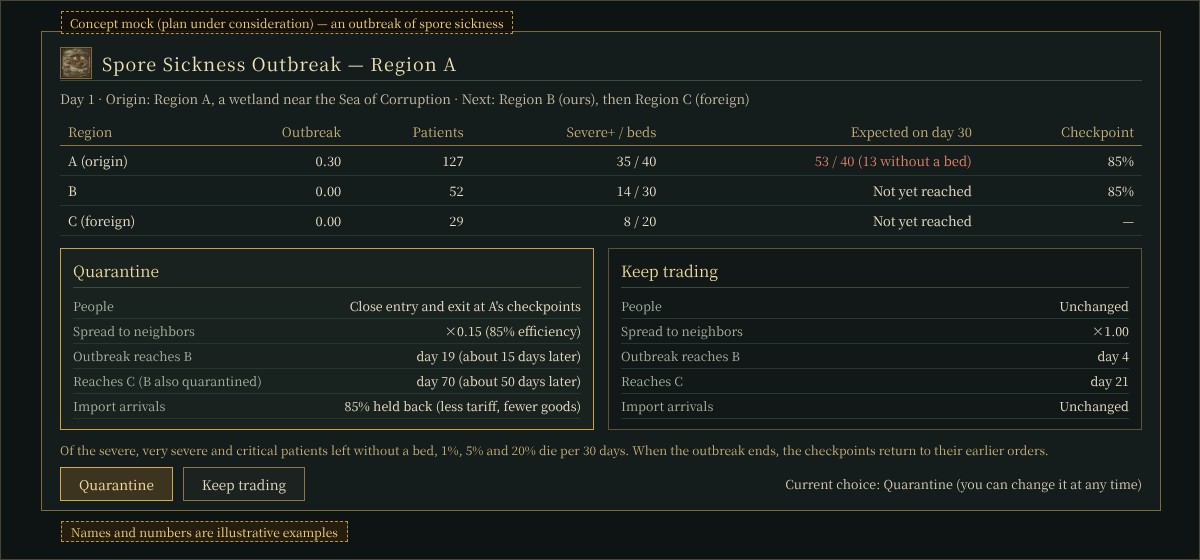
Concept mock (plan under consideration): the notice on the day an outbreak starts. By day 30, origin region A is expected to have 53 severe-or-worse patients for 40 beds, leaving 13 without one. Quarantining at 85% checkpoint efficiency delays the outbreak by about 15 days in neighboring B and about 50 days in C (another country) beyond it. Names and numbers are illustrative; this is not a game screen (only the clinic picture is a game image).
In our trial numbers, quarantine does not stop an outbreak; it delays it. We think its value lies in the time it buys: to staff up clinics in the next region or ship medicine there before the wave arrives.
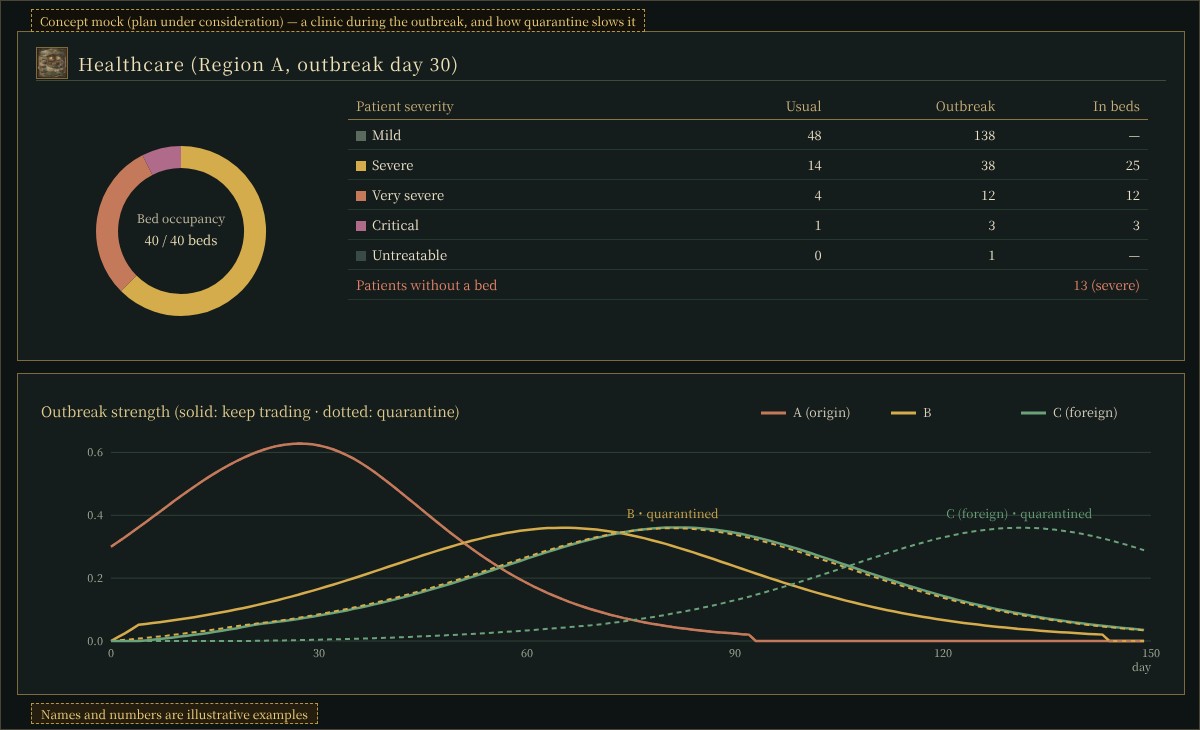
Concept mock (plan under consideration). Top: region A's healthcare on day 30 of the outbreak, with usual and outbreak patient counts, and who is in a bed and who is not. Bottom: outbreak strength in three regions, solid for keep trading and dotted for quarantine. The numbers come from the current draft formula.
Implementation steps and how it ties in- Outbreak start, daily strength, spread and the illness-rate multiplier.
- Deaths among patients without a bed, written to the population records.
- The quarantine choice, wired to checkpoints and import arrivals.
- Display on the clinic screen, the map and the notices.
- How AI countries choose (quarantine when their checkpoint is efficient).
Only regions with an active outbreak will hold its state, and the daily calculation will look only at those regions and their neighbors, so the midnight processing stays light. Deaths will be recorded once under an ID made from the outbreak, region and date, so reprocessing a day never counts them twice. The numbers (15% a year, three times the illness rate, 1%/5%/20% per 30 days and so on) are a draft and will be checked again before implementation.
Tell us what you thinkWould you rather stop trade to slow an outbreak, or protect your tariffs and supplies and absorb it in your clinics? Does that sound like a fun decision to make? We would also like to hear how you would want to use border checkpoints when an outbreak comes from another country.
About the imagesImage 1 is the actual game screen. Images 2 and 3 are mocks that explain the plan; they are not game screens. The notice window, the healthcare table and the spread chart were drawn for the mocks; only the clinic picture is a game image.
Related posts: DEVELOPMENT PLAN #117 — Preparing for the Insect Stampede with Troops and Supplies, DEVELOPMENT PLAN #99 — Tariffs Collected at the Checkpoint: Trade Routes and Who Gets Through, DEVELOPMENT SNAPSHOT #104 — Facilities at a Nationwide Glance: One List, Queue Cards, Named Houses, DEVELOPMENT SNAPSHOT #98 — Birth Rates from Day One: Demography in the National Analysis
See the files available now and the development status on the downloads page