Welcome to Happa, Anonymous Saturday, November 14 2026

Ashwind Chronicle — Survive the Ashen Winds

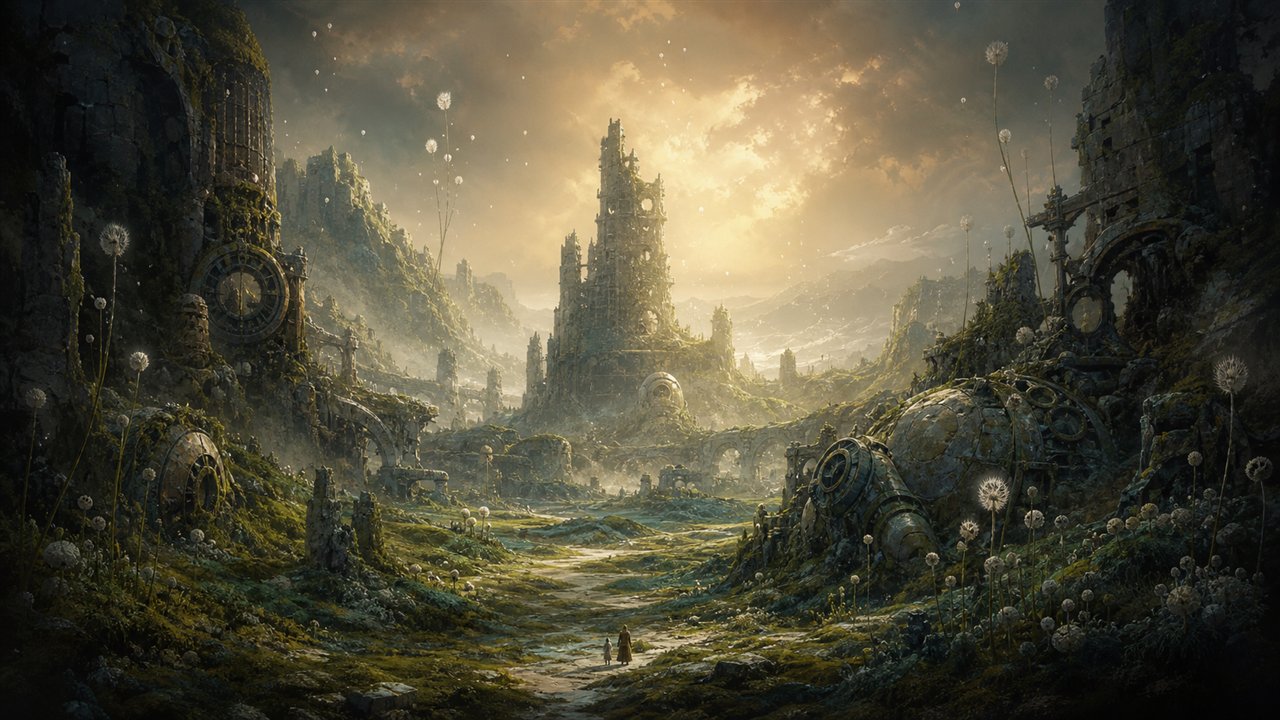
Ashwind Chronicle title screen

A strategy game in development

What will your civilization evolve to protect?

Ashwind Chronicle is a grand strategy simulation about shaping a nation's future in a world of ash-bearing winds, spreading toxic forests, and the dormant legacy of a lost civilization.

Prosperity alone is not the answer. What will your people fear? What will they choose to live beside? How much of their humanity will they surrender to survive? Those beliefs reshape technology, economics, diplomacy, war, and ultimately the fate of the world.

A World Carried by Ashen Winds

Toxic forests spread across the land while colossal insects sustain an ecosystem of their own. People survive by connecting scarce habitable land and resources, raising cities, and building routes across land and sea. Beneath ruined cities lie the machines and knowledge of a civilization that once transformed the world.

You lead one nation through this uncertain age. Read the terrain, population, resources, production, trade routes, research, and military balance—then decide between immediate advantage and long-term survival.

Four Ways to Face the World

Symbiotic Civilization

Live with nature and the insects instead of eradicating them. Quiet technology, purification, reconnaissance, and long-term renewal define this path.

Imperial Industrial Civilization

Protect humanity by mastering the environment through industry and force. Mass production, heavy armor, firepower, and centralized rule drive its expansion.

Relic-Seeking Civilization

Decode lost knowledge and restore the technology of the old world. Excavation, research, precision engineering, and advanced flight open the way forward.

Adaptive Engineering Civilization

Instead of changing the world, change humanity to endure it. Poison resistance, living materials, and neural resonance lead toward dangerous new possibilities.

A World That Keeps Moving

Shape a Nation

Connect cities and regions, then nurture their people and industries. A nation's strength comes not only from territory, but from the systems that sustain everyday life.

Read the Economy

Supply, demand, production, employment, prices, and transport distance shape regional markets. A single trade route can change the fate of a distant city.

Live with the Consequences

Powerful weapons carry maintenance and environmental costs. Unknown technology can fail catastrophically. Choose the answer that belongs to your civilization—not the answer that is merely convenient.

System Requirements (Development Build — Provisional)

Operating system
Windows (64-bit planned)
Runtime
.NET 10 Desktop Runtime (current development build)
Recommended display
1920×1080 or higher (UI reference size: 1920×1024)
Input
Mouse and keyboard
CPU, memory, graphics, and storage
Under evaluation

These requirements are provisional for the development build and will be updated after optimization and the release format are finalized. The .NET runtime may be bundled with the release version.

Help Us Map the Stories Still Unwritten

Ashwind Chronicle is currently in development. We are building its world, nations, characters, resources, equipment, and economic simulation one system at a time. We would be delighted if you followed the journey and witnessed the world take shape.

Support Game Development

SUPPORTED BY PLAYERS

Messages from Our Supporters

Words from the people helping Ashwind Chronicle grow. Message styling reflects each support plan.

Be the first supporter to leave a message.

Write a message with a supporter token

Each token can publish one message. Submit again with the same token to update it (500 characters maximum).

DEVELOPMENT SNAPSHOT #100 — From Plan #87 to the Game: Field Repair Caps and Arsenal Repairs

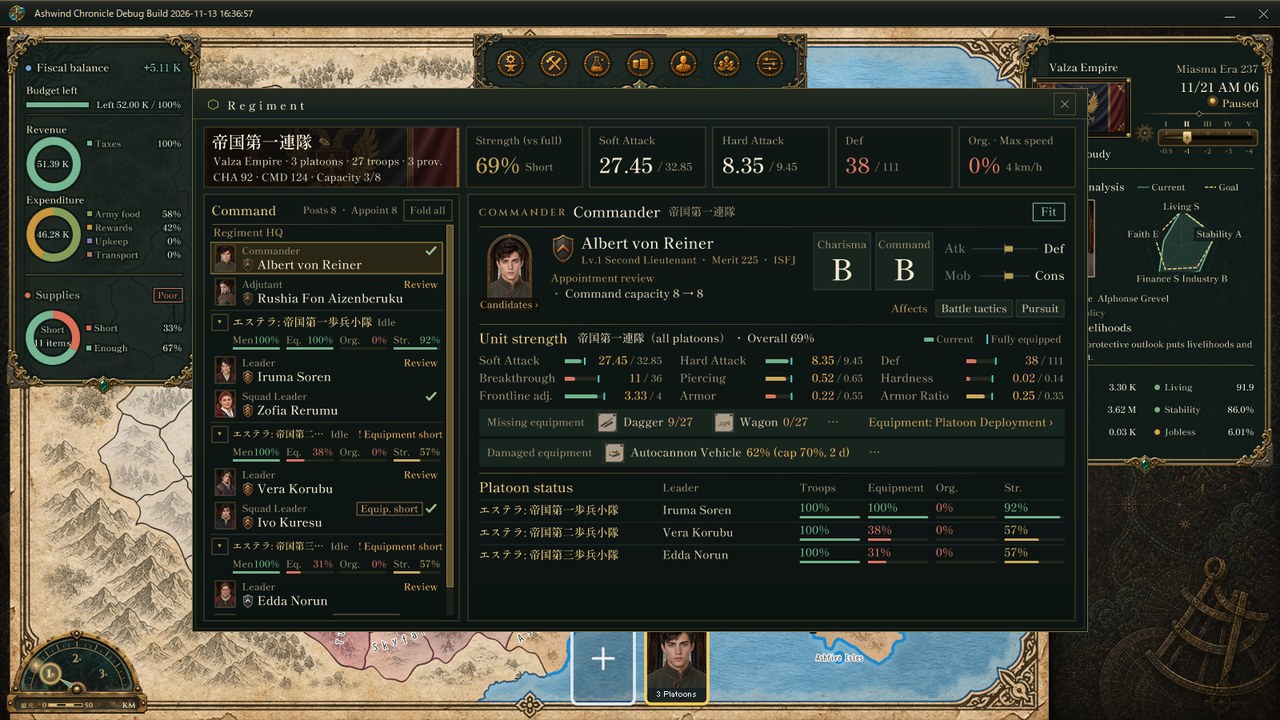
This morning's post is the 100th on this developer blog. For the milestone, here's the follow-up to a plan I wrote up a week ago. In #87 I proposed splitting battle-damaged equipment into what can be fixed in the field and what only a rear arsenal can restore. Yesterday steps 1 through 5 of that plan landed in main. Below I go through what the plan turned into, what is still open, and the actual screens.

The Regiment window (an actual screen from the Debug build). A new "Damaged equipment" row now sits below "Missing equipment".

DEVELOPMENT PLAN #99 — Tariffs Collected at the Checkpoint: Trade Routes and Who Gets Through

This is a development-plan article: it describes something we want to build next. Nothing described here is implemented yet, and the details are still under consideration and may change before implementation.

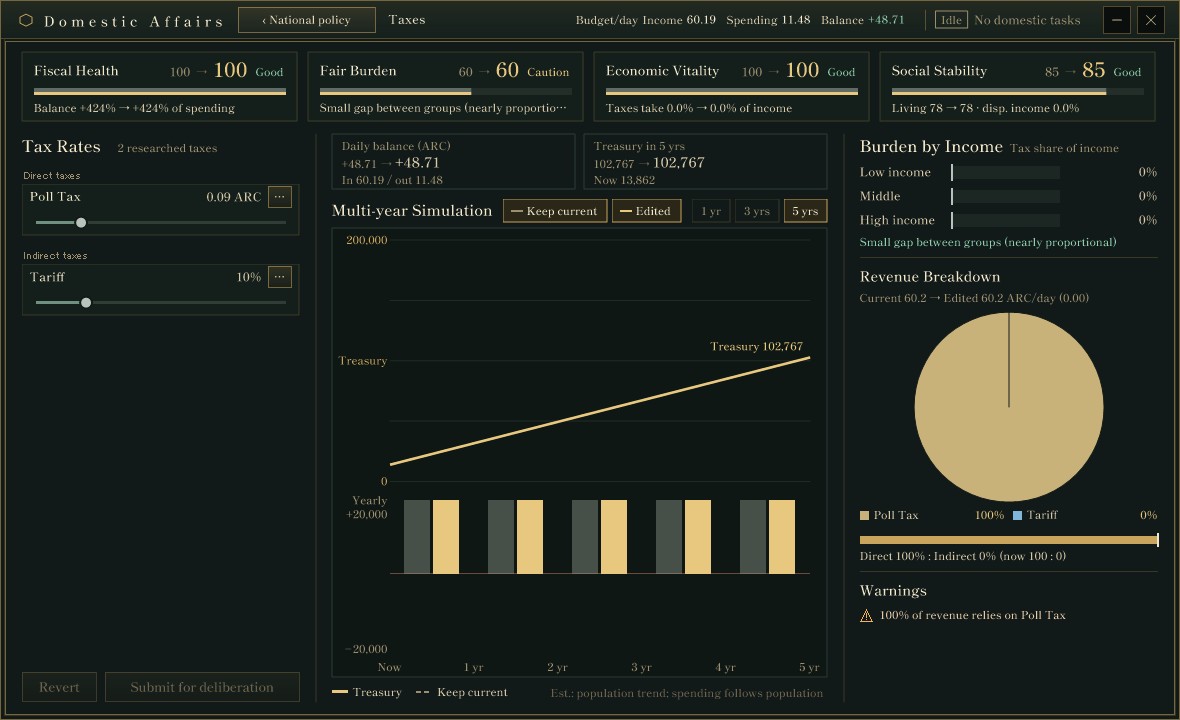
Today the social security tax on wages (first proposed in plan #81) arrived in the Tax policy screen. With one more tax in place, tonight's plan revisits another pillar of the tax system: tariffs. Right now, once you set a tariff rate, it is always collected in full, everywhere. We want tariffs to be collected only in regions that have a new facility, the checkpoint, and only as well as that checkpoint can manage. The same checkpoint would also let you stop people from entering or leaving the region. This fleshes out improvement item TAX-018 (a checkpoint facility for tariff collection and controlling who comes and goes).

The current Taxes screen in Domestic Affairs (an actual screen from the Debug build, using small verification data for screen checks). Under Tax Rates on the left, the tariff is an indirect tax set at a national rate (10% here); changes go through deliberation before they take effect. This verification data has no imports, so tariffs are 0% of the tax revenue breakdown on the right.

DEVELOPMENT SNAPSHOT #98 — Birth Rates from Day One: Demography in the National Analysis

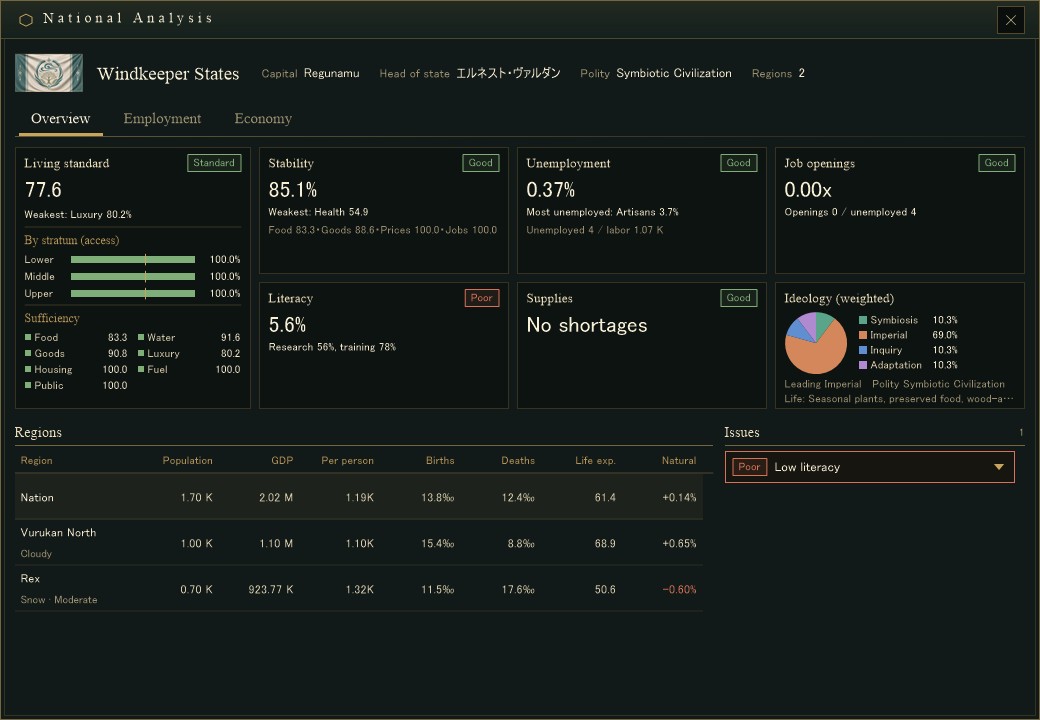
The National Analysis window lists birth rate, death rate, life expectancy and natural change for the whole nation and for each region. Right after starting a new game, though, some regions showed only "—" in these columns, and no values appeared until the first month boundary. Yesterday two changes closed that gap from both sides. This morning I'll walk through them with actual screens.

The National Analysis overview right after starting a new game (an actual screen from the Debug build). In the Regions table at the bottom, births, deaths, life expectancy and natural change are filled in for the nation and both regions.

DEVELOPMENT PLAN #97 — Breaking the Air-Defense Net from Within: Sabotage and Ammunition Stores

This is a development-plan article: it describes something we want to build next. Nothing described here is implemented yet, and the details are still under consideration and may change before implementation.

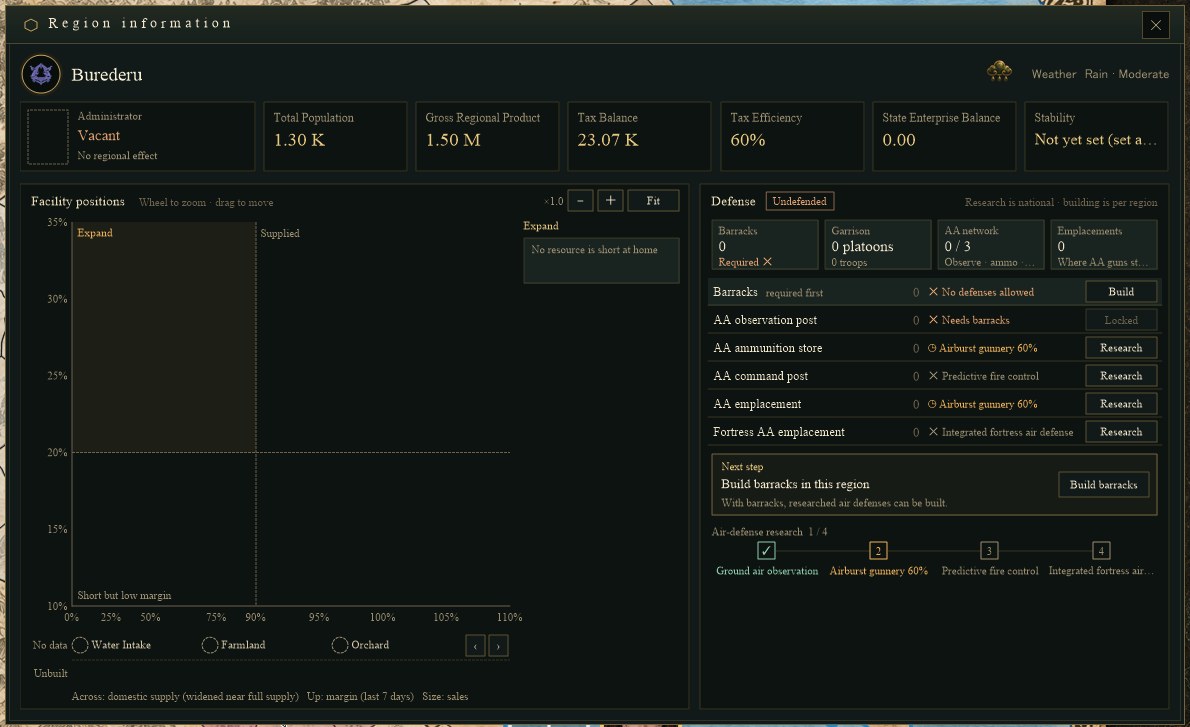
In plan #89 we proposed making ground anti-aircraft guns, observation posts, ammunition stores and command posts work as one connected air-defense network that meets enemy air missions. Tonight's plan is the other side of that coin: breaking an enemy's air-defense network from the inside. A covert operation targets an observation post, a command post or an ammunition store, creating a weak link before the air attack comes. For the defender, how to split up and protect ammunition stores becomes a new question. This fleshes out improvement item AAD-003 (sabotage of air-defense facilities and secondary damage).

The current Region information screen (the actual Debug build screen, in a verification state started from the initial master with barracks removed for the capture). The Defense section on the right lists the AA observation post, AA ammunition store, AA command post and other facilities, and shows AA network 0 / 3 (observe, ammo, command).

DEVELOPMENT SNAPSHOT #96 — From Plan to Game: Command Capacity and the Adjutant

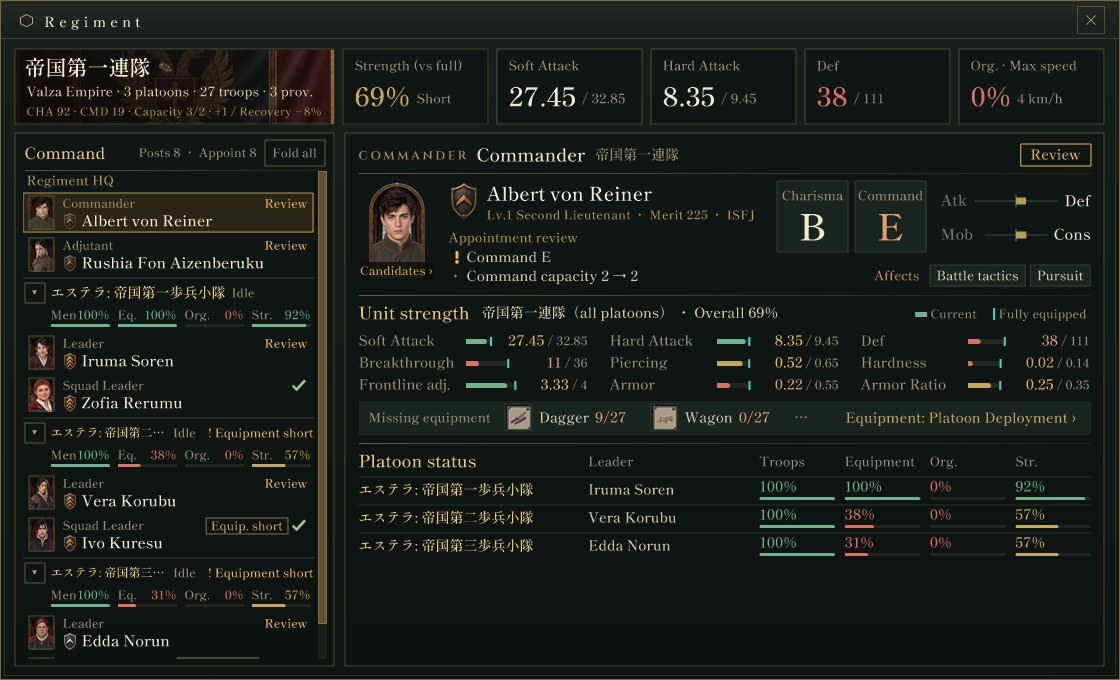
Last night's development plan (#95) proposed letting the commander's Command decide how many platoons a regiment can lead without penalty, with the adjutant extending it by half of their ability. It was implemented the same night and improvement item MOB-015 is now complete. The formulas and draft values from the plan were adopted unchanged. This morning I'll show the calculation that went in, and how it appears in the regiment window and the candidate lists.

A regiment with more platoons than its command capacity (an actual screen from the Debug build). Under the regiment name it reads "CHA 92 · CMD 19 · Capacity 3/2 · +1 / Recovery −8%". To show the over-capacity state, a capture switch set the commander's Command to 19 and the adjutant's to 0.

Page navigation