
DEVELOPMENT SNAPSHOT #66 — Sharing a Welfare Budget Across Six Programs: Employment Support and Elder Care
- Monday, October 26 2026
- Contributed by: Takeshi Miyaoka
- Views: 13
When you decide to spend on welfare, does the money actually reach the unemployed, people with disabilities and job trainees alike? Until now, welfare only let you set each program's benefit, and when money ran short the screen could not tell you which program would stop paying.
This round of development rebuilt welfare so that the national welfare budget is a ceiling for six programs, shared among them by percentage. Employment Support is now separate from Public Assistance, and a new Elder Care program has been added. The Welfare Policy screen under Domestic Policy was rebuilt around the same idea. 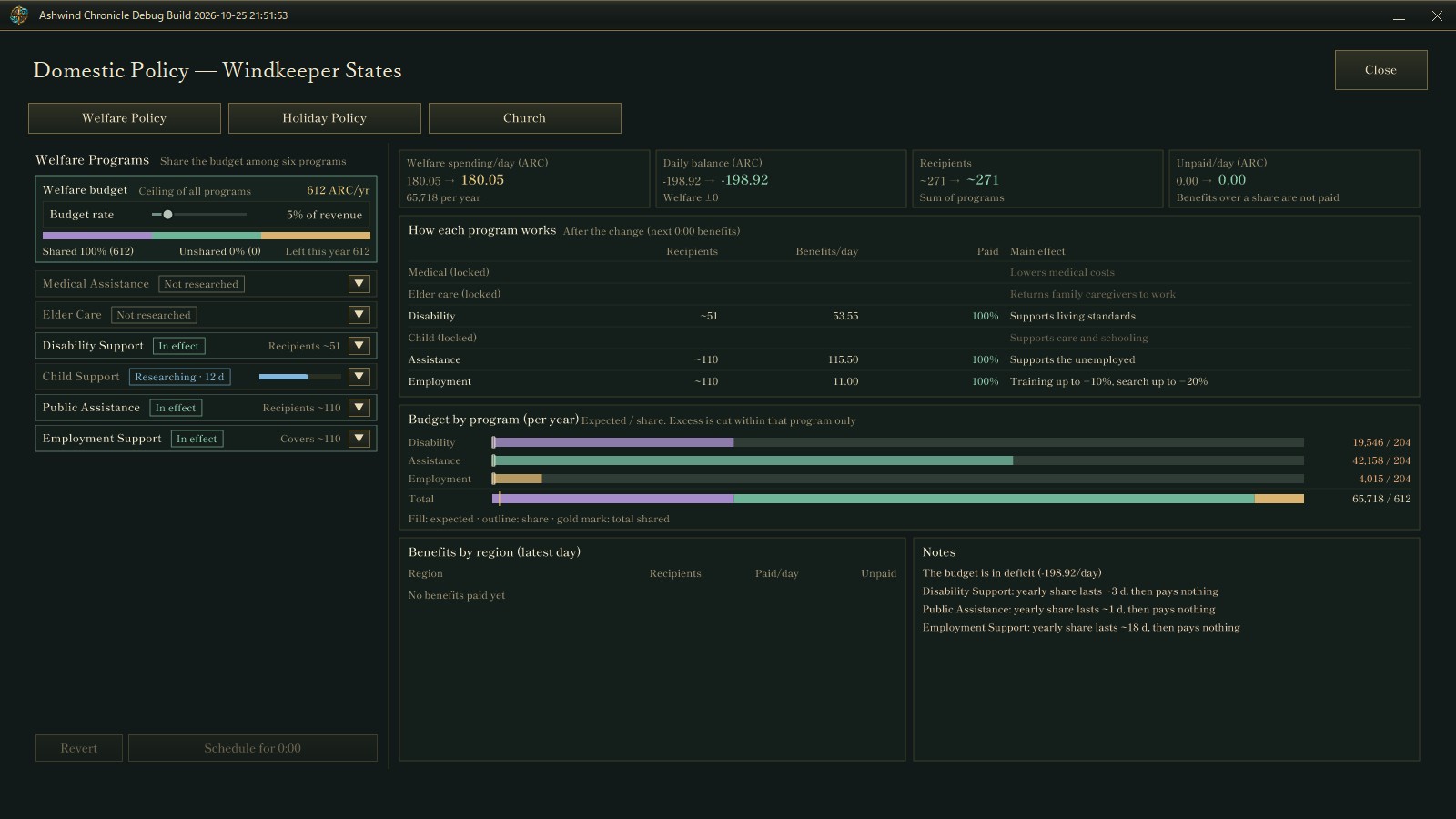
The Welfare Policy screen of the Windkeeper States, captured for verification in a development debug build (2026-10-25). The welfare budget is at the top left, with the six programs collapsed below it. Values are still being tuned and may change.
The budget is a ceiling, the shares are percentagesUnless an explicit limit is set, the yearly welfare budget is annual revenue times the budget rate. In the image the rate is 5% of revenue, or 612 ARC a year. That amount is shared by percentage among six programs: Medical Assistance, Disability Support, Child Support, Public Assistance, Employment Support and Elder Care. Shares add up to at most 100%. Anything left unshared is not spent, and it is never moved automatically to a program that runs short.
When a program's benefits exceed its share, only that program's benefits are cut, all by the same ratio. A shortfall in Public Assistance does not reduce Disability Support. Which program comes first is decided by the shares you set.
In "Budget by program (per year)", the fill is the expected cost and the outline is the share. In this state Disability Support expects 19,546 a year against a share of 204, and Public Assistance 42,158 against 204. The notes say Public Assistance's yearly share lasts about one day, then pays nothing. You can see that a 5% budget covers almost none of the benefits before anything takes effect.
A country that has never saved its shares, including AI-run countries, is treated as sharing equally among its researched programs. Older saves start from the ratio of what each program actually paid over the last 30 days.
Employment Support, split from Public AssistanceRe-employment help used to live inside Public Assistance. It is now its own program, Employment Support. It covers unemployed people looking for work and people registered for job training, whether or not they receive Public Assistance. Training support and job-search support are set per person per day, and nobody receives both. 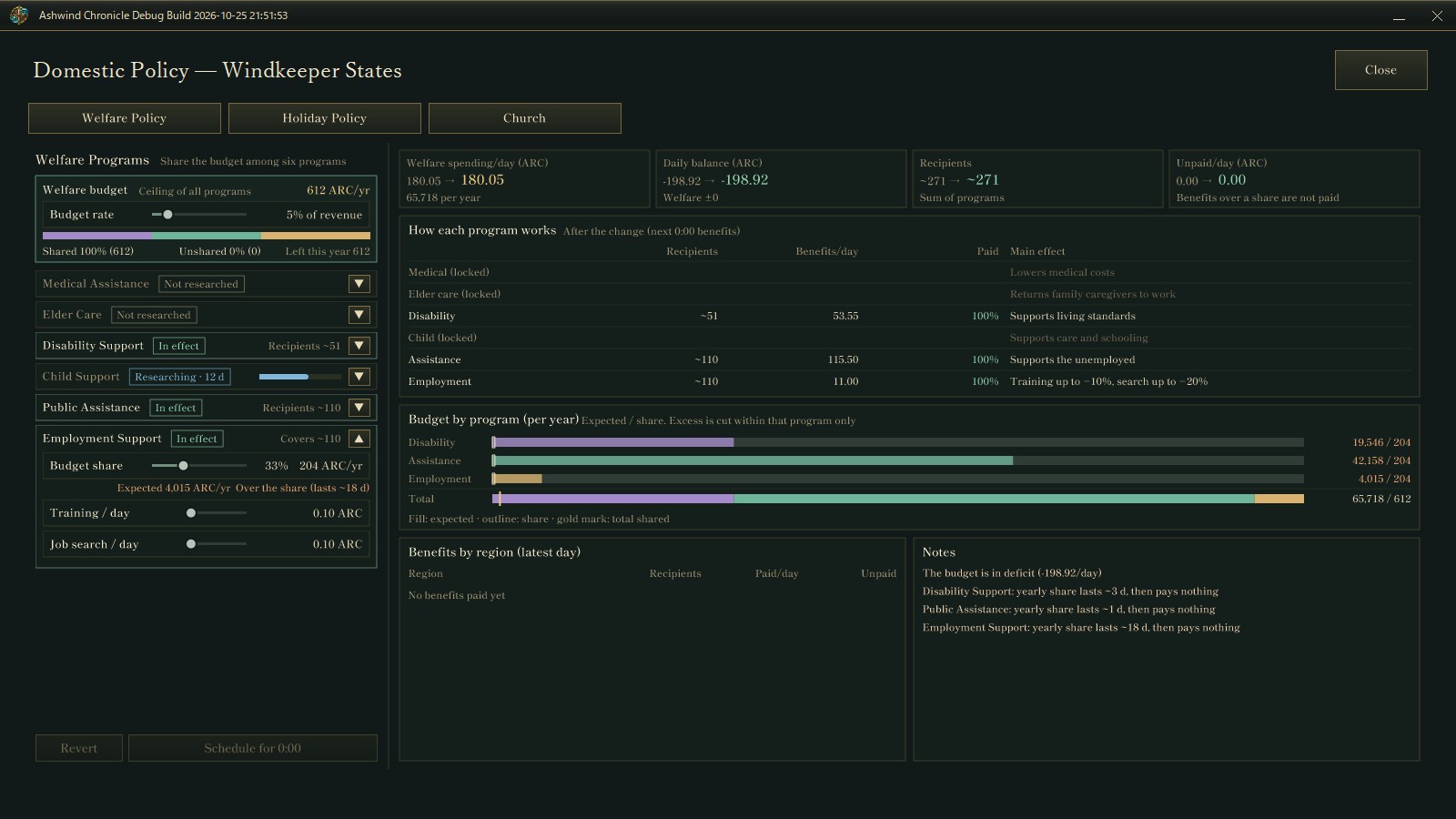
Employment Support opened in the same build. Its 33% share (204 ARC a year) faces an expected 4,015 ARC a year, so the screen says it lasts about 18 days.
The effect depends on how much was actually paid the day before. At full payment, job training takes up to 10% fewer days, and searching for work in a different occupation takes up to 20% fewer days. Research alone, with a 0% share, has no effect. Money spent here brings people back to work sooner.
Elder Care, and family members who cannot workThe new Elder Care program covers people aged 65 and over, multiplied by each region's care-need rate (20% to start). Ages come from the five-year population cohorts introduced in an earlier article (DEVELOPMENT SNAPSHOT #53). People who also qualify for Disability Support are covered there first, so nobody is paid twice.
The program has a second role. For each person needing care, 0.2 of a family member is treated as unable to work and is taken out of that region's labour force, in every employment calculation. If Elder Care was paid in full the day before, the deduction disappears and those family caregivers return to work. Welfare spending comes back as working hands.
Elder Care is researched after Medical Assistance, and the country in the image has not researched it yet. Programs that are not yet researched can be opened to read their description and settings, but cannot be edited.
Move the sliders, apply at 0:00The next image is a draft that raises Public Assistance's share to 43% and its benefit rate from 50% to 55%. 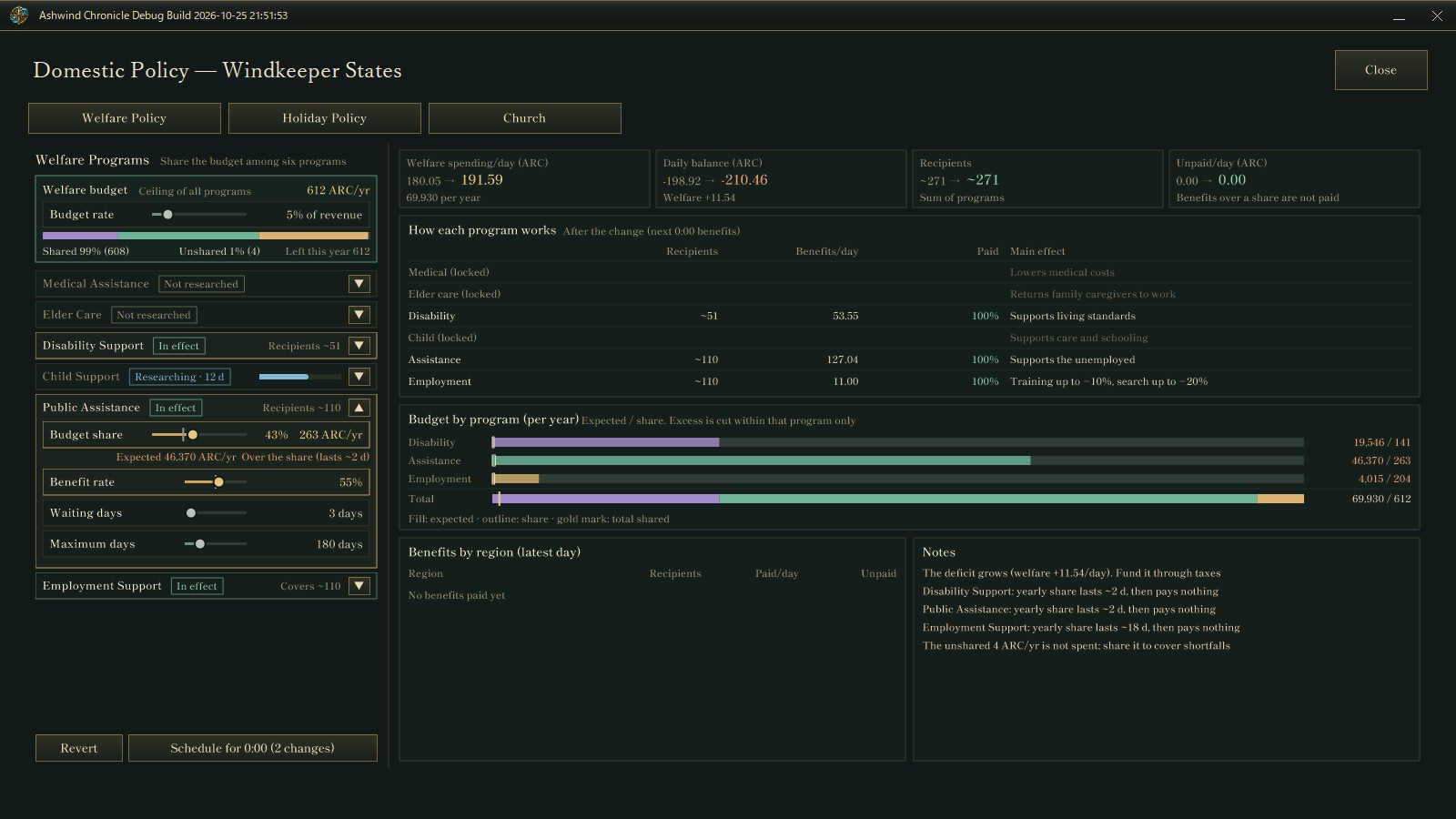
Two changes drafted in the same build. Welfare spending rises from 180.05 to 191.59 a day and the daily balance falls from −198.92 to −210.46. The notes also point out that the unshared 1% (4 ARC a year) will not be spent.
The top row compares welfare spending, the national balance, recipients and unpaid benefits before and after the change. The notes warn that the deficit grows by 11.54 a day and suggest funding it through taxes. Drafts do not apply immediately: "Schedule for 0:00" queues them for the next game day's midnight economy pass. To raise the money, use the Tax Policy screen from the previous article.
About these images and numbersAll images were captured for verification in a development debug build. The drafted shares and benefit rate were set by a capture script to check the screen. Country names, starting values, the care-need rate and the caregiver deduction are all still being tuned and do not represent real-world welfare systems or statistics.
How the national budget is planned: DEVELOPMENT SNAPSHOT #46 — The January Budget: Planning Room for Next Year
Previous article: DEVELOPMENT SNAPSHOT #65 — See Five Years Ahead Before You Touch a Tax: Health Scores and Reform Plans
Check the currently available files and development status on the download page