Welcome to Happa, Anonymous Saturday, November 14 2026

Ashwind Chronicle Developer Blog

DEVELOPMENT PLAN #70 — Turning Deposits into Workshops: Bank Loans for Private Expansion

This is a development plan: an idea we want to build next. Nothing described here is implemented yet, and the details are still under consideration and may change.

This morning's post (#69) covered money changers taking deposits from businesses, becoming banks, and underwriting government bonds. Tonight we look at the step we are considering next: banks lending to businesses so that private owners can expand their own facilities. We have filed it as improvement item FIN-020.
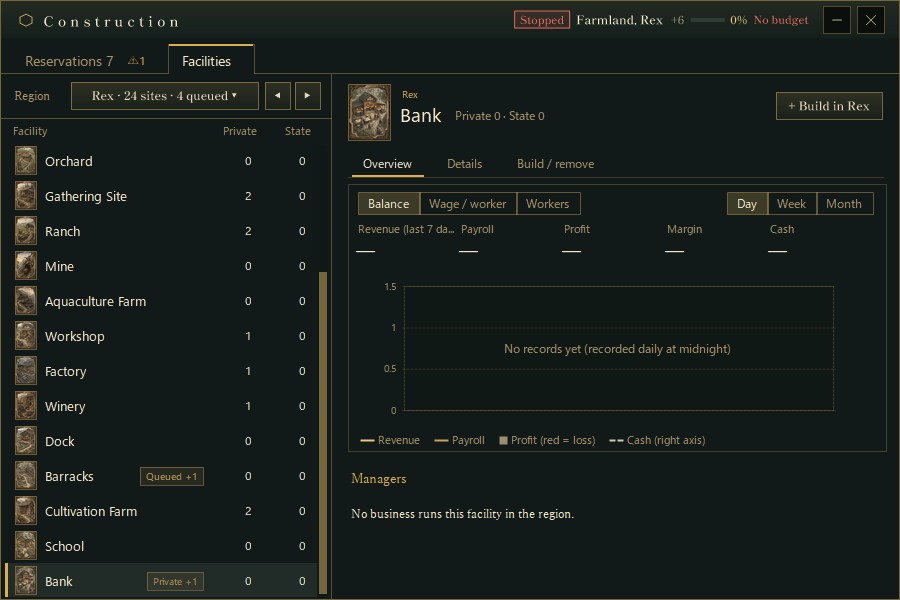
The construction screen today (an actual capture from a development Debug build, taken for verification). The only private construction is a money changer building a bank (“Private +1”). Private facilities such as workshops do not grow on private initiative yet.
DEVELOPMENT SNAPSHOT #69 — When a Money Changer Becomes a Bank: Deposits, Discount Rate, Bonds

Draw up the budget, look ahead at tax rates, share money out to welfare: the recent snapshots have made it much clearer where a country's money goes. But the money businesses earned simply sat in their own hands, and the state had no one to borrow from.

This round of development adds the machinery that holds money and puts it to work: a money changer in each region taking business deposits, banks unlocked by research, an official discount rate set by each country (FIN-013), money changers that build their own bank once deposits pile up (FIN-014), and government bonds underwritten by those banks (FIN-011).

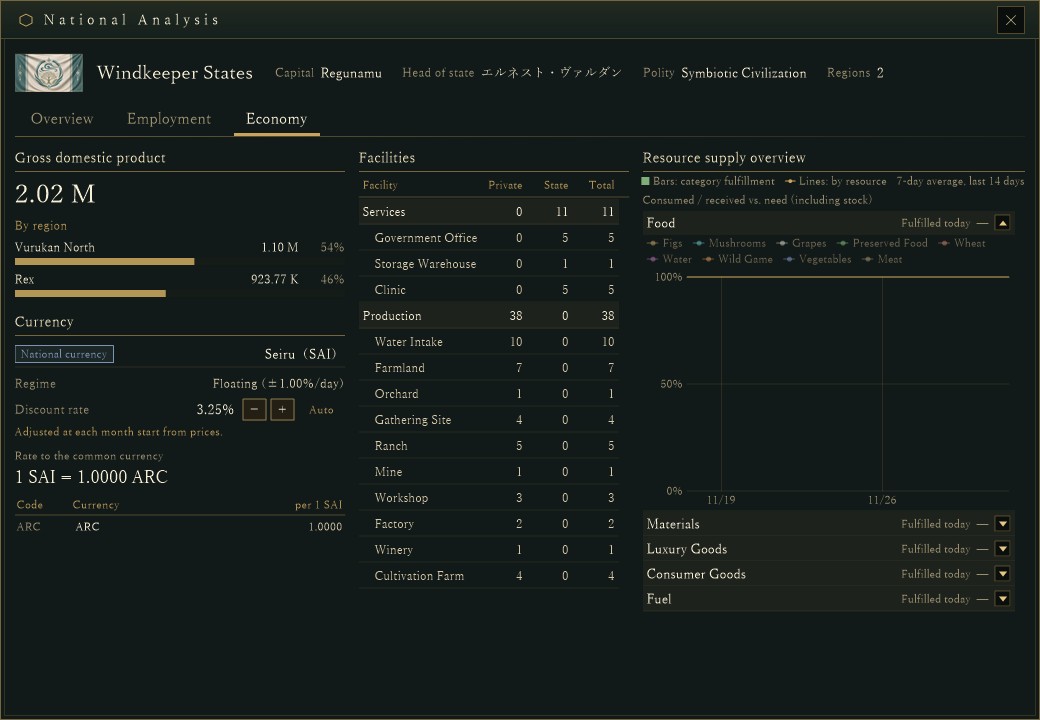
The Economy tab of National Analysis for the Windkeeper States, captured for verification in a development debug build (2026-10-28). The Currency section now has a discount rate row; here it is on automatic, adjusted at each month start from prices. Values are still being tuned and may change.

DEVELOPMENT SNAPSHOT #68 — The Cabinet in One Window: Personnel Joins Domestic Affairs, and Reserved Appointments Can Be Swapp

Where do you go to see who is actually running your country? Until now, appointing the minister, the diplomat and each region's administrator happened on a separate Personnel screen, while national policy, welfare, faith and finance lived on the Domestic Affairs screen. Choosing a person and checking how the country would change meant switching back and forth.

This round of development retires the Personnel screen and moves every appointment, replacement and dismissal into the Domestic Affairs window (DOM-037). It also adds a way to swap an already reserved appointment for a different person (DOM-033), and shows post-research projections on the minister's proposals (DOM-035).

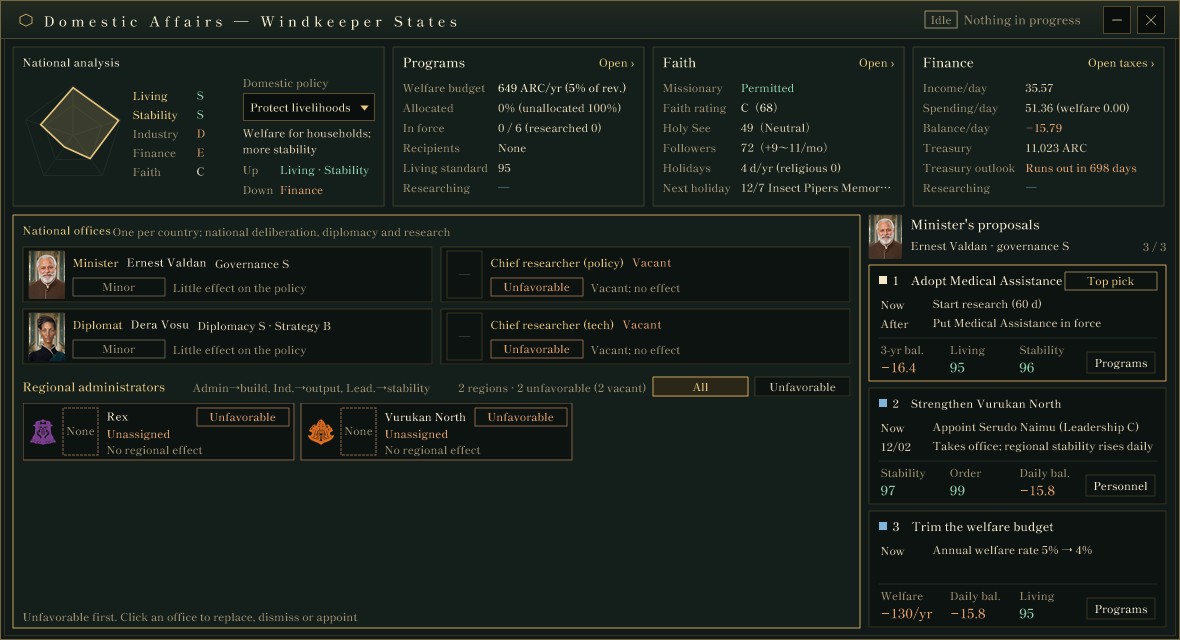
The Domestic Affairs window of the Windkeeper States, captured for verification in a development debug build (2026-10-28). National analysis and the program, faith and finance summaries sit on top; national offices and regional administrators below; the minister's proposals on the right. Values are still being tuned and may change.

DEVELOPMENT SNAPSHOT #67 — State Cargo Takes to the Air: Dock-to-Dock Routes and the Break-Even with Land

In a world where the sea is poisoned, the standard way to move goods over long distances is through the air. Airships fly at safe altitudes, taking off from and landing at docks. Until now, though, only military supplies could use air routes in the game; national stockpiles and raw materials for state-run factories went overland (or by sea where conditions allowed).

This round of development (stage 2a of WLD-007, six commits) opens the air to state cargo. Air routes between state-run docks are now generated automatically, and the game compares "overland" with "land, then air, then land" on both freight cost and expected losses. It also decides how long cargo waits when no flight can be booked, and how many docks and aircraft each country gets at the start of a new game.

The values in this article are current development values (calibration v2) and may change with further tuning.

DEVELOPMENT SNAPSHOT #66 — Sharing a Welfare Budget Across Six Programs: Employment Support and Elder Care

When you decide to spend on welfare, does the money actually reach the unemployed, people with disabilities and job trainees alike? Until now, welfare only let you set each program's benefit, and when money ran short the screen could not tell you which program would stop paying.

This round of development rebuilt welfare so that the national welfare budget is a ceiling for six programs, shared among them by percentage. Employment Support is now separate from Public Assistance, and a new Elder Care program has been added. The Welfare Policy screen under Domestic Policy was rebuilt around the same idea.

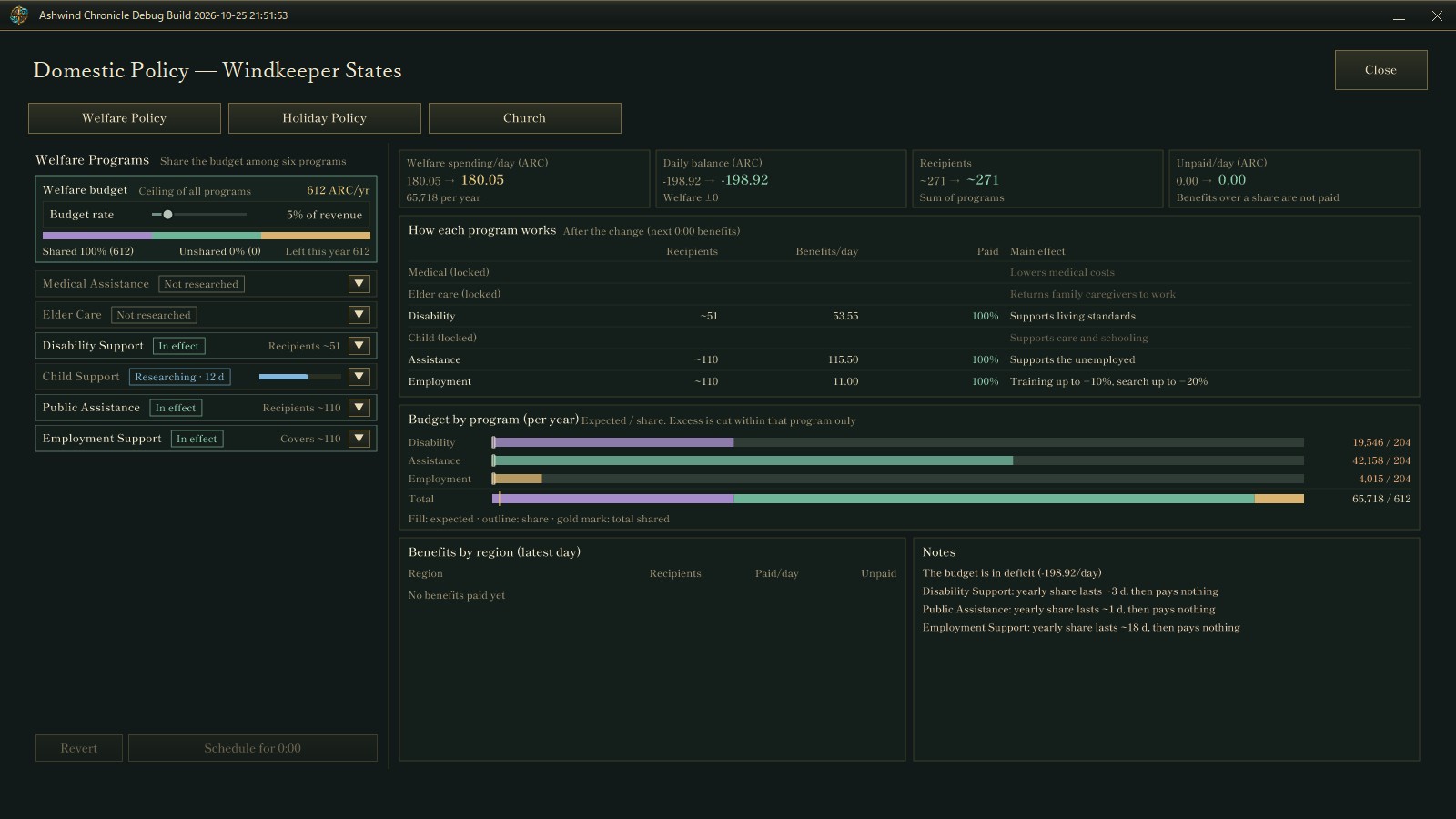
The Welfare Policy screen of the Windkeeper States, captured for verification in a development debug build (2026-10-25). The welfare budget is at the top left, with the six programs collapsed below it. Values are still being tuned and may change.

Page navigation